A Beast Slinks Towards Beijing Summary, Characters and Themes
A Beast Slinks Towards Beijing by Alice Evelyn Yang is a multigenerational historical fantasy about inheritance, memory, violence, and the fear that the worst parts of a family can pass from one generation to the next.
The novel follows Qianze, a young Chinese American woman whose estranged father suddenly returns after eleven years, bringing fragmented memories of a supernatural prophecy with him. His damaged recollections lead backward through the Cultural Revolution and into the life of Qianze’s grandmother Ming during the Japanese occupation of Manchuria. Across these generations, supernatural creatures exist beside very human forms of cruelty, raising a central question: how much of a person’s future is inherited, and how much can still be chosen?
Summary
In 2017, twenty-five-year-old Qianze is living in Manhattan and working an exhausting accounting job when two disturbing things happen almost simultaneously. A childhood nightmare about a white, red-eyed hare with antlers returns, and her father Weihong, whom she calls Ba, unexpectedly reappears after abandoning her and her mother eleven years earlier.
Qianze finds Ba at her old Virginia home and brings him back to New York. He is physically frail, drinks heavily, smokes constantly, shifts between past and present, and speaks about monsters, witches, ghosts, and a prophecy that he believes explains why he disappeared.
Because Ba cannot reliably care for himself, Qianze installs a camera and tracks his movements while she is at work. His fragmented speech repeatedly returns to his childhood in Ānshān, China, where he grew up during an era of political upheaval, but the details often seem impossible or contradictory to Qianze.
Ba’s memories reveal that his damaged mind contains experiences he has spent decades trying to suppress. Images of the Cultural Revolution, political violence, his abusive father, and his own participation in brutality return alongside the idea of a beast hidden somewhere within him.
Qianze also begins having supernatural experiences of her own. An elderly Asian woman at a subway station somehow knows her name, knows about Ba, and warns her that something is following her; Qianze later encounters strange women, foxes, and other signs resembling creatures she secretly drew as a frightened teenager.
The narrative moves into Ba’s childhood, when he was known simply as Weihong. His grandmother Nǎinai suddenly entered his life and hinted that his parents, Ming and Fei, had hidden much of their history, including the fact that their supposedly humble family background concealed connections to education and medicine that could later become politically dangerous.
As a teenager, Weihong takes his younger sister Kangmei to a supernatural figure known as the Woman in the Alley. She transports them into a strange realm filled with possible lives and futures and shows Weihong that a horned, three-eyed divine creature is growing inside him.
The Woman explains that the creature is not simply possessing him but is part of his own nature and will require roughly forty years to mature. Weihong understands that his future may bring suffering to the people he loves, but his memory of the prophecy begins disappearing almost immediately after he returns to ordinary life.
The story moves further backward to Ming, Weihong’s mother. Born in rural Manchuria in 1924 to parents who had expected and wanted a son, Ming is promised in marriage almost immediately to Fei, the newborn son of a respected physician.
Ming and Fei nevertheless grow up as extremely close companions. Fei’s family gives Ming affection, food, and education that she rarely receives from her own mother, although Ming gradually realizes that even their kindness is tied partly to expectations that she will eventually become Fei’s wife and bear children.
As a child, Ming encounters the same white, red-eyed hare that later appears in Qianze’s dreams. It grows antlers, attacks her, and leaves a deep scar across her palm, while an old text identifies such a creature as an omen associated with disorder and war.
Those omens become increasingly relevant as Japanese power expands across Manchuria. Ming grows up surrounded by uncertainty, shortages, and occupation, while her younger brother Qian becomes increasingly committed to resisting Japanese rule.
Ming marries Fei in 1940 and initially hopes that their childhood closeness will make the arranged marriage a happy one. War and starvation quickly alter their life, however, and Ming suffers a miscarriage before a Japanese attack on her village changes everything.
During the attack, Ming is captured by Japanese soldiers and taken to a military comfort station. She spends years imprisoned there, surviving repeated sexual violence, treating other captive women with the medical knowledge she learned from Fei’s family, and becoming dependent on opium as a means of separating her mind from what is happening to her body.
The commander who favors and torments Ming eventually reveals that he is an oni, an immortal supernatural predator who feeds on human flesh and blood. He tells her that war benefits beings like him because humans create immense suffering on their own, without supernatural creatures needing to manufacture it.
Ming becomes close to another prisoner known as Mouse, whose death leaves her carrying yet another person she feels responsible for remembering. Her rage grows so powerful that she begins imagining herself transformed into a creature capable of consuming the Oni rather than remaining his victim.
Eventually Qian, now a guerrilla fighter, finds Ming and helps her escape. He is shot during their flight and dies before they reach home, sacrificing his life for the sister he has spent years trying to find.
Ming’s homecoming provides little comfort. Her mother blames her for Qian’s death, her community treats her as contaminated by her captivity, and her marriage to Fei is deeply damaged by everything she has survived.
Years later, after repeated miscarriages and stillbirths, Ming desperately prays during the Hungry Ghost Festival for a child and for some restoration of the life war destroyed. The Oni returns, assaults her again, and Ming subsequently becomes pregnant with Weihong, making the supernatural predator his biological father.
Weihong grows up believing Fei is his father, but his household is marked by Fei’s alcoholism and violence. During the Cultural Revolution, Weihong learns that survival may require cruelty, joins the Red Guards, participates in attacks and killings, and ultimately kills his school principal during an initiation.
The experience awakens something disturbing in him: violence makes him feel powerful. The Woman’s voice returns to warn him that the monstrosity he fears is not merely something waiting in the future but something his own choices are already helping to create.
His moral compromises continue. When Nǎinai develops dementia and begins saying things that could expose Ming’s hidden wartime history and the family’s politically dangerous background, Weihong denounces his grandmother as a former comfort woman to protect the rest of the family.
Kangmei reveals that the event resembles the terrible future she had seen during their childhood encounter with the Woman. Although the siblings alter who performs the betrayal, the basic outcome still happens, making them question whether fate can truly be escaped.
Before Weihong leaves for university, Fei tells him that he is not his biological son. Years later, shortly before Weihong leaves China for America with his wife Hong, whom he calls Red, Ming finally explains the truth about the Oni and Weihong’s conception.
Weihong reacts by confessing his betrayal of Nǎinai and rejecting Ming. He later regrets this deeply, especially after learning that Ming died before he could repair their relationship.
In America, Weihong and Red eventually have Qianze. Parenthood initially allows him to believe that supernatural ancestry does not have to determine what he becomes, because the infant he feared might be monstrous is simply his daughter, whom he immediately loves.
When Qianze turns fourteen in 2006, however, the Woman’s warning returns to Weihong’s mind. Forty years have passed since the prophecy, and he becomes convinced that the beast inside him has matured and that remaining near his family will destroy them.
He disappears that night without explanation. Red tells Qianze that he died from an aneurysm and falls into severe depression, leaving Qianze to assume adult responsibilities while still a teenager.
Weihong hides in Vermont under the name Wayne and spends the next eleven years drinking heavily while imagining a perfect version of his old family home. What begins as a comforting mental refuge gradually becomes a distorted labyrinth containing the memories and fears he has refused to face.
Meanwhile, Qianze grows up presenting Ba as dead because admitting that he abandoned her feels harder. At college she struggles with money, race, belonging, and supernatural visions before meeting Theo through the Asian Student Union and gradually building friendships that help her feel less isolated.
Ba’s return in 2017 eventually destroys the careful separation Qianze has created between her past and present. Theo discovers that Ba is alive and feels betrayed by Qianze’s long deception, while Qianze explains that her parents remain almost her only link to Chinese family history and that abandoning Ba would feel like discarding part of herself.
As Ba speaks his memories aloud during episodes of confusion, Qianze finally learns about Ming, the Oni, Nǎinai, the Red Guards, and the prophecy. She realizes that Ba has been shaped by abuse, political terror, addiction, secrecy, and inherited supernatural power, yet she also understands that explanations cannot erase his responsibility for the harm he chose to cause.
When Ba reveals that the prophecy concerns Qianze as well, she fears that the same beast may exist inside her. She leaves the apartment, wanders through New York, and eventually reaches Coney Island, where she begins imagining what her life might look like if she refuses to let inherited fear make her decisions.
She wants honesty with Theo, a better relationship with Ma, a different career, a return to painting, greater familiarity with Chinese culture, and a life not structured around Ba’s mistakes. Qianze realizes that Ba’s greatest failure may have been allowing fear of becoming monstrous to push him into doing something monstrous: abandoning the people he loved.
Ba reaches a similar understanding. The Woman tells him that the end of an old life does not require death; he can destroy the identity he created through exile, accept that the beast is only one part of him, and choose to become different.
When Qianze returns home, Ba has prepared an enormous family meal. He admits that leaving her was the most monstrous thing he did, and although Qianze does not forgive everything immediately, she accepts his acknowledgment as the beginning of a different relationship.
Ba also reveals that he has contacted Kangmei and wants to return to Ānshān to reconcile with her and visit Ming’s grave. Qianze agrees to accompany him, accepting the possibility of becoming connected to a family history that has always been hidden from her.
Their future remains uncertain, and neither supernatural ancestry nor decades of emotional damage disappear. Yet the novel closes with father and daughter eating hand-pulled noodles together and planning to plant flowers at Ming’s grave, choosing connection and accountability over another generation of silence and escape.
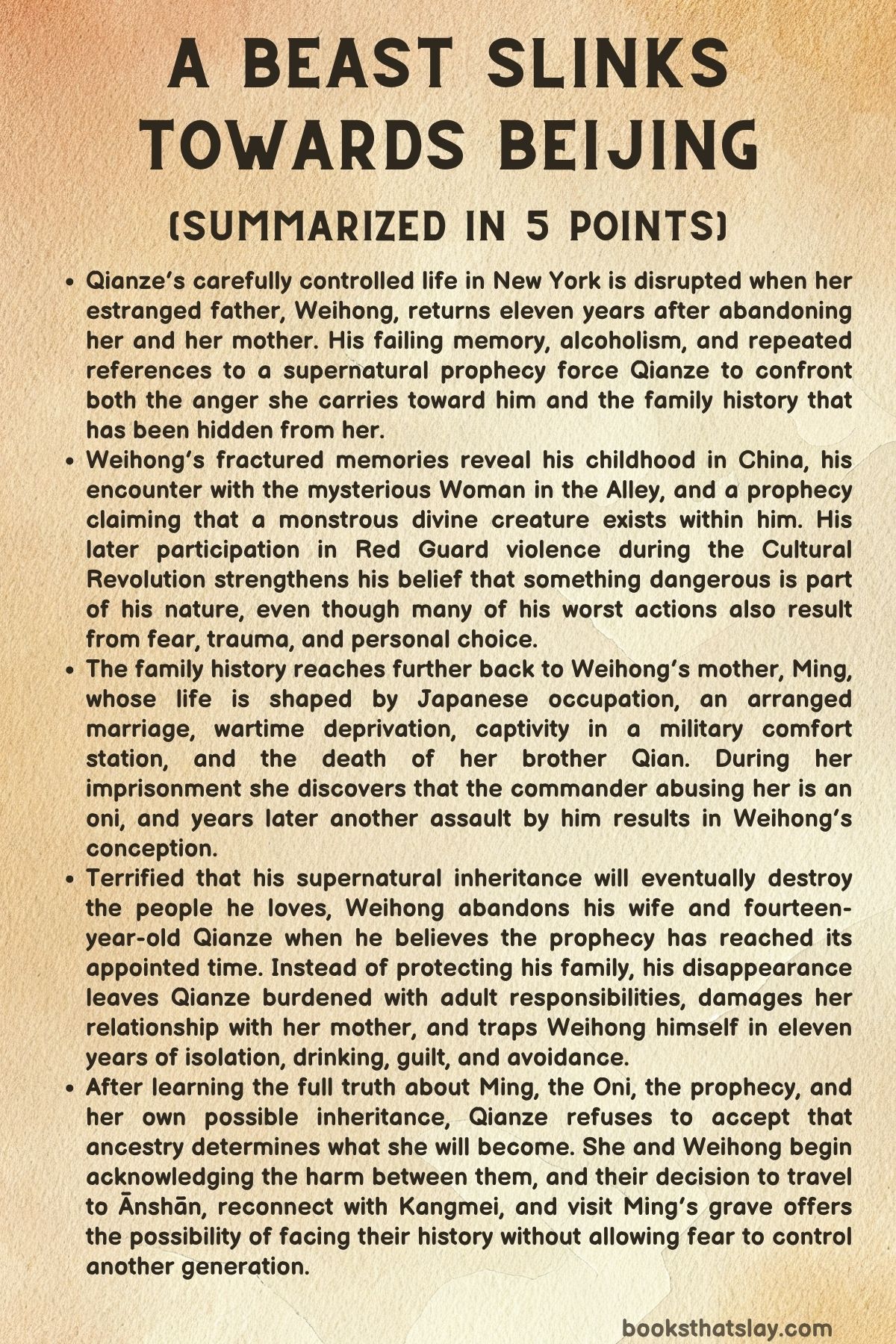
Characters
Qianze
Qianze is the emotional center of A Beast Slinks Towards Beijing, because the entire history of the Zhou family eventually arrives at her doorstep in the form of Ba. At twenty-five, she appears highly functional: she has an accounting career, a relationship with Theo, and a life far removed from the supernatural beliefs and Chinese histories that shaped earlier generations.
That apparent stability is built on years of forced responsibility. Ba’s disappearance when she was fourteen required Qianze to grow up while Ma was consumed by depression, creating a daughter who knows how to manage crises but has difficulty admitting how much she still wants care from other people.
Her anger toward Ba is therefore inseparable from longing. She resents cleaning him, supervising him, protecting him, and rearranging her life around him, yet his collapse terrifies her because some part of her still wants the father she lost.
Qianze also represents the difficulties of living with an incomplete cultural inheritance. She barely speaks Chinese, has never visited China, knows little about her extended family, and has spent years accepting Ma’s refusal to discuss the past, so Ba becomes both a source of injury and one of the few remaining doors into her ancestry.
Her supernatural experiences increase the fear that family history may be physically present inside her. The horned hare, foxes, strange Aunties, childhood drawings, and eventual revelation about the Oni make her wonder whether rage and monstrosity have literally passed down through blood.
Her development depends on rejecting the idea that inheritance equals destiny. By the end, Qianze does not deny the darkness in her family or pretend that Ba’s explanations excuse him; instead, she begins defining the future she wants and accepts that knowing the past can inform her without controlling her.
Weihong / Ba / Wayne
Weihong is one of the most morally difficult figures in A Beast Slinks Towards Beijing because he is simultaneously a victim, perpetrator, frightened child, abusive participant in political violence, absent father, and aging man trying to understand the damage he caused. His fractured memory allows these identities to exist almost simultaneously in his consciousness.
As a boy, he suffers beneath Fei’s drinking and violence while watching Kangmei receive preferential treatment. He also grows up during the Cultural Revolution, when political survival becomes associated with proving loyalty through aggression and when family background can determine whether someone is considered worthy of protection or punishment.
The prophecy intensifies his existing fears. Learning that something supernatural exists within him gives Weihong a language for explaining impulses he already fears, but it also becomes an excuse that prevents him from fully accepting responsibility.
His participation in the Red Guards demonstrates this tension most clearly. Weihong initially enters the movement partly because he thinks political violence can protect his family, but his enjoyment of power shows that coercive circumstances do not explain everything he becomes.
The betrayal of Nǎinai follows the same pattern. He sacrifices someone he loves to protect Ming and the rest of the family, receives political rewards for doing so, and then constructs a lie about what happened, showing how survival and self-interest become almost impossible to separate.
His abandonment of Qianze is the adult version of that pattern. Convinced that distance will protect his family from the beast, he makes the decision without allowing Red or Qianze any choice, turning his fear of hurting them into an action that causes eleven years of suffering.
Ba becomes more sympathetic without becoming innocent. His final growth begins when he stops asking whether the beast caused his failures and admits that leaving Qianze was itself monstrous; accountability, rather than supernatural purity, becomes his first genuine path toward change.
Ming
Ming is the character through whom the novel most fully examines what prolonged violence can do to a person’s identity. Her life begins with rejection because she is born female, continues through an arranged childhood future, and is later transformed by occupation, sexual slavery, addiction, bereavement, social judgment, and repeated reproductive loss.
Her childhood contains genuine freedom despite these restrictions. She loves the countryside, Fei, and her younger brother Qian, and her closeness with Fei initially allows her to imagine that the marriage arranged before she could speak might eventually become something she freely desires.
The comfort station fundamentally changes her relationship with survival. Ming uses medical knowledge to help other prisoners and forms bonds with women such as Mouse, but she also depends on opium and emotional separation because remaining fully conscious of her circumstances becomes unbearable.
Her encounter with the Oni makes supernatural monstrosity inseparable from human cruelty. The Oni recognizes rage in Ming and suggests that suffering can create monsters, while Ming herself begins to understand how similar forces shaped her own mother’s bitterness.
Qian’s death creates another burden of guilt that Ming cannot resolve. He gives his life rescuing her, only for their mother to blame Ming for his death, turning survival itself into something she is taught to feel ashamed of.
Her later motherhood is therefore filled with fear and secrecy. She hides the truth of Weihong’s conception partly because she wants to protect him from the circumstances of his birth, but that protection contributes to the confusion that eventually drives him away.
Ming’s importance lies partly in the fact that the story refuses to reduce her to what happened to her. She remains a daughter, sister, wife, healer, storyteller, survivor, mother, and flawed person whose capacity for love continues even after others insist that suffering has made her fundamentally different.
Fei
Fei begins as Ming’s closest childhood companion and the boy selected to become her husband. His family initially appears to offer Ming the warmth and security missing from her own household, making him central to her earliest understanding of belonging.
Their marriage reveals the limits of that childhood ideal. Fei is not presented as equivalent to the Oni or the soldiers who imprison Ming, but gender expectations and assumptions of marital entitlement influence the relationship even before their wedding.
After the war, Fei struggles with the changed reality of the woman who returns to him. Their relationship cannot simply resume where childhood ended, because Ming carries trauma, addiction, grief, and difficulty with intimacy while the surrounding community treats her as contaminated.
As a father, Fei becomes far darker. His alcoholism and violence toward Weihong reproduce another cycle in which a damaged adult transfers pain downward, while his favoritism toward Kangmei creates resentment between the siblings.
His knowledge that Weihong is not biologically his son complicates his behavior without excusing it. When he finally tells Weihong the truth, he destroys the young man’s understanding of his identity at precisely the moment Weihong is preparing to leave home.
Kangmei
Kangmei functions as an important moral contrast to Weihong. She is compassionate toward animals and vulnerable people, instinctively trying to help Xiaoli even when doing so could put her own life in danger.
Her position as Fei’s favored child creates tension with Weihong, but Kangmei correctly understands that she did not create their father’s favoritism. When she forces Weihong to admit that jealousy influenced his decision to take her to the Woman in the Alley, she makes him take responsibility instead of allowing resentment to remain unspoken.
The prophecy affects Kangmei differently because she remembers her vision while Weihong loses most of his. She knows she is destined to participate in something terrible involving Nǎinai and later discovers that changing the person who performs the betrayal does not prevent the betrayal itself.
Her love for Little Bodyguard also exposes the cruelty of the political environment surrounding the family. The chicken becomes a small object of care in a society increasingly willing to classify ordinary living things according to ideological usefulness.
Kangmei survives into old age and eventually reconnects with Ba. Her existence gives him a remaining relationship through which he may confront the past directly rather than continuing his lifelong habit of exile.
Qian
Qian is Ming’s younger brother and one of the purest expressions of familial devotion in the novel. Ming protects him as a child, explains frightening political changes to him, and promises that marriage will not end their relationship.
As Qian grows older, the siblings develop opposing ideas of survival. Ming believes keeping quiet may be necessary under occupation, while Qian sees acceptance of injustice as another way of allowing violence to continue.
His decision to join resistance fighters is dangerous but consistent with that belief. Unlike characters who commit violence primarily for self-preservation or power, Qian chooses risk because he believes people must actively oppose an occupying force.
His final act is rescuing Ming from captivity after searching for her for years. Qian dies from a gunshot wound during their escape, making Ming’s survival inseparable from the loss of the brother she spent her childhood trying to protect.
Hong / Red / Ma
Hong, known to Weihong as Red and to Qianze as Ma, occupies a quieter but essential place in the family pattern of grief and secrecy. She builds a life with Weihong, endures reproductive losses with him, moves toward a future in America, and eventually becomes Qianze’s mother.
Ba’s disappearance damages Ma severely. Rather than tell Qianze that he abandoned them, she invents the story that he died of an aneurysm and then falls into a depression so intense that her teenage daughter becomes responsible for much of their daily survival.
Her later recovery is complicated from Qianze’s perspective. Qianze sees a healthier, energetic mother but cannot immediately celebrate because Ma appears to have regained her life only after her daughter spent years carrying responsibilities that were never hers.
Ma’s refusal to discuss China or family history also contributes to Qianze’s sense of cultural homelessness. Her silence is understandable as a method of surviving loss, particularly given her own family grief, but it leaves Qianze without the information she needs to understand herself.
Theo
Theo first appears during Qianze’s college years, when he recognizes her from the Asian Student Union and intervenes after other students deliberately abandon her at a party. His invitation to join Asian classmates for dinner offers Qianze a community in which she does not have to turn her identity or family tragedy into something entertaining for others.
Their later romantic relationship depends on a long friendship, which makes Qianze’s lie about Ba particularly painful. Theo is less disturbed by the existence of her father than by the realization that Qianze maintained such a fundamental deception despite years of closeness.
Even while angry, Theo recognizes Qianze’s exhaustion and does not force an immediate resolution. His character therefore represents the possibility of intimacy based on truth, provided Qianze becomes willing to stop managing every difficult part of herself alone.
Nǎinai
Nǎinai is a keeper of family history whose presence immediately threatens the carefully edited story Ming and Fei have created for their children. Her memories reveal that the family’s background is more complicated than the official account of ordinary peasant ancestry.
She also brings storytelling into Weihong’s childhood. Through her, family history exists not merely as dates and facts but through anecdotes, contradictions, folk beliefs, and details that adults may prefer children never hear.
Her dementia later makes that knowledge politically dangerous. Because she moves unpredictably between different periods of her life, she begins speaking openly about Ming’s history and could expose information capable of endangering everyone.
Weihong’s decision to denounce her is therefore both a calculated act of protection and a profound betrayal. Nǎinai becomes one of the clearest examples of how authoritarian systems force families into impossible moral calculations while still leaving individuals responsible for the choices they make.
The Woman in the Alley
The Woman in the Alley represents knowledge that human beings want but may not be prepared to carry. She shows Weihong and Kangmei possible futures, reveals the divine creature developing inside Weihong, and establishes the prophecy that shapes much of his life.
Her power is not simply predictive. By showing people futures they fear, she changes the decisions they make afterward, creating uncertainty about whether prophecy describes an unavoidable fate or helps produce the very outcome it predicts.
Her later message to Ba significantly changes the meaning of her earlier warning. Instead of telling him that he can escape the beast by fleeing, she tells him that the beast is only part of him and that an old life can end through personal transformation rather than death.
She therefore shifts from an apparently threatening prophet to a figure who exposes the danger of interpreting fate too literally. Her role suggests that knowledge of darkness is useful only if it encourages responsibility rather than fear.
The Oni Commander
The Oni Commander is the novel’s most direct supernatural embodiment of predatory violence. He enters Ming’s life during the Japanese occupation, when institutional brutality already gives human aggressors nearly unlimited power over women such as her.
His supernatural identity intensifies rather than replaces the historical violence around him. He openly observes that war makes existence easier for creatures like him because human beings already create enormous quantities of suffering without needing supernatural encouragement.
His fascination with Ming comes partly from recognizing her capacity for rage. He suggests that cruelty can be produced by suffering, forcing Ming to consider whether surviving terrible treatment may transform victims in ways they never chose.
As Weihong’s biological father, the Oni becomes the apparent biological source of the family’s supernatural inheritance. Yet the story repeatedly undermines the idea that his blood alone explains Weihong or Qianze, because the most consequential acts in later generations still depend upon human decisions.
Ming’s Mother
Ming’s mother initially appears harsh, disappointed, and emotionally withholding. She wanted a son, directs much of her affection toward Qian, and teaches Ming from childhood that a daughter’s value is closely connected to marriage and fertility.
Her history later complicates that judgment. She came from a wealthier family, had bound feet, lost the comfortable future she had expected through war and economic collapse, and was herself married while still a child.
None of those experiences erase the harm she causes Ming. Instead, her character shows how a victim of rigid social systems can reproduce those same systems inside her own family.
Her cruelest moment comes after Qian’s death, when she blames Ming rather than comforting her. The accusation demonstrates how unresolved grief can become punishment directed at the nearest survivor.
Mouse
Mouse is one of Ming’s fellow prisoners in the comfort station and represents the human relationships that allow the women to retain parts of themselves under conditions designed to erase individuality. Ming becomes particularly close to her and helps care for her as her health deteriorates.
When Mouse develops a fatal infection, Ming cannot save her. What Ming can offer is companionship, remembrance, and a promise that Mouse will not simply disappear as another anonymous casualty of war.
Mouse’s death strengthens the novel’s emphasis on memory as a moral obligation. For Ming, remembering the dead becomes one of the few acts that captivity cannot entirely take from her.
Felix
Felix appears during Ba’s years of self-imposed exile in Vermont and briefly offers him hope that the supernatural realm of his childhood might be reached again. His ability to perceive auras allows him to recognize that Ba has crossed into another spiritual space.
His descriptions of psychedelic experiences resemble the strange watery realm Ba entered with the Woman. This resemblance encourages Ba to imagine that perhaps he can return, recover the prophecy, and discover a way to change his fate.
Felix ultimately becomes another warning about desperation for supernatural certainty. His extreme attempt to reach altered spiritual awareness through trepanation leaves him brain-dead, showing how the desire to force an answer from the unknown can itself become destructive.
Ainsley
Ainsley is Qianze’s wealthy white college roommate and helps expose the economic and cultural distance Qianze feels when entering university. Through their contrast, Qianze becomes increasingly conscious of how poverty, family history, and race affect her ability to reinvent herself.
The social world around Ainsley also shows how Qianze is exoticized. Her ethnicity and supposedly dead father become material for other students’ curiosity rather than parts of her life deserving genuine understanding.
Ainsley is not as individually developed as the central family characters, but her presence is important to Qianze’s early college identity. She belongs to the environment from which Qianze gradually turns toward Theo and the Asian Student Union for a more authentic sense of connection.
The Chinatown Aunties
The mysterious elderly women Qianze encounters in New York blur the boundary between ordinary community figures and supernatural entities. They often look familiar enough to be dismissed as neighborhood Aunties, yet possess impossible knowledge about Qianze, Ba, nightmares, spirits, and returning things.
Their appearances force Qianze to reconsider experiences she has spent years classifying as exhaustion, hallucination, or mental illness. The subway encounter is particularly significant because one woman knows Qianze’s name and Ba’s presence without being told either.
The supplied story leaves aspects of their precise identities unresolved, which strengthens their function as signs rather than conventional characters. They represent a supernatural reality that keeps entering Qianze’s modern, rational life until denial becomes harder than acceptance.
Xiaoli
Xiaoli is a classmate of Weihong and Kangmei whose politically condemned family background makes him vulnerable during the Cultural Revolution. When the siblings encounter him tied to a tree after torture, Kangmei immediately wants to help while Weihong understands that intervention could make them targets as well.
His brief appearance is important because it places an identifiable human victim in front of Weihong before Weihong fully commits himself to the Red Guards.
Xiaoli therefore represents the people sacrificed when fear becomes the governing principle of society. Weihong’s decision to walk away may be understandable as self-preservation, but it also prepares him for later moments when protecting himself and his family requires treating someone else’s suffering as acceptable.
Fei’s Parents
Fei’s parents give Ming much of the affection, education, food, and medical knowledge missing from her own household. Their home becomes so important to her that she imagines marriage to Fei as entry into the family where she truly belongs.
Their care nevertheless contains social expectations. Ming eventually overhears Fei’s parents discussing whether marriage should wait until she menstruates and demonstrates the ability to bear children, forcing her to recognize that even people who love her evaluate her partly through reproductive usefulness.
After the war, they also struggle to understand the woman who returns. Their uncertainty shows that affection alone does not automatically equip people to respond well to trauma, especially when cultural ideas of purity and shame influence how survivors are perceived.
Themes
Inherited Trauma and the Fear of Becoming What Hurt You
Each generation inherits consequences from events it did not initiate. In A Beast Slinks Towards Beijing, Ming receives the bitterness created by her mother’s childhood marriage and lost privilege; Weihong inherits the consequences of Ming’s wartime captivity and supernatural assault; Qianze inherits the emotional damage produced by Ba’s fear, addiction, violence, and disappearance.
The supernatural beast makes this inheritance literal, but the novel repeatedly broadens its meaning. Blood may carry something unusual from the Oni to Weihong and possibly to Qianze, yet abusive behavior, shame, secrecy, political fear, and ideas about survival also travel across generations without requiring anything supernatural.
The danger appears when characters treat inheritance as destiny. Weihong becomes so terrified of becoming destructive that he abandons his family, reproducing the damage he claimed he wanted to prevent.
Qianze takes a different approach. Learning about the violence behind her family does not make her deny her anger, but she begins separating the existence of anger from the decision to harm others.
The novel therefore treats self-knowledge as more useful than the pursuit of purity. A person does not end an inherited cycle by proving that nothing dark exists inside them; the cycle changes when someone recognizes what has been inherited, accepts responsibility for present choices, and stops using ancestry as either an excuse or a sentence.
Fate, Prophecy, and Choice
The Woman’s prophecy creates a constant argument between what appears predetermined and what characters still control. Weihong is shown a future in which something monstrous within him will mature, while Kangmei sees herself committing an act she finds morally unimaginable.
Their later experiences make prophecy difficult to interpret. Kangmei changes an important detail of her vision by allowing Weihong to denounce Nǎinai instead of doing it herself, yet the underlying betrayal still occurs, suggesting that people may alter the route toward an event without easily escaping the pressures producing it.
Weihong responds to uncertainty by treating prophecy as absolute. Forty years after meeting the Woman, he believes leaving his family is the only way to prevent catastrophe, but his attempt to escape fate becomes one of the worst injuries he causes.
The irony is central to the novel’s understanding of destiny. Prophecy does not have to force an action directly if fear of prophecy can persuade someone to perform the destructive act voluntarily.
Qianze eventually rejects that logic. Rather than asking whether the beast guarantees a terrible future, she asks what kind of life she actually wants and begins identifying choices consistent with that future.
Fate therefore becomes less important than the manner in which people respond to uncertainty. The future may contain forces nobody controls, but fear does not remove responsibility for decisions made in the present.
Family Secrecy, Memory, and Silence
Nearly every generation hides information in the belief that concealment will protect someone. Ming and Fei disguise their politically dangerous family background, Ming hides the truth of Weihong’s conception, Ma refuses to discuss much of her past, Ba conceals his fears behind disappearance, and Qianze tells friends and Theo that her father died.
These lies often begin as survival strategies rather than acts of simple dishonesty. During political terror, revealing the wrong ancestry can place an entire family in danger, while disclosing Ming’s history exposes her to social judgment and forces her son to confront a truth she wants to spare him.
Yet silence accumulates costs. Qianze grows up knowing almost nothing about China, her ancestors, or the reasons behind her parents’ behavior, leaving her to interpret supernatural experiences and family conflicts without the information needed to understand them.
Memory becomes equally unstable. Ba’s illness destroys chronological order, but his confusion paradoxically causes buried history to emerge because he begins speaking memories aloud that he would never consciously choose to tell Qianze.
The story therefore presents remembering as painful but necessary. Knowledge does not automatically create forgiveness, and Qianze explicitly understands that learning why Ba acted as he did does not make those actions acceptable.
What knowledge offers instead is freedom from false explanations. Once secrets become history that can be examined rather than shame that must be hidden, Qianze and Ba finally have the possibility of making decisions based on truth.
History, Violence, and Survival
Private family conflicts repeatedly unfold inside much larger systems of violence. Ming’s childhood is shaped by Japanese expansion into Manchuria, her adulthood by military occupation and sexual slavery, and Weihong’s adolescence by the Cultural Revolution and the Red Guards.
These historical forces do not remain distant political events. They determine who eats, who is safe, which family histories can be admitted, what behavior is rewarded, and whether ordinary moral choices are even available without severe consequences.
The Oni’s observation that war produces suffering without supernatural assistance captures one of the novel’s darkest ideas. Human systems repeatedly create conditions so brutal that a literal monster can operate comfortably within them.
At the same time, the novel refuses to make survival morally simple. Ming does what she must to remain alive in captivity; Qian joins armed resistance; Weihong joins the Red Guards partly to protect his family; Kangmei and Weihong sacrifice Nǎinai to prevent greater political danger.
These choices differ greatly, and the story does not treat them as morally equivalent. Instead, it asks how responsibility should be understood when people act inside situations where every available option carries harm.
Survival can preserve a life while leaving guilt, shame, addiction, violence, and grief behind. The challenge facing later generations is not to judge history from a position of safety alone, but neither is it to excuse every harmful choice as historically inevitable; understanding the pressures surrounding an action and holding people responsible for that action must remain possible at the same time.