And So The Breaking Begins Summary, Characters and Themes
And So The Breaking Begins by Lacey Lehotzky is a dark fantasy romance built around fate, political oppression, religious power, war, and the difficult question of whether people can become more than what they have been trained to be.
At its center are Sylaira, a powerful Angel Seer who has spent centuries trying to escape prophecy, and Vaeron, the feared Issaraeth whose ability to control minds has made him the crown’s most dangerous weapon. Their fated bond does not create an easy romance. Instead, it forces two enemies to confront violence, consent, responsibility, loyalty, trauma, and the possibility of changing a society that has made prisoners of them both. It’s the 3rd book in the An Age of War and Prophecy series.
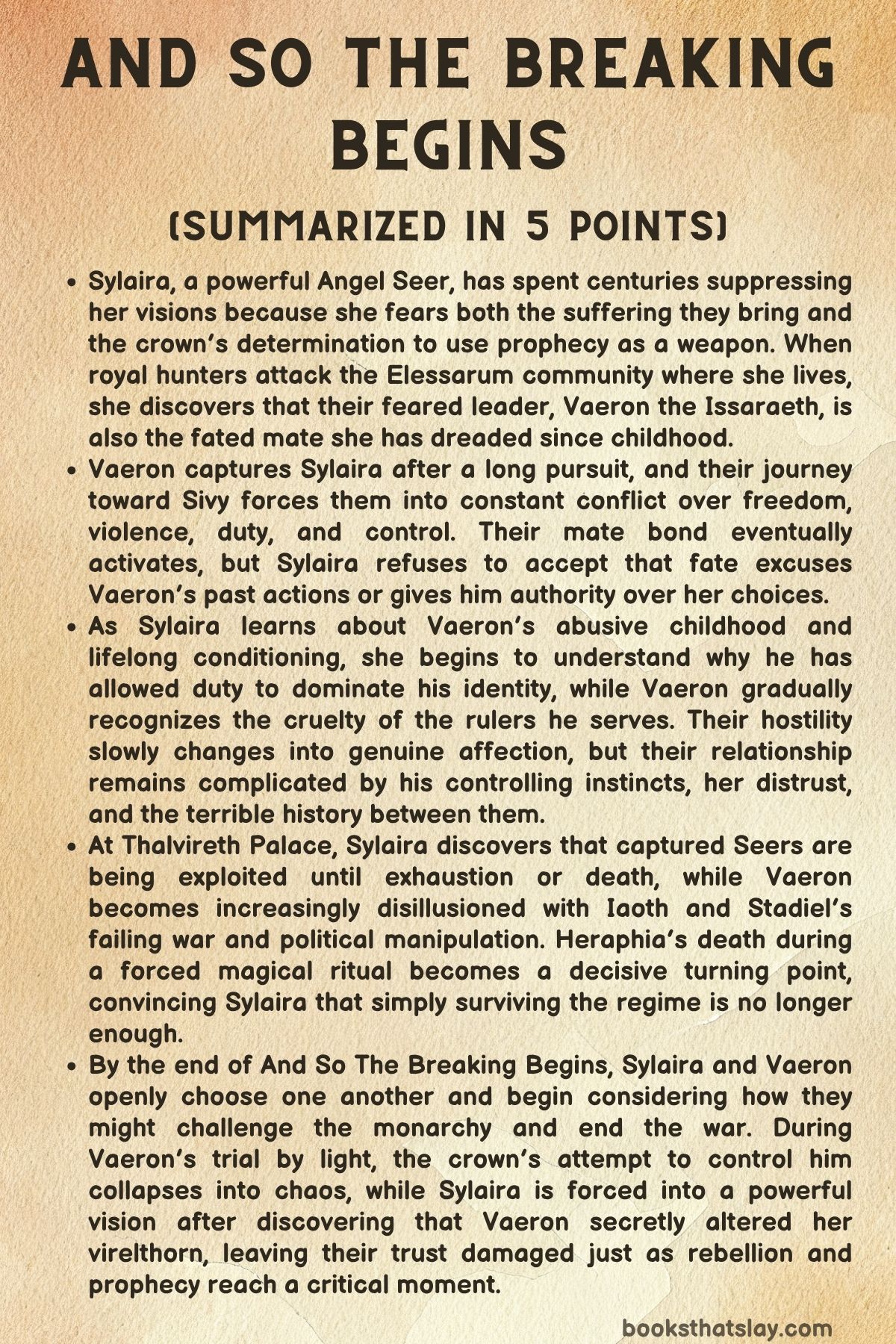
Summary
Sylaira has feared her future mate since childhood. As one of the most powerful Angel Seers, she has spent years suppressing her Sight with virelthorn because the visions sent by the Goddess are painful, violent, and capable of turning her into a valuable weapon for the Angel crown.
She lives among the peaceful Elessarum with her closest friend Heraphia and Heraphia’s husband, Zuriel. When royal hunters attack their settlement, Sylaira discovers that the feared Issaraeth leading the pursuit is Vaeron, the same man she Saw in the vision that has haunted her for centuries and therefore the mate chosen for her by the Goddess.
Sylaira knows that direct eye contact can activate the mate bond, so she becomes determined never to meet Vaeron’s gaze. She, Heraphia, and Zuriel flee toward the estate of Zuriel’s uncle Ithuriel, hoping they can hide long enough to find another route to safety.
Vaeron follows them with his soldiers and his bonded auravane, Ilae. Although he is feared for his Command magic, which allows him to overpower the minds and bodies of others, his private thoughts reveal that he is also controlled by the rulers he serves, particularly his sister, Korona Iaoth.
The fugitives reach Ithuriel’s manor, but the hunters soon find them. Sylaira narrowly escapes while Heraphia and Zuriel are captured, leaving her burdened by guilt because she has preserved her freedom at the cost of abandoning the two people closest to her.
Vaeron learns Sylaira’s identity and discovers that she is a Seer who depends on virelthorn to silence her visions. What begins as an official mission becomes increasingly personal as he becomes fascinated by her scent, defiance, intelligence, and repeated ability to escape him.
Sylaira heads toward Vaelsűr Temple, hoping for sanctuary, while Vaeron deliberately prolongs the pursuit. He discovers that chasing someone who refuses to fear him in the expected way gives him a rare sense of freedom from the duty that has controlled almost every part of his life.
After days of exhaustion, hunger, and psychological pressure, Sylaira reaches the area near the temple but is finally captured. Vaeron shackles her in bronze, removing her access to magic, and immediately notices that the victory feels empty when her anger collapses into despair.
During their journey toward Sivy, Sylaira keeps her gaze lowered so the mate bond cannot form. Their relationship becomes a constant struggle between her determination to preserve autonomy and Vaeron’s instinct to control situations whenever he believes force will prevent harm.
Bad weather and Sylaira’s injuries force them into closer proximity. Vaeron provides clothes, shelter, medical care, and protection, but every act of kindness exists beside the fact that he is still taking her to a ruler who intends to exploit her Sight.
Sylaira eventually attempts another escape and badly damages her knee. Vaeron catches her and uses Command, forcing the confrontation Sylaira has tried to avoid; their eyes meet, and the mate bond activates with overwhelming force.
The bond exposes their emotions to one another, but Sylaira refuses to treat fate as forgiveness. Vaeron is still responsible for hunting the Elessarum and participating in the system that destroyed lives, while Vaeron struggles to reconcile his growing attachment to Sylaira with the duty that has defined him.
His controlling instincts remain dangerous. When Sylaira refuses medicine, he Commands her to take it, only to realize afterward that he has repeated the same kind of coercion that has dominated his own life.
At Stadur, a healer confirms the seriousness of Sylaira’s injuries but also gives her hope that she may eventually dance again. Dance represents the person Sylaira was before fear, prophecy, and persecution narrowed her existence to survival, so the possibility of recovering it becomes deeply important.
Vaeron confides in Maelsar that Sylaira is his mate, and Maelsar immediately recognizes the political danger. Iaoth has always exploited Vaeron’s attachments, making the secrecy surrounding the bond essential if Sylaira is to have any protection.
As the journey continues, Sylaira begins seeing contradictions in Vaeron. He can kill brutally when she is threatened, but he can also show restraint, protect vulnerable creatures, reject unnecessary taxation of his lands, care for her injuries, and listen seriously when she speaks about the peaceful life she once wanted.
Vaeron, meanwhile, begins understanding that Sylaira will never willingly choose him if he continues treating protection as ownership. The distinction between possessing the mate fate gave him and earning the trust of the woman herself becomes increasingly important.
Their conversations expose the history behind Vaeron’s obsession with duty. His mother was killed during a Demon attack, and his abusive father later manipulated his will, blamed him for perceived weaknesses, and carved the words DUTY ABOVE ALL into his chest, teaching him to suppress emotion and obey regardless of personal cost.
Sylaira initially tries to use Vaeron’s growing feelings to gain influence, but discovering the extent of his history makes her ashamed of the strategy. Manipulating him would reproduce the methods that helped turn him into the feared weapon she condemns.
Their attraction gradually becomes genuine. After difficult confrontations, apologies, and increasing honesty, they choose to begin again, and Vaeron becomes more careful about consent, allowing Sylaira to decide what physical and emotional closeness she actually wants.
A serious conflict arises when Vaeron discovers her remaining virelthorn and mistakenly believes she may be poisoning herself. Once Sylaira explains that the herb suppresses Sight because she refuses to let her visions fuel the crown’s war, he agrees to obtain more and help her deceive Iaoth by providing information she can disguise as prophecy.
Their arrival at Thalvireth Palace changes everything. Iaoth immediately treats Sylaira as state property, and Sylaira learns that Vaeron is formally engaged to Dasha through a political arrangement he never told her about, destroying much of the trust they had begun building.
Her reunion with Heraphia reveals the true horror of palace life for captured Seers. They are housed comfortably but forced to produce visions until their bodies and minds fail, while Zuriel has been separated from his wife and sent elsewhere.
Vaeron explains that his engagement was forced upon him through political pressure and Iaoth’s manipulation. He increasingly recognizes that the rulers he has served are not protecting the realm responsibly but driving it deeper into war, hunger, military collapse, and ideological fanaticism.
Lyriasthe, an Elessarum servant secretly helping the Seers, becomes another ally. With her assistance and Vaeron’s cooperation, Sylaira continues using virelthorn while pretending to produce useful visions, turning deception into a method of survival.
Sylaira also begins questioning some of her own absolutes. She remains committed to peace, yet repeated attacks, deaths, and acts of self-defense make it harder to believe that violence can always be avoided regardless of circumstance.
At a palace ball celebrating the captured Seers and Vaeron’s approaching marriage, the political situation explodes. When Zarethiel Elyriane hurts Sylaira while dancing with her, Vaeron uses Command against almost the entire ballroom and publicly declares Sylaira his mate.
The revelation destroys the planned marriage alliance and places both of them in greater danger. Iaoth and Stadiel arrange a trial by light between Vaeron and Zarethiel, ordering Vaeron to lose deliberately while using Sylaira as leverage to ensure his obedience.
By this point, Sylaira admits that she needs Vaeron, and the two complete their mate bond by mutual choice. Their union does not erase the past, but it marks a change from a relationship built on pursuit and coercion toward one in which Sylaira insists upon choice and Vaeron accepts that he must spend his life answering for what he has done.
Sylaira then encounters the Goddess in a strange vision or dream. When she asks why Vaeron was chosen for her, the Goddess answers with one word: change, while warning that peace will require sacrifice.
Heraphia, meanwhile, deteriorates rapidly under Iaoth’s forced use of Sight. Desperate after a devastating military defeat, Iaoth attempts forbidden power sharing with her, and Heraphia dies after speaking fragmented images of war, peace, mirrors, marriage, Angels, Demons, and death.
Heraphia’s death transforms Sylaira’s resistance. She no longer wants merely to survive or escape; she wants to destroy the system that turns Seers into expendable instruments and uses religion to justify suffering.
Vaeron reaches a similar conclusion from another direction. Military shortages, political manipulation, the crown’s extravagance, and threats against Sylaira finally convince him that loyalty to Iaoth and Stadiel may no longer be loyalty to the Angel people.
Before the trial, Sylaira regains enough strength in her knee to dance beneath the Goddess Moon with Vaeron. He gives her the ring of House Räviel and asks her to choose him freely rather than accept him merely because fate created their bond, and they finally confess their love.
The trial begins with Sylaira held hostage by Calrien while Vaeron fights Zarethiel. Vaeron intends to lose because Stadiel has threatened to claim Sylaira if he wins, but Stadiel orders Calrien to hurt her when Vaeron does not perform his defeat convincingly enough.
Seeing Sylaira injured breaks Vaeron’s restraint. His power explodes through the throne room, shattering the mirrors surrounding the Goddess Moon, and although Sylaira manages to calm him mentally, the resulting fight leaves Zarethiel defeated at Vaeron’s feet.
The crown immediately abandons any appearance of fairness and orders Vaeron seized. Maelsar rescues Sylaira, placing the group on the verge of open rebellion against the rulers Vaeron once served.
Before they can escape, Sylaira realizes something has happened to the virelthorn Vaeron supplied. It was mixed with another substance that gradually prepared her body to receive Sight, meaning Vaeron has broken the promise he recently made never to lie to her.
Vaeron begs forgiveness and insists that allowing the prophecy was the only way to keep her safe. As Sylaira loses consciousness, the Sight she has resisted for so long finally overwhelms her, and she Sees the end, leaving the story at the moment when prophecy, rebellion, love, betrayal, and the approaching collapse of the Angel regime converge.
Characters
Sylaira
Sylaira is the emotional and moral center of And So The Breaking Begins, beginning as a woman whose greatest objective is to avoid becoming what others want her to be. Her extraordinary Sight should make her powerful, yet she experiences it as a threat because every vision risks turning her body and mind into resources that religious and political authorities believe they have the right to exploit.
Her commitment to Elessarum pacifism initially gives her a firm ethical structure, but experience gradually forces her to test its limits. Being hunted, captured, threatened, and forced to witness the suffering of other Seers shows her that refusing violence does not automatically prevent violence from being inflicted upon innocent people.
Her relationship with Vaeron becomes the most difficult test of her ideas about autonomy. She is attracted to him and eventually loves him, but she repeatedly insists that fate, desire, magical bonds, and protection do not grant him ownership of her body or decisions.
Sylaira’s development is therefore not a movement from weakness to strength, because she possesses strength from the beginning. It is a movement from avoidance toward active choice, as she stops trying only to escape prophecy and begins considering how her power, intelligence, political position, and bond might be used to confront the system destroying the people around her.
Vaeron
Vaeron is the most internally divided character in And So The Breaking Begins, functioning simultaneously as persecutor, prisoner, protector, weapon, lover, and potential revolutionary. His Command ability has made him terrifying to others, but his past reveals that his obsession with control grew from a childhood in which control was repeatedly taken away from him.
The cruelty of his father and the manipulation of Iaoth teach Vaeron that duty is more important than identity, emotion, or individual desire. Even after becoming powerful enough to control almost anyone else, he remains psychologically conditioned to obey those who shaped him.
Sylaira threatens that conditioning because she refuses to treat obedience as virtue. Her challenges force Vaeron to recognize that following orders does not remove responsibility for the suffering those orders produce.
His greatest contradiction is his desire to protect Sylaira while repeatedly violating her autonomy in the name of that protection. His use of Command to force medicine upon her becomes especially important because it makes him recognize that supposedly protective coercion can reproduce the abuse he himself endured.
Vaeron improves when he begins understanding that love cannot be commanded. His desire changes from wanting Sylaira because fate identifies her as his mate to wanting her voluntary trust, and this distinction pushes him toward rebellion against the crown.
Yet his final deception concerning the virelthorn shows that his transformation is incomplete. Under extreme pressure, he still decides that protecting Sylaira permits him to make a life-changing choice on her behalf, leaving his central moral struggle unresolved.
Heraphia
Heraphia is Sylaira’s closest friend and one of the clearest examples of what the crown’s treatment of Seers actually costs. She begins as a loving companion, wife, believer, and fellow Seer who understands Sylaira’s fear of visions because she lives with similar burdens herself.
Her capture transforms her life into prolonged institutional abuse. Although the palace provides comfort in material terms, Heraphia is repeatedly forced to use Sight until exhaustion, trauma, separation from Zuriel, and desperation begin changing both her emotional stability and her principles.
Her growing willingness to consider assassination shows how oppression can push a committed pacifist toward ideas she once would have rejected. Her desperation is not presented as sudden cruelty but as the consequence of watching peaceful resistance fail while the people she loves remain trapped.
Her death during Iaoth’s forbidden power-sharing ritual becomes one of the book’s decisive events. She dies attempting to produce knowledge that might save others, yet the crown’s reaction proves that it values the lost prophecy more than the woman who carried it.
For Sylaira, Heraphia is more than a friend. She represents family, shared faith, innocence, resistance, and eventually the human cost that makes passive survival morally impossible.
Zuriel
Zuriel is defined primarily through loyalty, courage, and devotion to Heraphia. During the early pursuit, he repeatedly places himself in danger to protect both women and attempts to use his noble connections to provide them with sanctuary.
His relationship with Heraphia adds emotional weight to her captivity because their separation becomes another method through which the crown controls its prisoners. Heraphia’s repeated longing to reunite with him shows that his absence remains psychologically present even after he leaves the immediate action.
Zuriel also complicates the political structure of the world because he belongs to House Ilytharï while living closely with the persecuted Elessarum. His existence demonstrates that noble status does not automatically require ideological loyalty to the crown.
Although he spends much of the later story away from Sylaira and Heraphia, he remains one of the people whose survival motivates their decisions. Heraphia’s fear for him contributes directly to the choices that eventually lead her toward the fatal ritual.
Maelsar
Maelsar begins as Vaeron’s second-in-command and closest friend, but he gradually emerges as one of the most practical members of the resistance forming around Sylaira and Vaeron. Unlike characters who respond primarily from ideology or emotion, he often evaluates danger through strategy, political consequences, and available leverage.
He recognizes almost immediately how dangerous Sylaira’s mate bond could become if Iaoth discovers it. His willingness to hide the truth establishes him as someone whose loyalty to Vaeron exceeds his loyalty to the crown.
Maelsar also becomes essential whenever Vaeron and Sylaira need plans rather than promises. He helps conceal the failed escape, collects damaging information about Dasha and Calrien, assists in protecting Sylaira, and prepares for the possibility that service to the monarchy may become outright opposition.
His relationship with Lyriasthe adds another dimension to him. His feelings suggest that the people closest to the machinery of royal power have developed attachments that directly contradict the prejudices and policies they are expected to enforce.
Korona Iaoth
Iaoth is one of the novel’s principal antagonists because she turns personal relationships, supernatural abilities, religion, and state authority into instruments of control. She does not merely demand obedience from strangers; she systematically exploits the vulnerabilities of her own brother.
Her treatment of Vaeron demonstrates how manipulation can exist beneath the language of family and duty. She understands which memories, responsibilities, fears, and loyalties can be used to make him comply, leaving him powerful in public but constrained in private.
Her treatment of Seers is even more severe. She regards their visions as resources belonging to the state and accepts physical collapse, destroyed identities, and death as reasonable costs if useful prophecy can be obtained.
Her reaction to Heraphia’s death reveals her priorities with particular clarity. Rather than focusing on the loss of a person, she is frustrated that the information contained in Heraphia’s final vision has disappeared.
Iaoth therefore represents institutional cruelty rather than impulsive cruelty. Her danger comes from her ability to make exploitation appear necessary, lawful, religiously approved, and politically responsible.
Koron Stadiel
Stadiel represents authoritarian power stripped of almost every moral restraint. Where Iaoth frequently operates through emotional and political manipulation, Stadiel is more willing to use direct threats, magical domination, ritual coercion, and physical danger.
His rare magical ability to redirect another person’s power makes him particularly threatening to Vaeron. The fact that he can turn Vaeron’s own Command against Sylaira removes one of the advantages that has made the Issaraeth nearly untouchable.
Stadiel also embodies the crown’s refusal to reconsider the war. Even while the army suffers disease, shortages, mass casualties, and logistical collapse, he continues demanding troops and presenting victory as inevitable.
His handling of the trial exposes the emptiness of royal justice. The contest is never genuinely intended to determine merit; its rules, punishments, hostage arrangements, and demanded outcome are all designed to produce obedience.
Lyriasthe
Lyriasthe occupies a socially modest position but becomes one of the most quietly influential allies in the story. As an Elessarum working inside the palace, she understands both the danger facing the Seers and the importance of appearing harmless within a system built on surveillance.
She helps deliver virelthorn, protects Sylaira and Heraphia, supports the concealment of their escape attempt, and offers information that helps Sylaira understand whom she can trust. Her actions show resistance functioning through everyday courage rather than spectacular power.
Her loyalty to Vaeron and Maelsar also challenges Sylaira’s assumptions. If an Elessarum woman has reasons to trust men associated with the crown, then moral identity cannot be determined solely by title, faction, or reputation.
Lyriasthe consequently becomes evidence for one of Sylaira’s growing realizations: alliances capable of changing the realm may already exist across the divisions the monarchy depends upon.
Dasha
Dasha initially appears as a romantic obstacle because Sylaira discovers that Vaeron is formally promised to her only after beginning to trust him. Her sudden appearance therefore matters less because of personal rivalry and more because it reveals another major secret Vaeron has withheld.
The engagement also demonstrates how marriage functions as a political instrument among powerful Angel houses. Vaeron’s wishes are secondary to the alliance that Iaoth and Stadiel want to secure through House Elyriane.
Later revelations about Dasha’s involvement with Calrien further weaken the appearance that the engagement represents genuine commitment. She becomes part of a court culture in which official relationships, private desires, loyalty, and political usefulness frequently have little connection to one another.
Her character therefore helps expose the artificiality of the life Vaeron is expected to maintain. The future designed for him by the crown is based on obligation rather than choice, making his growing insistence upon choosing Sylaira politically dangerous as well as emotionally significant.
Zarethiel Elyriane
Zarethiel represents aristocratic entitlement and the political interests of House Elyriane. His treatment of Sylaira at the ball demonstrates that he is willing to disregard her discomfort because he assumes his position protects him from consequences.
Vaeron’s violent response transforms Zarethiel’s behavior into a public political crisis. What begins as mistreatment of Sylaira becomes the event that exposes the mate bond, destroys the planned marriage alliance, and leads to the trial by light.
Zarethiel’s demand for compensation shows how personal humiliation and political power reinforce each other within the court. Rather than examining his own conduct, he uses his influence to demand punishment from the crown.
During the trial, he becomes an instrument through which the monarchy attempts to discipline Vaeron. His expected victory is supposed to restore the hierarchy that Vaeron disrupted by publicly choosing Sylaira over court expectations.
Calrien
Calrien occupies the dangerous position of someone close enough to royal power to become useful but unreliable enough to threaten the conspirators. His secret involvement with Dasha gives Maelsar and Vaeron potentially valuable leverage against the political alliance surrounding House Elyriane.
His most significant action occurs during the trial, when he is placed in control of Sylaira as insurance against Vaeron’s disobedience. He accepts the role of physically threatening her so that the crown can manipulate Vaeron’s performance.
This makes Calrien an example of ordinary complicity within an authoritarian structure. He does not require Iaoth’s ideological intensity or Stadiel’s extraordinary power to become dangerous; willingness to serve their immediate purpose is enough.
Ithuriel
Ithuriel exists mostly at the edges of the central conflict, yet his role carries social and emotional importance. His manor becomes the first attempted refuge for Sylaira, Heraphia, and Zuriel, connecting him indirectly to their desperate attempt to escape the hunters.
His later apology concerning Heraphia reveals regret over his previous failure to accept her fully as Zuriel’s wife. That remorse arrives after Heraphia’s death, making it impossible to repair the relationship but still demonstrating the possibility of recognizing prejudice too late.
Through Ithuriel, the story shows that political or social harm does not always require open cruelty. Rejection, silence, and failure to support someone when support is still useful can create their own lasting consequences.
Ilae
Ilae begins as an extension of Vaeron’s frightening reputation because the auravane’s tracking abilities make Sylaira’s escape far more difficult. His bond with Vaeron initially strengthens the sense that the hunter possesses almost supernatural advantages over his prey.
The history of their relationship, however, reveals Vaeron’s capacity for patience and protection. Ilae bonded with him after Vaeron protected the creature’s nest, providing evidence that tenderness existed in Vaeron long before Sylaira entered his life.
Ilae also serves as a reminder that Vaeron forms some of his strongest connections without Command. The loyalty of the creature must be earned rather than forced, making the bond an important contrast to the human relationships in which Vaeron has relied upon power.
Ysolthe
Ysolthe, Ilae’s mate, becomes important when she chooses to bond with Sylaira. The decision gives Sylaira a connection that belongs to her personally rather than something created through the commands of the crown.
The bond carries particular emotional significance because Vaeron introduces Ysolthe partly as protection in case he dies during the trial. What initially appears to be a gift therefore contains an acknowledgment that he may not survive what is coming.
Ysolthe’s simple understanding of mates also contrasts with the moral complexity faced by Sylaira and Vaeron. The creature’s instinct that mates remain together may sound straightforward, but the human relationship requires consent, accountability, forgiveness, and choice before such closeness can become healthy.
The High Priestess
The High Priestess represents the religious institution’s participation in the exploitation of Seers. Spiritual authority in the story is not automatically compassionate, and she becomes involved in practices that treat bodies as tools for increasing magical or prophetic output.
Her willingness to participate in the forced ritual involving Sylaira demonstrates how religious language can be used to remove personal autonomy. The supposed pursuit of divine knowledge becomes indistinguishable from physical coercion.
Her role also complicates Sylaira’s relationship with faith. Sylaira does not simply have to decide whether she believes in the Goddess; she must separate the possibility of genuine divine purpose from institutions that claim to speak for divinity while committing abuse.
The Goddess
The Goddess remains deliberately difficult to interpret because her influence appears through prophecy, fate, magical bonds, prayer, and Sylaira’s unusual encounter in the sacred white space. She is therefore central to the world without functioning like a conventional character whose intentions are fully explained.
Her choice of Vaeron as Sylaira’s mate initially seems almost cruel from Sylaira’s perspective. When asked why the pairing exists, however, the Goddess answers with the concept of change, implying that their relationship may have significance extending far beyond personal romance.
The warning that peace requires sacrifice introduces another troubling question. Sylaira must decide whether divine purpose can be trusted when human religious authorities have repeatedly used the Goddess’s name to justify war, forced prophecy, and political control.
Vaeron’s Father
Vaeron’s father is one of the most important unseen forces shaping his adult personality. His ability to influence will allows him to invade the autonomy of his own children, teaching Vaeron from an early age that love and control can exist together.
After the death of Vaeron’s mother and Vaeron’s accidental consumption of Demon blood, his father responds with blame and increased domination rather than comfort. Carving DUTY ABOVE ALL into his son’s chest turns emotional abuse into a permanent physical command.
The father’s influence explains why Vaeron initially struggles to recognize coercion as coercion when he believes his intentions are protective. Vaeron’s later development requires him not simply to oppose Iaoth but to reject the understanding of love, strength, and duty inherited from his father.
Vaeron’s Mother
Vaeron’s mother appears primarily through memory, yet her influence provides an important counterweight to his father’s brutality. Her death during the Demon attack becomes one of the defining traumas of Vaeron’s childhood.
Unlike the command of duty imposed upon him afterward, the guidance associated with his mother encourages him to follow his heart. The conflict between those two lessons survives throughout his adult life.
Her memory therefore represents the possibility that Vaeron’s capacity for love, protection, and independent moral choice was never entirely destroyed. Even after centuries of conditioning, some part of him continues to remember that obedience is not the only possible measure of a worthy life.
Themes
Autonomy, Consent, and the Meaning of Choice
The struggle over personal autonomy drives nearly every major relationship in And So The Breaking Begins. Sylaira’s Sight belongs to her, yet the crown believes her visions belong to the state; her body belongs to her, yet political authorities restrain, drug, threaten, and ritualize it whenever they consider her power useful.
Her relationship with Vaeron places the same issue inside romance. The fated mate bond guarantees connection, but Sylaira repeatedly insists that destiny cannot provide the consent that Vaeron must earn from her as an individual.
Vaeron’s Command makes the problem especially serious because he possesses the literal ability to override another person’s will. Each time he uses that power against Sylaira, even for reasons he considers protective, he damages the possibility that she can ever feel genuinely safe with him.
His most meaningful development occurs when he begins wanting Sylaira to choose him rather than simply remain bound to him. Their eventual intimacy matters because he asks rather than commands and because Sylaira consciously decides what she wants.
The final deception involving the altered virelthorn deliberately reopens the issue. Vaeron may believe he is protecting Sylaira, but he again decides that his judgment permits him to control a choice she would not freely make, showing that respect for autonomy requires more than love or good intentions.
Duty, Conditioning, and Breaking Cycles of Control
Duty initially functions as the organizing principle of Vaeron’s entire identity. He hunts, captures, threatens, and obeys because he has been taught that personal feelings become irrelevant when authority defines an action as necessary.
The scar carved into his chest reveals that this loyalty is not simply patriotism. Duty was taught through fear, violence, psychological manipulation, and the destruction of his ability to imagine himself apart from the expectations imposed upon him.
Iaoth continues the pattern established by their father. She understands that Vaeron’s loyalty to family can be transformed into a chain, so she uses memories, political obligations, guilt, threats, and eventually Sylaira herself to keep him useful.
Sylaira becomes disruptive because she refuses to admire obedience for its own sake. By asking why Vaeron serves rulers he could physically overpower, she forces him to recognize that submission does not become moral simply because it has been renamed responsibility.
The theme expands beyond Vaeron when Sylaira realizes that she too can reproduce manipulative behavior. Her initial attempt to exploit his feelings frightens her once she understands his history, showing that victims of controlling systems must consciously resist repeating their methods.
Breaking the cycle therefore requires more than changing rulers. It requires rejecting the belief that love, protection, religion, duty, or political necessity can justify controlling another person’s will.
Violence, Pacifism, and Moral Responsibility
Sylaira begins with a strong Elessarum belief that violence should be rejected. Her experiences gradually force her to confront situations in which refusing to fight does not prevent violent people from hurting others.
Vaeron represents the opposite starting point. He has been trained to use violence almost automatically, especially when protecting someone he considers his responsibility, and his ability to kill quickly horrifies Sylaira.
Neither worldview remains untouched. Sylaira discovers that self-defense may sometimes require force, while Vaeron begins understanding that the ability to destroy an enemy does not prove that destruction is wise, necessary, or morally justified.
The war gives this debate political scale. Iaoth and Stadiel treat extermination of the Demons as a sacred duty even while soldiers starve, disease spreads, supplies fail, and enormous numbers of people die.
The crown’s ideology depends upon defining an entire people as inherently evil. Sylaira’s refusal to accept that assumption exposes how easily prejudice can be transformed into policy when religious certainty, fear, and military power reinforce one another.
Heraphia’s transformation makes the theme even more difficult. Oppression pushes a pacifist toward considering assassination, suggesting that prolonged violence can change not only what people do but what they begin believing is morally possible.
Prophecy, Faith, and the Abuse of Sacred Power
Sight creates a continuous conflict between divine possibility and human exploitation. Sylaira’s visions may originate with the Goddess, but the crown’s determination to extract and weaponize them makes the gift feel like a form of captivity.
Virelthorn becomes important because suppressing Sight is one of the few choices Sylaira can make about her own spiritual life. Refusing prophecy is therefore not simply fear; it is also refusal to participate in a military system that may use her knowledge to kill.
Heraphia demonstrates the terrible consequences of removing that choice. Repeated forced visions damage her mentally and physically until the forbidden power-sharing ritual finally kills her.
Iaoth’s reaction reveals how sacred language can conceal institutional dehumanization. The Seers are honored publicly while being privately treated as containers from which useful information must be extracted.
Sylaira’s encounter with the Goddess complicates her rejection of Sight because it suggests that prophecy itself may not be the enemy. The divine message concerning change and sacrifice implies that a purpose may exist beyond the crown’s interpretation of religion.
The final forced vision makes the question even more urgent. Sylaira must eventually determine whether she can claim Sight on her own terms, distinguishing genuine spiritual power from the rulers, priestesses, and even loved ones who believe they may decide how that power should be used.