Liberty Street Summary, Characters and Themes
Liberty Street by Heather Marshall is a historical novel about women whose lives are shaped by systems that decide which voices deserve to be believed.
Moving between 1961 and the 1990s, the story follows young journalist Emily Radcliffe as she enters Toronto’s Mercer Women’s Prison undercover, and detective Rachel Mackenzie as she investigates unidentified remains found decades later in a rural cemetery. Through these two women, the book examines institutional abuse, mental illness, gender expectations, family secrets, journalism, and the long consequences of silence. At its center is the fate of Annie Little, a woman whose suffering connects the two timelines and gives both investigations their deepest purpose.
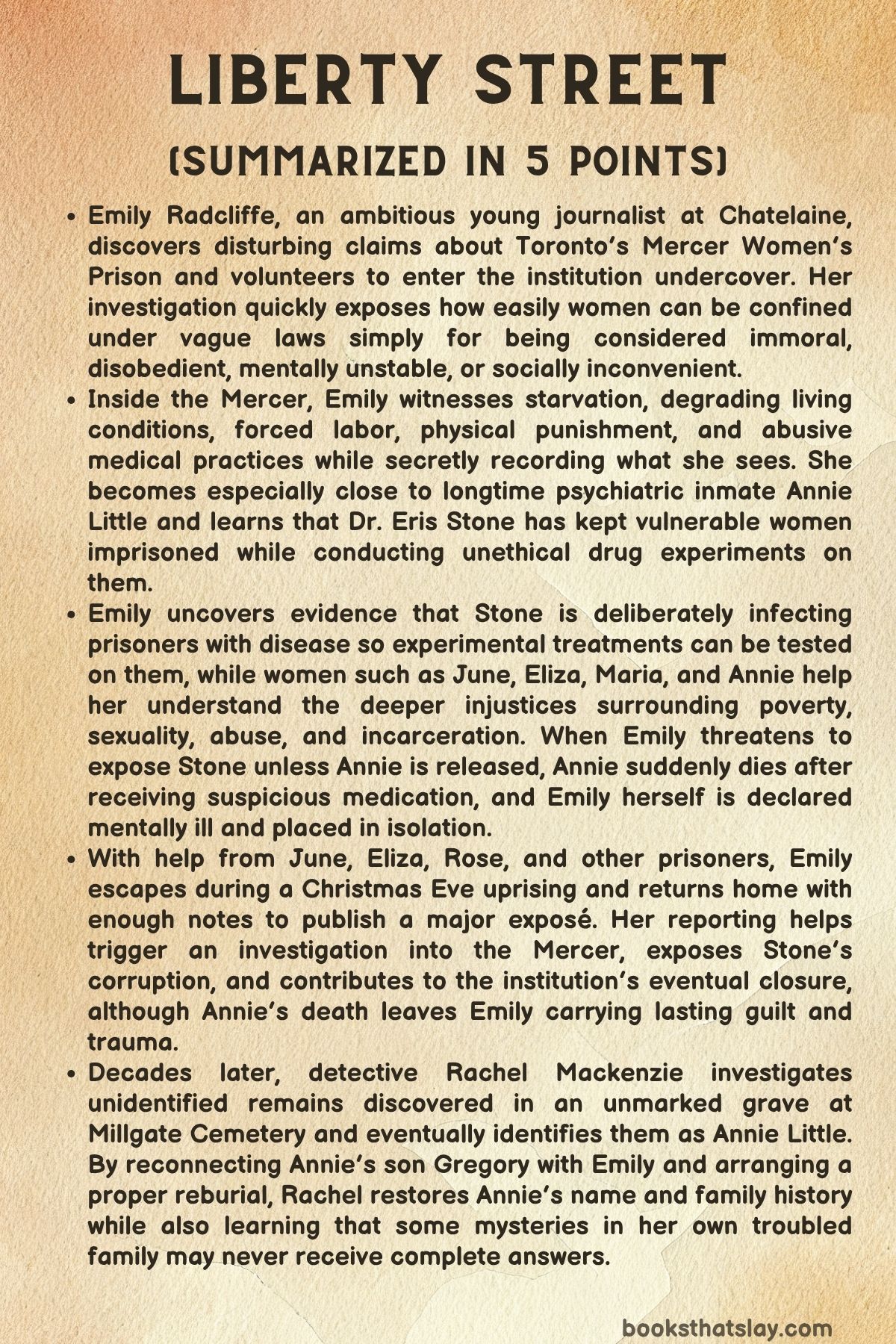
Summary
In Toronto in 1961, twenty-four-year-old Emily Radcliffe works as an editorial assistant at Chatelaine magazine and dreams of becoming a journalist whose name appears beneath serious reporting. Her editor, Doris Anderson, encourages women to question the narrow roles society assigns them, while Emily is increasingly disturbed by the possibility that her boyfriend Jem expects marriage to end her career.
Emily’s professional ambitions become more urgent when a delivery driver brings the magazine an anonymous message from inside Mercer Women’s Prison. The letter describes starvation, filthy conditions, medical experiments, physical punishment, rats, lice, and women imprisoned under legislation that allows them to be confined for being considered difficult or morally improper.
Researching the Female Refuges Act, Emily discovers that women can be sentenced for vague accusations such as leading an idle or dissolute life. Even more disturbing, parents or guardians can have young women declared incorrigible and sent away without their having committed a serious crime.
After meeting former inmates June Jones and Lila outside the Mercer, Emily becomes convinced that ordinary reporting will never reveal what happens behind the prison walls. Inspired by earlier undercover journalists, she proposes having herself legally committed so that she can investigate the institution from inside.
Doris recognizes the danger but eventually supports the idea. Emily’s father William, himself a respected journalist, initially fears for his daughter but realizes that he would probably admire the same courage more easily in a son, and he reluctantly agrees to tell a judge that Emily is uncontrollable.
Emily’s mother, Bess, is even harder to persuade. Yet their conflict becomes part of Emily’s larger struggle to define freedom for herself, because she refuses to accept that the education and opportunities her parents gave her should ultimately lead only to marriage and domestic life.
The court proceeding proves more disturbing than Emily expected. William performs the role of an exasperated father, Emily deliberately behaves badly, and the judge sentences her to six months in the Mercer with astonishingly little investigation into whether imprisonment is justified.
Inside the prison, Emily is stripped of her clothing, privacy, control, and ordinary identity. Bells govern every part of daily life, meals are inadequate, sanitation is humiliating, and the women are divided according to institutional labels that strongly influence how they are treated.
Emily quickly befriends Annie Little, a psychiatric inmate who has spent fifteen years at the Mercer. Annie explains that she suffered severe mental illness after the birth of her son Gregory but recovered relatively quickly, only for prison doctor Eris Stone to continue declaring her unstable and subjecting her to medication and electroshock treatments.
Other inmates show Emily how social conditions contribute to incarceration. Eliza repeatedly commits minor crimes because prison provides food and protection from an abusive father, while women such as Gertrude, Lizzie, Peggy, and Vera have been confined because poverty, sexuality, domestic violence, pregnancy, or social judgment placed them outside respectable expectations.
Emily begins secretly writing observations in crayon on toilet paper and hiding the pages inside the tap in her cell. Her investigation becomes increasingly dangerous after Dr. Stone performs painful examinations and Emily notices that numerous prisoners develop symptoms of venereal disease despite having no sexual contact during incarceration.
The disease becomes especially suspicious because women suffering from such infections can legally be kept beyond their normal release dates. Emily discovers that Stone is using experimental treatments and eventually concludes that prisoners are being deliberately infected so that drugs can be tested on them without meaningful consent.
June Jones, who has returned to the prison, recognizes Emily from their earlier encounter. Rather than expose her, June gradually becomes an ally and reveals that she has been bribing Stone to protect women who work for her from the medical experiments.
Emily now wants documentary evidence. She also begins to understand the limits of her own assumptions, particularly when Eliza rejects Emily’s initial offer of respectable rescue because it does not address the realities of her life.
June succeeds where Emily fails by offering Eliza safe employment, housing, food, and firm protection from exploitation. Together, Emily, June, and Eliza develop a plan to enter Stone’s office and steal records proving the drug experiments.
Their operation becomes far more dangerous when June turns the planned distraction into a factory fire. During the confusion, Eliza picks the locks while Emily searches Stone’s files and finds Annie’s extensive record, including proof that Annie’s mother repeatedly tried to secure her release.
Emily also retrieves another concealed file and her hidden notes, but she is horrified to discover that psychiatric patients have been left locked in their cells during the fire. Annie and the others are treated as though their lives matter less than institutional security.
Afterward, Emily tells Annie that her mother never abandoned her. She decides to use the stolen information to pressure Stone into authorizing Annie’s release, despite June’s warning that threatening someone whose career and power are at stake could have lethal consequences.
Emily confronts Stone and reveals that she is a journalist. She threatens to expose the illegal experiments unless Stone releases Annie, but that evening Annie is given unfamiliar medication, collapses, and dies in Emily’s arms.
Convinced Stone has killed Annie, Emily publicly announces the truth about the experiments. The matrons restrain and sedate her, and when she awakens she has been placed in isolation and dressed in the blue uniform used for psychiatric inmates, giving Stone the power to keep her indefinitely.
Emily spends days starving, freezing, and blaming herself for ignoring the warnings of people who understood the Mercer better than she did. Her confidence in journalism as an easy weapon against injustice has been replaced by the recognition that institutions can destroy people before public attention ever reaches them.
On Christmas Eve, June, Eliza, Rose, and other inmates organize a riot to free Emily. Disguised in Stone’s white coat, Emily escapes with June, carrying the toilet-paper notes that survive after Stone destroys the stolen files.
Emily returns home and writes her exposé, accusing the Mercer of abuse, corruption, experimentation, and responsibility for Annie’s death. Doris believes her and publishes the article under Emily’s own byline, while the revelations eventually help trigger an investigation and the institution’s closure.
Decades later, Detective Rachel Mackenzie is investigating skeletal remains discovered beneath an unmarked patch of ground in Millgate Cemetery. The remains belong to a woman who died around the early 1960s, and a code on the inexpensive casket eventually leads Rachel to the former Mercer Women’s Prison.
Rachel’s work is complicated by her own history with Millgate. Her mother Mary suffered serious mental illness throughout Rachel’s childhood, while Rachel was largely raised by her grandmother Dora, and old memories of instability, secrecy, miscarriage, addiction, and family conflict repeatedly surface during the investigation.
The deepest family wound concerns Dora’s death. Rachel witnessed Mary push Dora from a cliff after Dora revealed that Mary’s younger brother Walter Jr. had died years earlier under suspicious circumstances while Mary was responsible for him.
Rachel told police the truth, and Mary was convicted of murder. The trauma later contributed to Rachel’s depression and alcoholism, but Detective Tom Stevens helped her enter treatment, and Rachel eventually built a career around finding answers for people forced to live with uncertainty.
Searching Mercer records, Rachel reduces the possible identities of the cemetery remains to several women, including Annie Little and Emily Radcliffe. She eventually learns that Emily survived, became a journalist, and helped expose the Mercer, while official records claim that Annie died by suicide.
An elderly Emily tells Rachel about Annie, Stone, and the events surrounding the prison investigation. Rachel then traces Annie back to Huron County and discovers that Annie’s parents, Helen and Richard Sharrock, are buried near the unknown grave.
The truth emerges from Reverend Holland Sr. Annie had been returned home after her death, but because she had been labelled mentally ill and suicidal, Helen feared that the church community would reject a public burial, so Annie was secretly buried beneath a maple tree without an official record or marker.
Rachel later meets Annie’s son Gregory and brings Emily to meet him. Gregory does not first ask Emily about evidence or punishment; he asks her to tell him something good about his mother, and Emily describes Annie’s kindness, her love of strawberries, and the devotion she never stopped feeling for her son.
Rachel then confronts her own unresolved past by visiting Mary in prison and asking whether she deliberately killed Walter Jr. Mary refuses to provide certainty, forcing Rachel to accept that even a skilled detective cannot solve every mystery that shapes a life.
The story ends with Annie finally receiving a proper resting place. Emily joins Rachel, Gregory, and Gregory’s family as Annie’s remains are placed beside her parents, her name added to the family stone, and her identity restored after decades of secrecy.
Characters
Emily Radcliffe
Emily Radcliffe is the central figure of the historical storyline and the character through whom Liberty Street examines both the power and limitations of investigative journalism. At the beginning, she is intelligent, ambitious, sheltered, and impatient with the narrow future that others assume she should accept.
Her decision to enter the Mercer is partly driven by genuine outrage and partly by professional ambition. She wants to prove that she can take the same risks as male reporters and establish an identity separate from her famous father, but she initially underestimates how completely imprisonment can remove a person’s control over her own life.
Emily changes most dramatically when the inmates stop being subjects for an article and become people she loves, respects, and feels responsible toward. Annie’s suffering, Eliza’s poverty, June’s realism, and the treatment of psychiatric prisoners destroy Emily’s earlier confidence that courage and good intentions are enough to defeat institutional cruelty.
Her greatest mistake is confronting Stone after June warns her not to do so. Annie’s death forces Emily to recognize that her own confidence has consequences for other people, leaving her with guilt that continues decades later.
Yet Emily does not retreat from what happened. She writes the article, helps expose the institution, builds the career she wanted, and eventually creates a marriage with Howard that does not require her to surrender her independence.
Rachel Mackenzie
In Liberty Street, Rachel Mackenzie represents a different form of truth-seeking. Emily tries to expose hidden injustice through journalism, while Rachel approaches buried history through police investigation, evidence, records, interviews, and the patient reconstruction of events.
Rachel’s dedication to unresolved cases is inseparable from her childhood. She grew up surrounded by adults who concealed information, offered conflicting explanations, and expected her to live with uncertainties involving her mother, grandmother, and dead uncle.
Her relationship with Mary leaves Rachel emotionally divided between compassion and anger. She understands that her mother is genuinely ill, yet she also refuses to use illness as an excuse for violence, abandonment, manipulation, or Dora’s murder.
Rachel’s alcoholism after Dora’s death demonstrates how unresolved trauma nearly destroys her. Tom Stevens’s intervention becomes crucial because he recognizes her pain without reducing her to it, giving Rachel the opportunity to recover and eventually turn her need for answers into professional purpose.
Her final visit to Mary marks an important stage of growth. Rachel begins the novel believing answers can bring order to suffering, but she ends by recognizing that truth sometimes consists of accepting what cannot be known.
Annie Little
Annie Little is the emotional center of Liberty Street, even though much of her life has been erased from official history. She enters the story as a psychiatric prisoner whose blue uniform encourages others to treat her diagnosis as her entire identity.
Her history reveals the terrible difference between experiencing mental illness and losing the right to define one’s own recovery. Annie acknowledges that she suffered severe psychological distress after Gregory’s birth, but she insists that she recovered while Stone continued to classify her as dangerous.
What makes Annie especially tragic is that she has spent years believing her family abandoned her. The discovery that her mother repeatedly tried to secure her release restores a piece of her identity shortly before her death, giving her proof that she was loved even when the institution told her otherwise.
Annie’s love for Gregory survives fifteen years of separation. When Emily later tells Gregory about his mother, the memories that matter are not diagnoses or prison records but strawberries, kindness, games, companionship, and Annie’s constant love for her child.
Her eventual reburial corrects only part of the injustice done to her. What is restored is not her lost life, but her name, family connection, dignity, and place in history.
Dr. Eris Stone
Within Liberty Street, Dr. Eris Stone represents institutional authority stripped of accountability. Her medical position gives her unusual control over prisoners whose testimony can easily be dismissed because they are incarcerated, poor, stigmatized, or labelled mentally ill.
Stone uses that authority to conduct painful examinations, manipulate diagnoses, prolong confinement, and participate in drug experiments that prisoners cannot meaningfully refuse. Her conduct shows how professional credentials can protect cruelty when an institution already assumes that the people being harmed are unreliable.
Her treatment of Annie reveals the personal dimension of her abuse. She repeatedly blocks Helen Sharrock’s attempts to secure Annie’s release, maintaining a diagnosis that ensures Annie remains under her control for years.
Stone becomes most dangerous when Emily threatens her career and income. Annie’s sudden death after receiving an unfamiliar medication, followed by Emily’s immediate classification as psychiatric, strongly supports Emily’s belief that Stone is prepared to destroy anyone who threatens her position.
Stone is not merely an individual villain. Her effectiveness depends on laws, prison procedures, obedient staff, social prejudice, and institutions willing to trust authority more readily than imprisoned women.
June Jones
June Jones initially appears cynical, intimidating, and morally ambiguous, but she becomes one of the book’s most perceptive characters. As a madam who has experienced exploitation and understands how police and prisons operate, she knows that official respectability often has little relationship to actual morality.
Her skepticism toward Emily is justified by experience. June has already seen authorities witness abusive prison conditions without producing meaningful reform, so she has little reason to believe that one article will suddenly force powerful institutions to behave differently.
June also exposes Emily’s class assumptions. When Emily offers Eliza education and shelter, June understands that the girl needs immediate safety, employment, food, privacy, and protection from sexual exploitation rather than an idealized rescue plan.
Her decision to help Emily is partly practical, especially after Stone increases her bribes, but it develops into genuine resistance. June risks severe punishment, helps organize the escape, agrees to testify, and becomes essential to bringing the Mercer’s abuses into public view.
Eliza
Eliza is a teenage inmate whose circumstances expose the failure of the social world outside the prison. She deliberately commits small offences because incarceration provides food, shelter, and protection from an abusive father, making imprisonment safer than freedom.
Her intelligence is evident in her ability to steal, pick locks, judge danger, and recognize when adults are offering solutions that serve their own values more than hers. Emily’s initial attempt to rescue her fails because Emily does not yet understand Eliza’s circumstances.
Eliza’s eventual agreement to help depends on June speaking honestly about survival rather than respectability. Once given a believable possibility of safety after release, Eliza becomes crucial to obtaining Stone’s records and later to freeing Emily from isolation.
Her character shows that criminalized behavior can be a strategy for surviving abuse rather than proof of moral failure.
Doris Anderson
Doris Anderson is Emily’s editor, mentor, and model of a professional woman who refuses to treat marriage and ambition as mutually exclusive. Her influence appears early when she teaches Emily that a women’s magazine can discuss recipes and fashion while also creating space for difficult conversations about violence, contraception, independence, and social reform.
Doris does not encourage Emily recklessly. She understands the risks of entering the Mercer and forces Emily to consider practical consequences before agreeing to the investigation.
Her importance becomes clearest after Emily returns. Doris believes the account, accepts the legal danger of publication, and gives Emily the professional recognition she has earned by identifying her as a staff writer.
Decades later, she also helps Rachel reconnect the historical evidence to Emily, showing that her loyalty to the story and its people continues long after publication.
William Radcliffe
William Radcliffe is a respected journalist and a loving father whose reactions reveal how easily progressive principles can conflict with parental fear. He admires investigative courage but initially struggles to accept Emily taking risks he might more readily have encouraged in a son.
His willingness to examine that double standard is important. William does not simply grant permission; he recognizes Emily as an adult whose ambitions deserve the same seriousness as his own profession.
By participating in the court deception, he becomes essential to the investigation. Later, when Emily fails to return on schedule, the danger he feared becomes real, forcing him to confront the possibility that helping his daughter pursue her calling may have placed her beyond his ability to protect her.
Bess Radcliffe
Bess initially represents the conventional security Emily fears. She wants her daughter safe and assumes that marriage with Jem may provide a stable future, making Emily’s determination to enter prison seem almost incomprehensible.
Her resistance, however, comes from her own history rather than simple conservatism. Bess remembers women in her family enduring poverty and exhausting labor, and she believes that the opportunities she and William provided were meant to protect their daughters from hardship.
She changes when she understands that education without freedom of choice would make those opportunities incomplete. After Emily’s escape, Bess becomes one of the people encouraging her to publish.
Her revelation that Eleanor once suffered severe psychological distress after childbirth also creates a painful connection between Annie’s experience and Bess’s own family.
Jem
Jem embodies the respectable future Emily is expected to want. He plans to marry her and assumes that marriage will naturally lead to her giving up professional ambitions.
He is not portrayed primarily through cruelty but through entitlement to a social arrangement he rarely thinks to question. His assumptions make Emily realize that affection is not enough if a relationship requires one person to become smaller.
Jem therefore serves as an important contrast to Howard, the man Emily eventually marries. Emily’s rejection of the future Jem represents becomes one of her earliest acts of self-definition.
Eleanor
Eleanor, Emily’s twin sister, gives Emily a close view of conventional domestic life. Emily watches her care for children while her husband enjoys the social freedom available to men, and the imbalance strengthens Emily’s fear that marriage could consume her ambitions.
Later, Bess reveals that Eleanor experienced serious psychological distress after childbirth but feared seeking help because institutionalization remained a real possibility. Her experience demonstrates how the fear created by places such as the Mercer could silence even women living outwardly respectable lives.
Mary Mackenzie
Mary is one of the story’s most difficult characters because she is both genuinely ill and capable of causing profound harm. Rachel remembers a mother whose appearances bring unpredictability, emotional crises, accusations, abandonment, and repeated disruption.
Her mental illness includes severe depression, suicidal thoughts, disturbing perceptions, and periods in which she appears unable to function. Rachel recognizes that these experiences deserve medical treatment, even while resenting the burden placed on the family.
Mary also manipulates others and refuses responsibility for much of the damage around her. The revelation that she lied about being pregnant in order to test Dora, followed later by her murder of Dora, prevents the novel from treating illness as a simple explanation for every action.
Her final conversation with Rachel is deliberately unresolved. Mary offers her own account of a painful childhood but refuses to answer the central question about Walter, leaving Rachel to separate understanding from forgiveness and uncertainty from denial.
Dora
Dora is Rachel’s grandmother and primary source of stability during childhood. She provides the home and continuity that Mary repeatedly fails to provide, making her death especially devastating.
Yet Dora is not presented as morally simple. Her secretive handling of family history, her conflict with Mary, and the possibility that she used herbs to interfere with Mary’s pregnancies complicate Rachel’s idealized image of her.
Dora’s revelation about Walter Jr. finally breaks open the family’s deepest secret. Her insistence that Mary was responsible for the boy’s death leads directly to the confrontation in which Mary pushes her from the cliff.
Through Dora, the story shows that a loved and protective person can still participate in secrecy, judgment, and harmful decisions.
Officer Stevens
Stevens begins as the younger officer working beside Rachel on the unidentified remains case. His curiosity about her methods and personal history initially forces Rachel to confront the fact that colleagues know fragments of her past.
As the investigation continues, he becomes a trusted professional partner. Rachel eventually chooses to tell him the full story of Dora’s death rather than allowing rumor to define her.
His family connection to Tom Stevens also creates a bridge between Rachel’s traumatic past and her present stability.
Tom Stevens
Tom Stevens is the detective who investigates Dora’s murder and later becomes one of the most important figures in Rachel’s recovery. He treats the traumatized young Rachel with patience, recognizing that obtaining the truth does not require treating a vulnerable witness without compassion.
His later intervention during Rachel’s alcoholism is equally significant. Drawing on his own history of addiction, Tom recognizes what is happening and offers help without pretending that recovery can be forced.
He demonstrates the positive form authority can take when it is combined with humility, personal experience, and respect.
Gregory Little
Gregory spends most of his life separated from the truth about Annie. As a baby, he loses his mother not because she stops loving him but because institutions and family decisions prevent her from returning.
His adult reaction to Emily is revealing. Rather than immediately demanding evidence about Stone, he asks for good memories of Annie because his greatest loss is not legal information but knowledge of who his mother was.
Naming his own daughter Annie shows that the mother erased from public memory has remained part of the family. His decision to rebury her properly completes the restoration Helen was never able to achieve during her lifetime.
Helen Sharrock
Helen is Annie’s mother and one of the quietest examples of determined love in the story. Despite being told repeatedly that her daughter should remain confined, she submits request after request asking for Annie to be returned home.
Her own history of depression after childbirth helps her understand Annie’s condition more sympathetically than Annie’s husband or father. She knows severe psychological suffering does not erase a woman’s identity or permanently disqualify her from family life.
After Annie’s death, Helen ensures that her daughter is brought back to Millgate even though social prejudice forces the burial to remain secret. Her actions preserve the possibility that Annie may one day be found and restored to the family record.
Richard Sharrock
Richard Sharrock is Annie’s father and a contrast to Helen. Concerned with political reputation and public respectability, he refuses to support efforts to bring Annie home because her mental illness could damage his ambitions.
His choices demonstrate how stigma operates within families as well as institutions. Annie’s continued confinement is easier to tolerate when protecting reputation becomes more important than protecting a daughter.
Reverend Holland Sr.
Reverend Holland Sr. is morally compromised but compassionate in a specific way. Knowing that Annie’s family may face resistance to burying a woman officially recorded as insane and suicidal, he helps Helen return her daughter to Millgate in secret.
The unauthorized burial creates decades of uncertainty, yet his motive is not to erase Annie. He is trying to give Helen the closest thing available to bringing her daughter home.
Rachel’s decision not to prosecute him reflects an understanding that legality and justice are not always identical.
Matron White
Matron White represents institutional obedience without compassion. She repeatedly treats rules and classifications as more important than individual suffering.
Her response during the fire is especially revealing. She defends leaving psychiatric prisoners locked in their cells because she considers releasing them more dangerous than allowing them to face the flames.
When Annie collapses, White dismisses the emergency, and after Emily exposes Stone, she helps restrain her. Her behavior shows how abusive systems depend not only on powerful leaders but on ordinary employees willing to carry out harmful policies.
Matron Carnegie
Matron Carnegie provides one of the clearest contrasts to White. When Annie collapses, Carnegie attempts resuscitation and administers emergency treatment rather than accepting her death passively.
Her willingness to object ultimately costs her position. Carnegie demonstrates that individual conscience can survive inside a corrupt institution, although acting on that conscience can carry serious personal consequences.
Matron Grimes
Matron Grimes is more cautious than Carnegie but still recognizes wrongdoing. After Emily is placed in isolation, she quietly admits that the treatment is wrong and agrees to provide food that Emily can trust.
She refuses to carry a message outside, revealing the limits of her courage. Her character occupies the uncomfortable space between complicity and resistance, showing how fear can prevent people from opposing injustice fully even when they know it is occurring.
Maria
Maria works as a prison hairdresser and is connected to June outside the Mercer. Through her, Emily gains a better understanding of why some women may see prostitution under controlled conditions as safer than supposedly respectable employment where exploitation is common and unpunished.
Maria also assists June during the fire that makes the search of Stone’s office possible. Her role reinforces the network of solidarity that eventually develops among women whom the institution expects to remain divided.
Rose
Rose initially appears frightening because she is volatile and fiercely protective of Annie. Emily gradually understands that Rose’s behavior cannot be separated from the violence and institutional treatment that shaped her.
Her role in the Christmas Eve riot changes the meaning of that protectiveness. She becomes one of the women helping free Emily, transforming anger that the institution views only as dangerous into resistance against the system harming them.
Bernie
Bernie tells Emily that he is a man living in a female body, but prison staff interpret his identity as further evidence of mental illness. His treatment demonstrates the institution’s tendency to classify anyone outside accepted social categories as disordered.
Bernie’s presence broadens the story’s examination of institutional power. The Mercer does not merely punish crime; it attempts to define acceptable identity, behavior, sexuality, and gender.
Gertrude
Gertrude is imprisoned because her sexuality violates accepted social expectations. Her experience demonstrates how laws supposedly concerned with morality can become tools for regulating private behavior.
Through Gertrude, Emily sees that the Mercer contains women whose principal offense is failing to fit the identities society considers respectable.
Lizzie
Lizzie is one of the women whose circumstances expose the relationship between poverty, gender, and coercion. Her life has already been shaped by limited choices, and prison offers little genuine reform.
During the Christmas Eve riot, she remains with the frightened Peggy rather than joining the escape effort. Her decision demonstrates solidarity expressed through care rather than confrontation.
Peggy
Peggy has suffered violence from her husband but becomes the person arrested and confined. Her story demonstrates how legal systems can punish the victim when authorities fail to recognize the circumstances behind an act.
Her fear during the riot also reminds the reader that oppressed people do not all respond to danger in the same way. Resistance may feel liberating to some and terrifying to others.
Vera
Vera is pregnant and faces the likelihood that the institution will take her baby from her. Her situation shows how social judgment toward unmarried or otherwise disapproved pregnancies can be converted into direct institutional control over mothers and children.
Her presence also deepens Emily’s understanding of how reproductive decisions are repeatedly made for women rather than by them.
Thelma
Thelma’s hostility toward Emily complicates any romantic idea that all prisoners automatically become allies. Shared oppression does not erase personality conflicts, resentment, suspicion, or individual survival instincts.
Her presence gives prison life greater realism by showing that solidarity develops gradually and under pressure rather than appearing simply because everyone faces the same institution.
Howard
Howard represents the partnership Emily once feared might not exist. Unlike Jem, he does not require her to reduce her professional ambitions or accept motherhood as an obligation.
By 1996, Howard has shared Emily’s life while respecting her decision not to have children and supporting her through the lasting effects of Mercer trauma. His presence at Annie’s reburial shows that Emily eventually creates a personal life compatible with the independence she fought to preserve.
Kevin
Kevin appears during one of Mary’s more stable periods and seems genuinely interested in building a future with her. Rachel initially sees him as evidence that her mother may finally be capable of establishing a healthier life.
His presence makes the later family confrontation more painful because he represents a possible future interrupted by unresolved history. Dora’s revelation about Walter Jr. turns what might have been a hopeful family gathering into the moment that leads to her death.
Themes
Institutional Power and the Destruction of Individual Autonomy
Liberty Street repeatedly examines what happens when institutions obtain the power to define a person while giving that person almost no power to challenge the definition. The Mercer can classify women as incorrigible, criminal, diseased, or insane, and once such a label is applied, almost every form of abuse becomes easier to justify.
Emily’s own imprisonment exposes how little evidence is required for authority to remove a woman’s liberty. A judge accepts William’s claim that his adult daughter is uncontrollable, and the law allows the court to convert ordinary disagreement into incarceration.
Inside the prison, institutional control reaches the body itself. Women are subjected to invasive examinations, infection, experimental treatment, sterilization pressure, electroshock, isolation, inadequate food, and forced labor, while their objections can be dismissed as proof that they are difficult or unstable.
Annie’s experience is the clearest example of this power becoming permanent. A temporary mental health crisis becomes fifteen years of imprisonment because Stone controls the medical record and refuses to recognize Annie’s recovery.
Emily’s later classification as psychiatric completes the argument. Once Stone places her in a blue uniform, Emily discovers that identity itself can be confiscated when an institution has the authority to decide whose version of reality will count.
Women, Respectability, and the Policing of Social Behavior
The women connected to the Mercer are repeatedly punished not simply for crimes but for violating expectations about how women should behave. Sexuality, poverty, pregnancy, mental illness, resistance to parents, refusal of domestic roles, and survival outside respectable employment can all become reasons for social punishment.
Emily begins the story close enough to respectable society that she initially sees some prisoners from the outside. Her conversations with Doris, June, Maria, Eliza, and other women gradually force her to understand how economic vulnerability shapes choices that comfortable observers may condemn too easily.
The same pressure appears outside prison. Betty leaves her job because her future husband would be embarrassed by a working wife, Jem assumes Emily will abandon journalism after marriage, and Eleanor’s domestic life becomes evidence of how differently marriage can distribute freedom between men and women.
Mental illness is also filtered through expectations of acceptable womanhood. Annie’s psychological crisis after childbirth removes her from her family, while Eleanor later fears seeking help because she knows what can happen to women labelled unstable.
The story therefore treats respectability as a powerful social weapon. Women who fit approved roles are protected more easily, while those who fall outside them can become vulnerable to punishment presented as correction, treatment, or moral reform.
Truth, Journalism, and the Limits of Investigation
Emily and Rachel are separated by decades, yet both organize their lives around discovering truths that powerful people or institutions have allowed to disappear. Emily works through observation, testimony, documents, and publication, while Rachel works through forensic evidence, archives, police records, interviews, and reconstruction.
Neither investigation is presented as simple heroism. Emily enters the Mercer convinced that gathering enough evidence and publishing a strong article will create change, but June repeatedly challenges that faith because authorities have already witnessed abuses without acting.
Emily eventually learns that truth has a cost. Her investigation contributes to reform, but it does not save Annie, undo the suffering of prisoners, or remove the trauma Emily carries for the rest of her life.
Rachel approaches truth more cautiously, yet she faces a related limitation. She can identify Annie, reconstruct the secret burial, connect Gregory with Emily, and restore Annie’s history, but she cannot force Mary to reveal what happened to Walter Jr.
The two investigations therefore distinguish truth from complete resolution. Facts can expose wrongdoing, restore names, correct records, and give families knowledge, but knowing what happened does not always repair what was lost.
Memory, Family, and the Recovery of Erased Lives
Family memory in Liberty Street is unstable, incomplete, and often shaped by shame. Annie disappears from her son’s life, Walter Jr. becomes a hidden child represented by an unexplained Christmas stocking, Mary offers changing accounts of the past, and Annie herself is buried without a headstone or public record.
The novel repeatedly shows how silence changes the meaning of a life. Gregory grows up knowing only fragments about his mother, while Rachel grows up trying to interpret conflicting stories about Mary, Dora, and Walter.
Recovering the past therefore requires more than identifying facts. When Gregory finally meets Emily, his first desire is not to understand the investigation against Stone but to know what Annie was like as a person.
Emily gives him memories that official records cannot provide: Annie loved strawberries, cared deeply about her son, formed friendships, laughed, played games, and remained capable of love despite years of confinement.
The final reburial completes this recovery symbolically. Annie is no longer an unidentified skeleton beneath a tree or an institutional record describing a psychiatric prisoner who supposedly died by suicide.
Her name appears beside her family, Gregory and his children stand nearby, and Emily is present as the friend who remembered her. The ending cannot return Annie’s lost years, but it ensures that the version of her preserved for the future is larger than the labels once used to erase her.