All The Pretty Horses Summary, Characters and Themes
All The Pretty Horses by Cormac McCarthy is a coming-of-age Western about John Grady Cole, a young Texas horseman whose world collapses when his family ranch is sold. Set in 1949, the novel follows his ride into Mexico with his friend Rawlins, where he seeks work, freedom, and a life shaped by horses rather than law, money, or family disappointment.
What begins as an escape becomes a harsh education in love, violence, class, fate, and moral responsibility. McCarthy writes the story with spare beauty, giving John Grady’s journey the weight of a lost frontier dream. It’s the first novel in the acclaimed Border Trilogy.
Summary
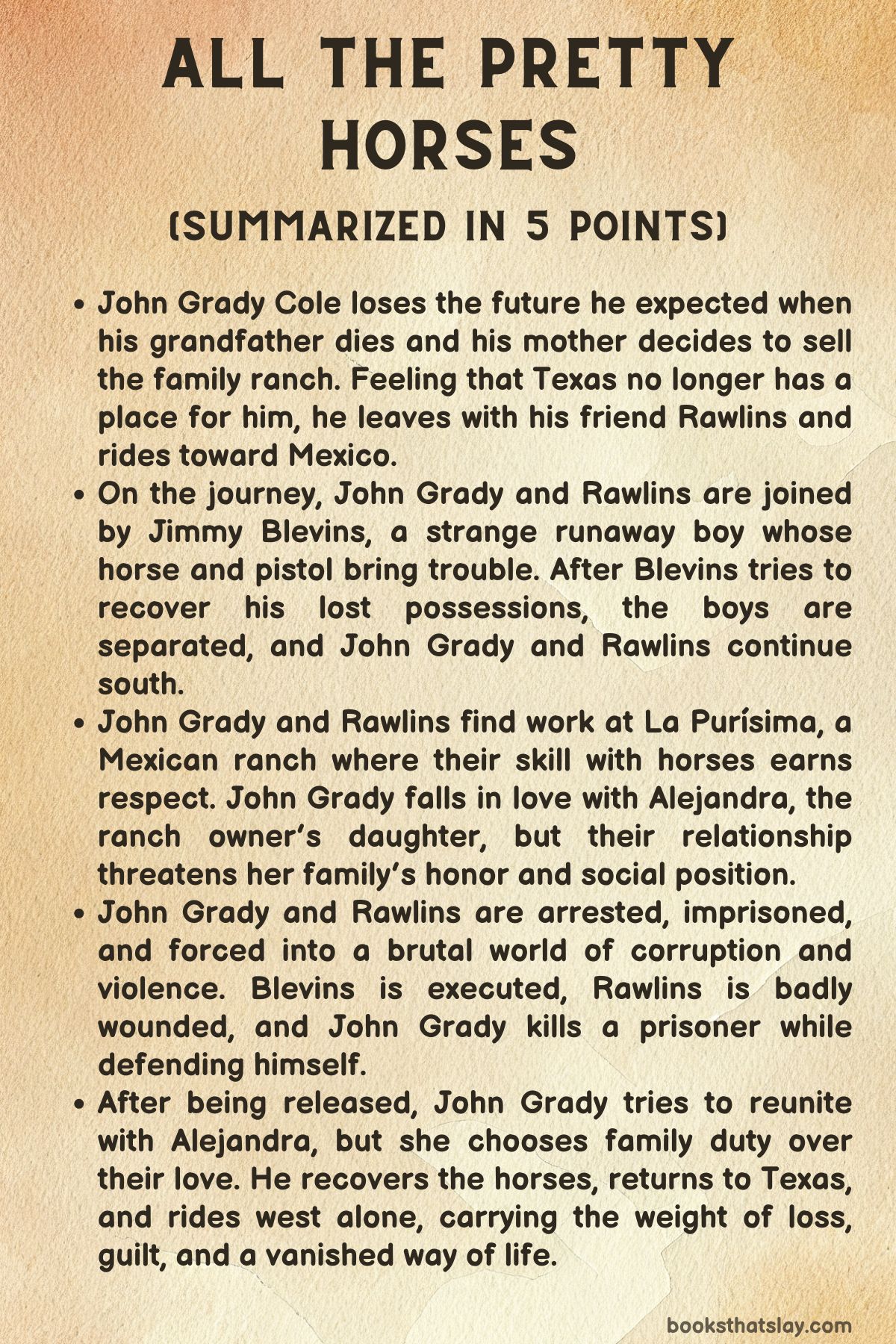
In All The Pretty Horses, John Grady Cole is a sixteen-year-old boy growing up near San Angelo, Texas, at the end of an older ranching world. His grandfather has died, and with that death the future of the family ranch is placed in the hands of his mother, who has no wish to keep it.
John Grady loves the land, the horses, and the life that has shaped him, but he has no power to preserve any of it. His mother is more interested in acting and in a life away from the ranch.
His father, a sick and damaged veteran, has little legal standing after agreeing to a divorce. The adults around John Grady seem resigned to loss, but he is not.
He tries to reason with his mother and even offers to rent the ranch from her. He speaks to the family lawyer, hoping there might be some way to stop the sale.
There is none. The ranch, the one thing that gives his life meaning, is going to be sold.
At the same time, his personal life is slipping away. His former girlfriend, Mary Catherine, has moved on.
His father, weakened by illness and old war suffering, offers him advice but cannot give him a future. John Grady sees that the life he wants no longer exists in Texas, so he turns toward Mexico, imagining that across the border there may still be room for horsemen.
John Grady leaves before dawn with his best friend, Lacey Rawlins. They ride south on horseback, joking, arguing, and testing their courage as they move into unfamiliar country.
Along the way they discover they are being followed by a strange young boy riding a fine horse. The boy calls himself Jimmy Blevins and claims to be sixteen, though John Grady and Rawlins doubt almost everything he says.
Blevins is proud, foolish, frightened, and reckless. He carries a pistol and insists the horse is his, though the others suspect it may be stolen.
Against Rawlins’s better judgment, Blevins joins them, and the three cross into Mexico.
At first, the journey has the feel of freedom. The boys sleep outside, meet rural families, drink, ride through open country, and live by their skill with horses.
But Blevins soon becomes a source of danger. During a storm, he panics because he believes lightning has cursed his family.
He runs off, loses his clothes, his pistol, and his horse. Later, when he sees his missing horse and gun in a Mexican town, he is determined to take them back.
John Grady and Rawlins try to control the situation, but Blevins acts too quickly. The attempt leads to pursuit and gunfire.
Blevins separates from them, drawing the pursuers away, and John Grady and Rawlins continue south without him.
The two older boys eventually reach a large ranch called La Purísima, owned by Don Héctor Rocha y Villareal. Their abilities with horses earn them work.
John Grady in particular impresses the vaqueros and the ranch owner. He and Rawlins break wild colts with patience, nerve, and deep understanding, turning the work into a public display that draws admiration.
Don Héctor sees John Grady’s rare knowledge and gives him a more important role overseeing a breeding project involving a valuable racehorse. For a time, John Grady seems to have found the life he wanted: work that suits him, respect from skilled men, and a place among horses.
But La Purísima also brings danger through love. John Grady meets Alejandra, Don Héctor’s beautiful daughter.
She is educated, strong-minded, and drawn to him, though their difference in class and nationality makes the relationship risky. Rawlins warns him that nothing good can come from pursuing her, but John Grady cannot stay away.
Alejandra and John Grady begin riding together at night, then become lovers. Their secret is soon known, or at least suspected, by those with power over them.
Alejandra’s grandaunt, Dueña Alfonsa, confronts John Grady indirectly through conversation and chess. She is intelligent, severe, and shaped by her own history of rebellion and loss.
She warns him that Mexico is not Texas and that a young woman’s reputation can be permanently damaged. For Alfonsa, love is not enough to overcome society, family, history, and consequence.
John Grady does not fully understand the strength of the forces against him. He believes in personal honor and direct feeling, but he is moving inside a world governed by older rules.
Soon John Grady and Rawlins are arrested by Mexican police and taken away in handcuffs. Don Héctor does not save them.
They are brought to Encantada, where they find Blevins imprisoned and badly beaten. Blevins has returned for his horse and pistol, and in the process he has killed men, including a rural policeman.
The captain in charge questions John Grady and Rawlins, trying to tie them to Blevins’s crimes. The boys deny wrongdoing, but truth has little power in this place.
They understand that the captain may intend to kill Blevins outside the law.
Their fear proves correct. On the way to Saltillo, the captain and a guard take Blevins away from the truck.
Blevins gives John Grady his money before being led into the brush. John Grady and Rawlins hear the shots that kill him.
The killing marks a turning point for John Grady. Mexico is no longer the imagined land of open possibility.
It is also a place where power can act without mercy and where innocence offers little protection.
John Grady and Rawlins are sent to prison in Saltillo, where they are not even properly listed on the roster. They are forced into a brutal struggle for survival.
Other prisoners attack them, and they learn that violence is part of the prison’s order. A powerful inmate named Emilio Pérez offers to arrange their release for a bribe, but they have no money to give him.
Rawlins is stabbed and taken away for medical treatment. John Grady is left alone, expecting an attack of his own.
He buys a knife with the last of Blevins’s money. When a young prisoner comes at him with a knife, John Grady fights for his life and kills him.
Badly wounded, John Grady is carried away and treated. During his recovery, he thinks of his father’s time as a prisoner of war and begins to understand suffering he once avoided hearing about.
Eventually he is released. Rawlins is alive, and the two are placed on a bus.
John Grady believes their freedom was bought by Dueña Alfonsa through Alejandra. Rawlins wants to go home and understands that John Grady will not.
John Grady is still tied to Alejandra and to the horses left behind. The friends part, with Rawlins returning to the United States and John Grady going back toward La Purísima.
At the ranch, John Grady learns from Dueña Alfonsa that Alejandra promised never to see him again in exchange for his release. Alfonsa explains her view of fate, history, and responsibility through stories of her youth, her connection to the Madero family, the Mexican Revolution, and the grief that shaped her.
She believes John Grady cannot give Alejandra the life she needs. John Grady argues from love and loyalty, but Alfonsa sees him as young, powerless, and unable to understand the social cost Alejandra would bear.
John Grady arranges to meet Alejandra in Zacatecas. They spend a final day and night together.
He tells her what happened, and she reveals that she confessed their affair to her father. Don Héctor had ridden out intending to kill John Grady but did not.
Alejandra loves John Grady, but she will not break her promise to Alfonsa and will not marry him. John Grady asks anyway, hoping love can overcome everything.
It cannot. Alejandra leaves by train, and John Grady is left with the knowledge that the future he imagined with her is gone.
After losing Alejandra, John Grady turns to the remaining duty he can still act on: recovering the horses. He buys a gun and returns to Encantada.
He takes the captain hostage, frees an old prisoner named Orlando, and forces the captain to help him locate the horses belonging to himself, Rawlins, and Blevins. The recovery turns violent.
John Grady is shot in the leg, but he escapes with the horses and the captain. Pursued through rough country, he uses clever tricks to mislead the riders behind him.
He later cauterizes his own wound with a heated pistol barrel and continues riding. Eventually, armed local men take the captain away, leaving John Grady alone with the horses.
John Grady crosses back into Texas. It is Thanksgiving Day when he reaches Langtry.
He spends weeks trying to find the true owner of Blevins’s horse, unwilling simply to claim it. In court, a judge believes his story and grants him ownership, but John Grady remains troubled.
He visits the judge afterward and confesses his guilt: guilt over the boy he killed in prison, over his role in the trouble at La Purísima, and over his silence when Blevins was led away to die. The judge tries to comfort him, but John Grady’s sense of moral burden remains.
He continues searching for the horse’s owner and even visits a radio preacher named Jimmy Blevins, but finds no connection. In the spring, he returns briefly to San Angelo and sees Rawlins, who tells him John Grady’s father has died.
The old life is truly gone now: the ranch is sold, his father is dead, and Abuela, the woman who helped raise him, is dying. Rawlins asks him to stay, but John Grady says the place is no longer his country.
After watching Abuela’s funeral from a distance, he rides west with the horses, moving through a changing landscape of oil pumps and fading old ways. The novel ends with John Grady still riding, carrying loss, honor, and loneliness into a world that has little room left for the life he loves.
Characters
John Grady Cole
John Grady Cole is the moral and emotional center of All The Pretty Horses. At sixteen, he is young enough to believe that courage, loyalty, and skill can make a life whole, yet old enough to feel the ruin of the world he loves.
His identity is built around horses, ranch work, open land, and an older code of honor. When his family ranch is sold, he does not merely lose property; he loses the future he had imagined for himself.
His ride into Mexico is an attempt to recover a life that Texas no longer offers him. John Grady is brave, capable, and deeply loyal, but his strength is also tied to innocence.
He believes that if a man acts with honesty and courage, the world should answer in kind. Mexico teaches him that power, class, law, and violence do not respect private codes of honor.
His love for Alejandra shows both his tenderness and his blindness. He wants love to be enough, but he cannot understand the social weight she carries.
By the end, John Grady is no longer simply a boy chasing freedom. He has killed, suffered, lost love, buried old hopes, and still tries to act rightly.
His tragedy is that he becomes honorable in a world where honor cannot protect him.
Lacey Rawlins
Lacey Rawlins is John Grady’s closest friend and his practical counterweight. He shares John Grady’s love of riding and adventure, but he is more skeptical, more cautious, and more willing to see danger before John Grady does.
Rawlins often understands the likely consequences of their choices, especially when Blevins joins them and when John Grady becomes involved with Alejandra. His warnings are not cowardice; they come from a sharper awareness of how badly things can turn.
Yet Rawlins is not merely a voice of fear. He stays with John Grady even when he believes the situation is foolish.
His loyalty is tested in the worst conditions: arrest, prison, violence, and the threat of death. Rawlins’s return to Texas marks a different response to suffering than John Grady’s.
He has seen enough and wants to survive, go home, and continue with life as best he can. His friendship with John Grady is one of the novel’s most important emotional bonds because it is built on banter, trust, irritation, and sacrifice.
Rawlins may not share John Grady’s romantic idealism, but he proves himself through endurance and loyalty.
Jimmy Blevins
Jimmy Blevins is one of the most troubling and memorable figures in the story. He is comic at first: boastful, strange, evasive, and almost absurd in his pride.
His claims about his age, his name, his shooting ability, and his horse make him seem like a boy inventing himself as he goes. Yet beneath that comic surface is fear.
Blevins is a runaway shaped by violence at home, and his pride becomes his main defense against humiliation. He cannot bear being laughed at, stripped of dignity, or separated from what he believes is his.
His pistol and horse are not just possessions; they are proof of identity. This is why he risks everything to recover them.
Blevins brings danger to John Grady and Rawlins, but he is not simply a burden. He is also a child abandoned to a harsh world.
His death is one of the story’s great moral shocks because it shows how quickly boyish recklessness can be answered by adult brutality. John Grady’s later guilt over Blevins reveals that Blevins remains a symbol of failed protection, innocence destroyed, and the cost of silence before injustice.
Alejandra Rocha y Villareal
Alejandra is the daughter of Don Héctor and the great-niece of Dueña Alfonsa, and she stands at the center of John Grady’s romantic hopes. She is beautiful, intelligent, independent, and drawn to danger in her own way.
Her rides with John Grady suggest a desire to step outside the limits placed on her by class, family, and gender. She is not passive; she chooses John Grady, seeks him out, and shares in the secrecy of their relationship.
Still, her freedom has limits that John Grady does not fully understand. For him, love is a matter of devotion and courage.
For Alejandra, love exists inside a world where a woman’s reputation can determine her future. Her decision not to marry him is painful because it is not caused by a lack of feeling.
She loves him, but she also knows the cost of defying her family completely. In All The Pretty Horses, Alejandra becomes the figure through whom John Grady learns that love can be real and still fail.
Her final choice is not weakness. It is a recognition that desire alone cannot erase social consequence.
Dueña Alfonsa
Dueña Alfonsa is one of the most powerful intellectual presences in the novel. She is stern, refined, and deeply aware of history.
At first, she appears to be an obstacle to John Grady’s happiness, a guardian of family reputation who interferes with his love for Alejandra. But her long conversations reveal a more complex person.
Her youth was marked by rebellion, political idealism, personal injury, and grief. Her association with the Madero family and her memory of revolution have taught her that ideals often lose against power, history, and violence.
Her damaged hand also shapes her understanding of how society judges women. Alfonsa knows what it means for a woman’s life to be reduced by appearance, reputation, and family control.
Because of this, she protects Alejandra in a harsh, controlling way. She does not believe John Grady is evil or worthless; she believes he is powerless to give Alejandra security.
Alfonsa’s worldview is fatalistic, but not shallow. She has suffered enough to distrust romance.
Her tragedy is that her wisdom has hardened into control, and her protection causes pain even when it is rooted in experience.
Don Héctor Rocha y Villareal
Don Héctor is a wealthy Mexican rancher whose authority rests on land, class, masculinity, and tradition. He admires John Grady’s knowledge of horses and recognizes in him a rare kind of skill.
Their early relationship is built on mutual respect. Don Héctor values competence, especially with horses, and John Grady earns his approval through work rather than words.
Yet Don Héctor’s respect has strict boundaries. Once John Grady becomes involved with Alejandra, the difference between employee and family becomes impossible to ignore.
Don Héctor may admire John Grady as a horseman, but he cannot accept him as a partner for his daughter. His failure to intervene when John Grady and Rawlins are arrested shows the cruelty behind his social power.
He does not need to dirty his own hands directly; he can allow institutions and police power to do the work. Don Héctor is not portrayed as a simple villain.
He is capable of intelligence, affection, and admiration. But when family pride and patriarchal control are threatened, his humanity narrows.
His love for Alejandra proves conditional, and that discovery wounds her deeply.
John Grady’s Father
John Grady’s father is a broken figure whose life has been marked by war, failed marriage, illness, and regret. He is dying when the story begins, and his physical decline mirrors the collapse of the world John Grady wants to inherit.
As a former prisoner of war, he carries suffering that John Grady does not fully understand until later, after his own prison experience. His conversations with John Grady are quiet but revealing.
He loved John Grady’s mother, loved horses, and once believed that shared affection for ranch life might be enough to build a marriage. He now sees that he was wrong.
His gift of the saddle is one of the few meaningful things he can offer his son: not land, not protection, not a future, but a symbol of the life John Grady still hopes to live. He urges John Grady to make peace with his mother, suggesting that he understands regret more deeply than the boy does.
His death confirms John Grady’s separation from home. By the time John Grady returns, the father is gone, and so is any remaining link to a recoverable past.
John Grady’s Mother
John Grady’s mother represents the life John Grady cannot understand and cannot forgive. She does not want the ranch, and her decision to sell it makes her seem, from John Grady’s perspective, like the person responsible for destroying his future.
Yet she is not simply careless. She wants a different life from the one expected of her.
Her interest in acting and her time away from the family suggest a woman who felt trapped by ranch life, marriage, and motherhood. John Grady sees the ranch as sacred, but she sees it as a burden or as something that no longer holds her identity.
Their conflict is not only personal; it is also a clash between two ideas of freedom. John Grady’s freedom is tied to land, horses, and tradition.
His mother’s freedom is tied to escape from those same things. She is distant and often unsympathetic, but her choices expose a hard truth: the ranching life John Grady idealizes did not mean the same thing to everyone who lived within it.
John Grady’s Grandfather
John Grady’s grandfather is dead at the beginning, but his presence shapes the entire story. He represents continuity, land, family authority, and the old ranching order.
His death sets the plot in motion because it removes the last figure who might have kept the ranch intact. For John Grady, the grandfather is connected to inheritance in the deepest sense.
He is not merely a relative but a symbol of the life John Grady believes he was born to continue. The grandfather’s refusal to believe that John Grady’s father died in the war also suggests a stubborn loyalty to family and hope.
His absence leaves a vacuum that no one else fills. John Grady’s mother does not share his values, his father lacks power, and the legal world has no place for sentiment.
The grandfather’s death therefore marks the death of John Grady’s imagined future. He becomes a memory of order, but also a reminder that even the strongest family figures cannot stop historical change.
Abuela
Abuela is a quiet but important figure in John Grady’s emotional life. She helped raise him, and her presence suggests a form of care that is steadier than what he receives from his parents.
She belongs to the domestic background of his childhood, but her importance becomes clearer near the end, when Rawlins tells John Grady she is dying. Her funeral marks another ending.
Alongside the sale of the ranch and the death of John Grady’s father, Abuela’s passing closes the last door to his childhood home. She also connects the Texas ranch world to Mexican culture in a subtle way, reminding readers that borders are more complicated than maps suggest.
John Grady’s decision to watch her funeral from a distance rather than fully rejoin the community shows how displaced he has become. He cares, but he no longer belongs.
Abuela’s death deepens the novel’s sense that home is not simply a place; it is made of people, and once those people are gone, return becomes impossible.
The Captain
The captain is one of the clearest embodiments of corrupt authority. He controls the fate of John Grady, Rawlins, and Blevins not through justice but through intimidation, manipulation, and violence.
His questioning of the boys is less an investigation than a performance of power. He has already decided what kind of people they are, and their answers matter only when they serve his purpose.
His role in Blevins’s execution shows the terrifying ease with which official power can become murder. The captain’s own story about his youth reveals a worldview based on domination and refusal to turn back once violence has begun.
He believes that a man must continue on the path he has chosen, even if that path is cruel. John Grady later takes him hostage, reversing the power between them, but the captain remains important as a moral test.
When John Grady realizes he would have killed him if the rifle had been loaded, he sees how close he himself can come to the violence he hates. The captain is not only an enemy; he is a warning.
Emilio Pérez
Emilio Pérez is a prison power broker who understands survival as a matter of influence, money, and moral flexibility. He lives apart from ordinary prisoners, which immediately marks him as someone who has learned how to make prison society work in his favor.
Pérez speaks with intelligence and cynicism. He does not believe in John Grady’s moral categories.
To him, good and evil are less important than power, negotiation, and knowing how systems actually function. His offer to help John Grady and Rawlins is not charity; it is business.
He knows Americans are vulnerable in Saltillo, and he uses that vulnerability. Pérez’s worldview challenges John Grady’s idealism in a different way from the captain’s brutality.
The captain represents open force, while Pérez represents corruption hidden inside practical wisdom. He is not sentimental and not shocked by violence.
His presence teaches John Grady that survival often depends on arrangements made in darkness, through people who do not care whether a person is innocent.
Luis
Luis, the old man who tells stories in the mountains, adds historical and philosophical depth to the ranch sections of the novel. His memories of war and revolution connect the boys’ immediate experiences to larger patterns of human conflict.
Luis has lived long enough to distrust simple explanations of men and their motives. His belief that men may not be understandable at all contrasts with John Grady’s youthful desire to read character through action, skill, and courage.
Luis represents an older form of knowledge, not formal education but experience gathered through survival and observation. His presence among the horsemen also reinforces the importance of oral storytelling in the novel.
Through him, history is not something contained in books; it lives in memory, speech, and the bodies of old men who have endured it. Luis does not change the plot directly, but he helps shape the atmosphere of a world where beauty, work, violence, and mystery exist side by side.
Antonio
Antonio is a secondary character, but he plays an important role in showing the loyalty and competence of the ranch workers. His journey to retrieve Don Héctor’s racehorse from America is difficult and humiliating, filled with harassment and imprisonment.
Through Antonio, the novel shows how border crossings are shaped by power, suspicion, and vulnerability. Unlike John Grady and Rawlins, who enter Mexico chasing freedom, Antonio travels through official systems and suffers the indignities that come with being a Mexican man moving across national lines.
His care for the horse and his return to La Purísima show endurance and duty. Later, when John Grady returns to the ranch after prison, Antonio is one of the people whose presence allows him to reenter that world briefly.
Antonio’s role is quiet, but he reflects the dignity of labor and the harsh realities faced by men who serve powerful landowners while having little power of their own.
Mary Catherine
Mary Catherine appears only briefly, but she matters because she shows John Grady’s early experience of romantic disappointment before Alejandra. Her decision to move on with an older boy who owns a car connects her to the modern world that is replacing John Grady’s horse-centered life.
She is not developed in great detail, but her presence helps establish John Grady’s emotional state before he leaves Texas. He has lost the ranch, feels distant from his mother, faces his father’s decline, and has also lost the girl he cared about.
Rawlins dismisses her, but John Grady’s response shows his romantic seriousness. He is not cynical about women or love.
This matters later because his love for Alejandra is not casual. Mary Catherine’s small role helps prepare the reader for John Grady’s pattern: he attaches meaning deeply, and when something is lost, he does not easily shrug it off.
Orlando
Orlando, the old prisoner in Encantada, represents helplessness before a legal system that does not care whether a man understands his own fate. He has been jailed for months because he cannot read the papers placed before him.
His situation is absurd and cruel, and it shows how bureaucracy can become a form of violence when it is joined with poverty and illiteracy. Orlando is not a central actor in the plot, but his presence helps John Grady and Rawlins understand the world they have entered.
In this place, innocence, age, and confusion do not protect anyone. John Grady later frees him when he takes the captain hostage, an act that reveals John Grady’s continuing need to correct wrongs where he can.
Orlando’s character also widens the moral scope of the prison and police sections. The boys are not special exceptions; they are part of a broader pattern of people trapped by systems stronger than they are.
The Judge
The judge near the end of the novel offers John Grady a rare moment of humane authority. Unlike the Mexican captain, he listens carefully and responds with sympathy.
His decision to grant John Grady ownership of Blevins’s horse is based not only on legal reasoning but also on moral recognition. He sees that John Grady has endured something severe and has tried to act honestly.
Yet his greater importance comes in the private conversation afterward. John Grady comes to him because praise does not comfort him.
He wants judgment, confession, or some way to understand his guilt. The judge does not erase that guilt, but he places it within the burden of being human.
His memory of sentencing a boy to death shows that even lawful decisions can haunt a person. The judge offers a gentler model of adulthood than most authority figures in the story.
He cannot heal John Grady, but he gives him a space where moral pain can be spoken aloud.
Themes
The End of the Old Ranching World
The world John Grady loves is already disappearing when the story begins. The sale of the family ranch is not only a private loss; it signals the decline of a way of life based on land, horses, cattle, inheritance, and physical skill.
John Grady has been raised to understand value through work, animals, weather, and open country, but the modern world measures value differently. Legal ownership, money, oil, cars, divorce, and personal ambition have replaced the older ranching order he wants to inherit.
His mother’s decision to sell the ranch makes this change immediate and irreversible. John Grady’s ride into Mexico is therefore not just an adventure.
It is an attempt to find a place where the old values still matter. For a short time at La Purísima, that hope seems possible because his skill with horses earns him respect.
Yet even there, land and horses exist under class power, family control, and political authority. By the end of All The Pretty Horses, John Grady has no true home to return to.
The country he seeks exists mostly as an ideal, and the world he rides through has already moved beyond it.
Innocence, Experience, and Moral Injury
John Grady begins with a strong belief in personal honor. He does not think of himself as naïve, because he is skilled, disciplined, and brave.
Yet his innocence lies in his belief that moral conduct can shield a person from the worst outcomes. Mexico forces him into experiences that permanently change him: Blevins’s execution, prison violence, Rawlins’s stabbing, his own killing of the prison attacker, and the failure of his love for Alejandra.
These events do not simply make him sadder or wiser. They injure his sense of himself.
He survives by doing things that trouble him afterward, especially killing the boy in prison and realizing he wanted revenge against the captain. The judge’s conversation with him near the end shows that John Grady is not trying to escape responsibility.
He wants to know what kind of man he has become. This theme is powerful because the novel does not treat experience as a simple path to maturity.
Growing up here means learning that even necessary actions can leave guilt behind. John Grady becomes more adult, but not more at peace.
Love and Social Constraint
John Grady’s relationship with Alejandra is passionate, sincere, and doomed by forces larger than personal feeling. He believes love should be judged by truthfulness and devotion.
If he loves Alejandra and she loves him, then marriage seems to him like the honest answer. But Alejandra lives in a world where class, family reputation, gender, and national identity carry enormous weight.
Her affair with John Grady threatens not only her father’s pride but also her own future. Dueña Alfonsa understands this clearly, even if her methods are severe.
She knows that men and women do not suffer consequences equally. John Grady can imagine leaving, working, riding, and starting over.
Alejandra cannot move through the world with the same freedom. Her refusal to marry him is painful because it is not a denial of love.
It is a recognition that love does not exist outside society. The novel presents romance as beautiful but insufficient.
Desire may create a private truth between two people, but public realities can still defeat it. John Grady’s heartbreak comes from learning that sincerity does not guarantee possession, rescue, or a shared future.
Fate, Choice, and Responsibility
The characters often struggle to understand whether their lives are shaped by choice, fate, history, or accident. Dueña Alfonsa’s story of the coiner suggests that what people call chance may already be determined by forces they cannot see.
Her own life has been shaped by injury, revolution, family control, and grief. She believes John Grady underestimates these forces because he is young and American, trained to think that individual will can overcome circumstance.
John Grady, however, is not simply a helpless victim. He makes choices: he leaves Texas, allows Blevins to ride with them, pursues Alejandra, returns for the horses, and confronts the captain.
Some of these choices are honorable, some reckless, and some both at once. The novel’s moral complexity comes from the fact that fate and responsibility are not opposites.
People inherit conditions they did not create, but they are still accountable for how they act within them. John Grady cannot control the sale of the ranch, Alejandra’s family, Blevins’s choices, or the corruption of the police.
Yet he must still decide what kind of man he will be when faced with loss, fear, and violence.