The School of Night Summary, Characters and Themes
The School of Night (original Norwegian title – Nattskolen) by Karl Ove Knausgaard is a dark, psychologically intense novel told by Kristian, a Norwegian photographer hiding in a house by a small harbour as he contemplates ending his life. He decides to write down what happened, day by day, as if recording evidence for himself and for whoever might later read it.
The story moves between his youth in London in the mid-1980s and his later adult life, tracing how chance encounters, artistic ambition, family fractures, and a mounting sense of menace push him toward isolation. At its core, it’s about responsibility, fear, and what grief does to a mind that can’t find a place to rest.
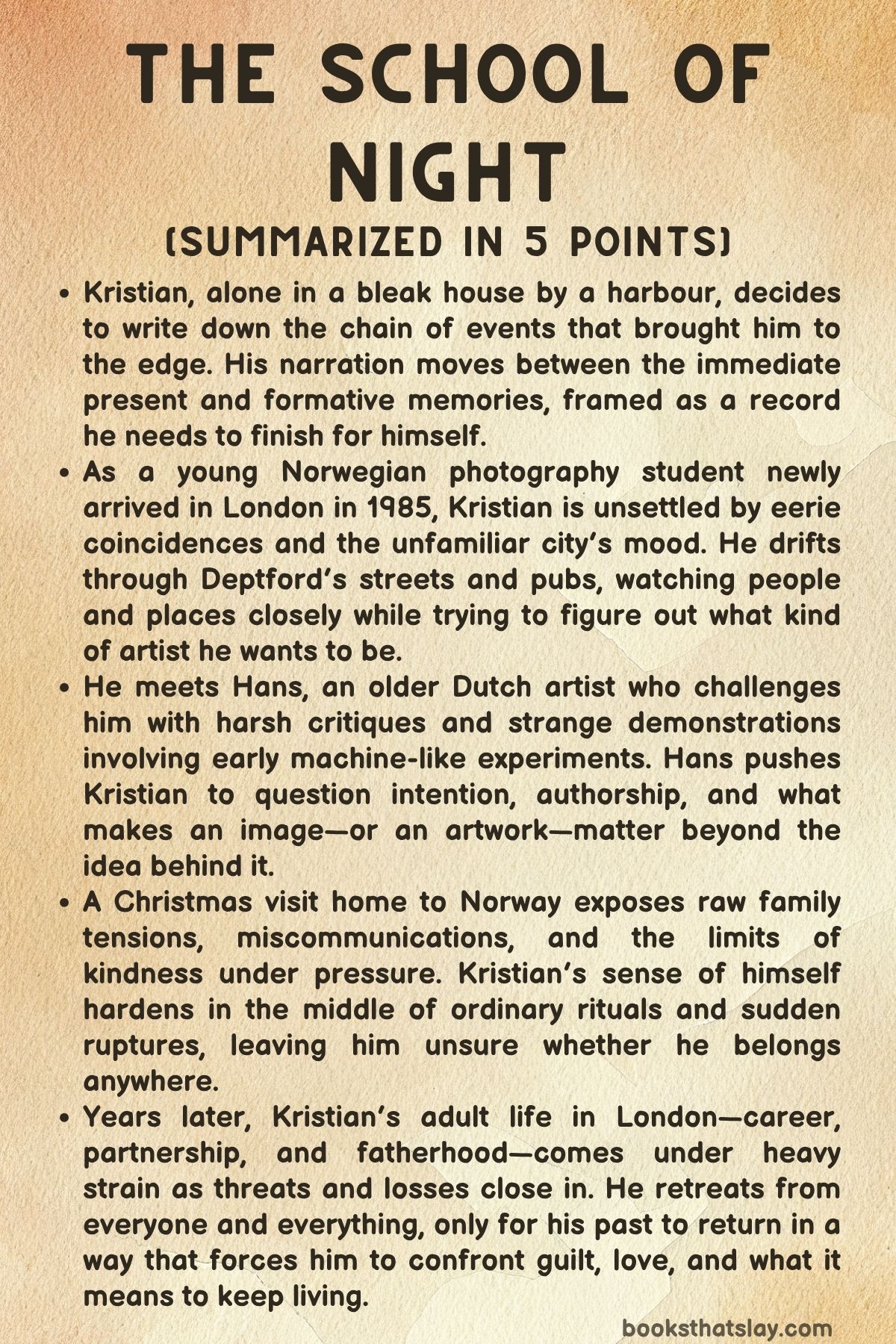
Summary
Kristian is alone in a house near a grey sea, certain he will soon kill himself. He sets up a strict routine: coffee, cigarettes, a desk by the window, and writing.
He speaks to imagined readers—people who may discover his body or recognize his story—but insists the account is primarily for him. Death feels close to him, not as an event he understands, but as a certainty that hovers just out of reach until the instant it ends everything.
He wants to reach that instant with his story complete.
He begins in August 1985, when he leaves Norway for London after unexpectedly getting a place at an art school to study photography. He arrives with little knowledge of British life and tries to educate himself through books.
While reading in Camden Town, he becomes fixated on Christopher Marlowe, partly because he learns Marlowe was killed in Deptford—the same area where Kristian has just moved. The coincidence unsettles him.
Deptford itself feels worn and neglected: old riverside industry, shabby storefronts, smoky pubs, remnants of a past that hasn’t been replaced by anything better. Kristian cycles around taking photographs, often to avoid the emptiness of his bedsit, and spends money on records at a small shop called Solid Cut.
In the pubs he begins noticing regulars and repeatedly crosses paths with Hans, a tall Dutch artist about a decade older. Hans is loud, forceful, and fascinated by systems and machines.
He approaches Kristian as if he already knows him, speaks about chance and “perfection,” and argues that human life and art are ruled by forces that can be mapped like mechanisms. He dominates conversations, pushing his theories with a confidence that makes Kristian both irritated and curious.
Hans eventually asks to see Kristian’s photographs. Kristian goes to meet him in heavy rain and is led to a hidden studio in a disused garage.
The place is cold, makeshift, and full of buckets catching leaks. Hans serves homemade vodka and studies Kristian’s work: a series of portraits made with repeated locations, poses, and clothes, changing only the face.
Hans says the idea is competent but attacks the work as lifeless, claiming it doesn’t matter on its own terms and doesn’t move anything forward. He insists that even ideas must be rooted in physical reality, then challenges photography itself as too bound to the photographer’s intention.
If intention guides everything, he implies, the image can never escape its maker’s control. He provokes Kristian with the suggestion that real interest might begin only when intention is removed.
Hans shows him what he has been making. In a back room filled with objects—mannequins, bones, shells, tools, televisions, and computers—he demonstrates a maze device with a mechanical rat that “learns” routes and triggers a bell and light at the end.
He also shows turtle-like robots that move, avoid obstacles, and respond to a torch beam. Hans treats them as evidence of something larger than art-as-expression: machines behaving, reacting, adapting.
Kristian is disturbed and unimpressed, suspecting the work is either a stunt or a childish obsession disguised as theory. Still, after he leaves, the garage stays in his mind: the damp walls, the devices, and the way Hans talked about perspective and control as if he were speaking about fate.
Kristian returns to Norway for Christmas and is struck by the stark quiet of home, which feels strangely lifeless after London. He fills his time with records and reading and meets an old friend, Vidar, who studies technology.
When Kristian describes Hans’s machines, Vidar immediately identifies them as recreations of famous early experiments—Claude Shannon’s maze and Grey Walter’s turtles. This both reassures and irritates Kristian: Hans is not unveiling a new world, only rebuilding old demonstrations and presenting them as revelation.
A brief encounter with a woman named Stina ends awkwardly and leaves Kristian ashamed of his own coldness. At home, family tensions intensify, especially around Kristian’s younger sister Liv, whose reckless behavior worries their parents.
Kristian says things about Liv that cut too deeply, and arguments linger under the surface. During the holiday, Kristian experiences a moment with his young niece that frightens him and leaves him trapped in panic and silence, unsure how to respond without being misunderstood.
He becomes restless, judgmental, and unable to feel at ease in his own family’s house.
Liv arrives late, thin and edgy, and brings tension with her. She and Kristian trade insults and accusations: he needles her about self-destruction; she attacks his pretensions and warns that his life could become a performance that exhausts him.
The family tries to continue Christmas traditions, but the mood is brittle. When it’s time for dinner, Liv cannot be woken.
Panic spreads. An ambulance is called, and it becomes clear she has overdosed.
She is carried out past the Christmas tree and the half-eaten meal. Kristian is left behind, stunned by how quickly celebration turns into emergency.
Alone, he starts photographing everything—Liv’s room, the table, the house—as if using the camera to convert chaos into evidence. His parents later confirm Liv will survive, but they attempt to act as if nothing happened.
When Kristian challenges this denial, he is shut down. He overhears his father describe him as a “black hole” and a “narcissist,” words that hit with the force of a verdict.
Before dawn, Kristian leaves without saying goodbye and returns to London.
Back in Deptford, his sense of threat grows. He has been captured in a CCTV still connected to the death of a homeless man named Ian Moore—someone Kristian recognizes as a man he had interacted with while smoking by a gate.
Kristian tells himself the encounter was minor, but the image makes him fear how easily he can be framed, identified, dragged into a narrative he cannot control. He considers going to the police, but outside the station he is diverted by Daniella, an acquaintance who seems to know too much.
Over coffee she mentions a woman named Vivian and quotes a line about the dead being beyond saving. Kristian is shaken because the same line appears on the back of a strange old photograph he has received.
Daniella claims Vivian is using the quote for a production of Doctor Faustus and says it comes from an Austrian poet and occultist, Paul Becker. The overlaps—Hans’s talk of Marlowe, Vivian’s project, the quote, the photograph—form a pattern Kristian can’t explain but can’t stop watching.
He studies his own photographs and becomes obsessed with small details, convinced he sees an extra shadowy figure in a self-portrait. At school, his work is first ridiculed as dull, then later praised as uncanny and charged, compared to Munch.
That brief lift ends abruptly when police officers enter and arrest him in front of everyone. Kristian is processed, held in a cell, and interviewed about Ian Moore’s death.
The police show him the footage: his body blocks the view at the crucial moment, and he walks away while the man slumps. They say they will charge him with manslaughter.
Terrified, Kristian calls Hans, who promises help and tells him to say nothing. After a night of spiraling fear, Kristian is suddenly released because new information clears him.
Outside, Hans is waiting, feeding pigeons, greeting him with a strange calm that suggests he has been closer to the situation than Kristian understands.
Years later, Kristian lives with Yelena and their six-year-old son Leo. Yelena celebrates finishing her thesis; Kristian tries to participate but is pulled apart by anxiety.
Leo mentions a man who stared at him on a school trip, and Kristian’s fear spikes. At the same time, Kristian’s professional life collapses: exhibitions are canceled, his major show is closed early, and colleagues abandon him.
He becomes convinced he is being targeted. He cuts ties, shuts off his phone, and retreats into isolation, letting anger replace connection.
One morning, Leo says he is going to die that day. Kristian dismisses it and takes him into central London anyway.
During the outing, Kristian sees Hans again—now dressed like a homeless man—watching him. Hans disappears before Kristian can confront him.
Kristian’s panic increases when Yelena texts that a woman named Sonja has come looking for him. While Kristian tries to manage his fear and craft a response, he makes a fatal choice at a street crossing: he rushes to a traffic island during a brief pause, and Leo runs after him.
A bus hits Leo and drags him underneath. Kristian, frantic, pulls him out despite warnings.
Paramedics arrive, but Leo dies. Yelena arrives and collapses into grief, while Kristian feels numb, as if his mind has shut down to survive the moment.
At home, their relationship fractures. Yelena demands details and blames Kristian for taking Leo into town.
Kristian can’t bear the house filled with Leo’s belongings and starts trying to clear them away, while Yelena pleads to keep everything intact. He reaches for escape in pills and fantasy, even suggesting another child, which Yelena rejects with cold finality.
Kristian then decides to disappear. He stages his own suicide by abandoning his car near Exmoor, drains hidden resources, travels quietly, and ends up under a false identity in a remote Norwegian house.
Months pass. Suspicion grows.
He believes he has only days left before he is found. Then a hydrofoil arrives, and Hans steps off.
Hans enters the house as if he owns the story, speaking to Kristian with a disturbing familiarity. He confronts Kristian’s wish to die and his obsession with Leo.
Hans brings Kristian to the bathroom mirror and forces him to look. In the reflection, the door opens and Leo appears, exactly as he was on the day he died, placing his hands on the glass.
Kristian breaks down, apologizing, desperate to reach his son, but Hans tells him Leo cannot hear. Kristian is left facing the unbearable divide between what he longs for and what the world allows, with Hans standing beside him like a guide, a witness, or something worse.
Characters
Kristian Hadeland
Kristian is the novel’s volatile center: a photographer who tries to turn experience into proof that life has meaning, then discovers that meaning is slippery, punitive, and sometimes indistinguishable from delusion. In The School of Night, he frames himself as a man already living beside his own death, beginning the book in self-imposed exile by a harbour where he expects to end his life and writes as if confession can both stabilize him and erase him.
That urge to control the narrative runs through every stage of his life: as a young art student in London he treats the city like a negative to be developed—biking, photographing, collecting coincidences—while keeping his emotional life sealed off behind technique and irony. Yet his posture of distance is constantly undermined by how permeable he actually is: Hans’s contempt gets under his skin, tutors’ criticism triggers rage and humiliation, and family conflict exposes a raw need to be seen as good, serious, exceptional.
Kristian’s moral self-image is one of the book’s pressure points: he wants to believe he’s merely observing, merely passing through, yet he repeatedly leaves damage behind—abruptly abandoning Stina, failing to respond wisely when Ane crosses a boundary, needling Liv while simultaneously craving her acknowledgment, and later making choices with Leo that he frames as ordinary but that become catastrophic. After Leo’s death, Kristian’s defining trait becomes flight: not just physical escape but a deeper refusal to inhabit the shared reality of grief, accountability, and community.
His disappearance is both punishment and performance—he stages a suicide-like vanishing to control how others will narrate him—while his inner life narrows to obsessive patterns: interpretation, paranoia, and the longing to reverse time. The final confrontation with Hans and the mirror suggests Kristian’s deepest conflict is not simply guilt but the impossible wish to convert loss into evidence that the dead can return, that meaning is more than a story he tells himself.
Hans
Hans functions as tempter, provocateur, and architect of destabilization, a figure who seems to live at the intersection of technology, metaphysics, and psychological manipulation. He enters Kristian’s life through chance encounters that feel “designed” even when they could be random, and he speaks in a way that turns ordinary reality into a system of hidden correspondences.
Early on, he humiliates Kristian’s artistic confidence by attacking intention itself, as if the moral impurity of wanting something from an image makes the image worthless. His garage—leaking, improvised, packed with machines and uncanny objects—operates like an externalization of his mind: cluttered with experiments that imitate life while remaining stubbornly artificial.
The rats and turtles are important less as inventions than as demonstrations of his worldview: that behavior can be engineered, that learning can be simulated, that “life” might be reducible to feedback loops—and that humans, too, can be steered. Hans’s power is partly rhetorical: he overwhelms conversations, sets the terms, and makes Kristian feel behind, naive, and defenseless.
But his power is also narrative: he reappears at pivotal moments, sometimes as helper, sometimes as threat, always as if he has been watching. Whether he is genuinely orchestrating events or simply exploiting Kristian’s suggestibility, Hans becomes the face of Kristian’s fear that the world contains a hidden logic that wants something from him.
By the end, Hans almost resembles a psychopomp—someone who escorts Kristian to the border between life and death, truth and hallucination—yet he is coldly unsentimental. He offers a vision of Leo while insisting it changes nothing: the child cannot hear, cannot return, cannot redeem the father.
Hans’s final role is brutally clarifying—he gives Kristian the one thing Kristian craves, a glimpse, but in a form that forces Kristian to confront the permanence of loss and the futility of bargaining with reality.
Yelena
Yelena is the novel’s counterweight to Kristian’s self-mythologizing: a person rooted in work, household life, and the ordinary structures that Kristian both depends on and resents. Her thesis celebration establishes her as someone capable of completion and stability—she finishes, submits, marks the moment—while Kristian is already slipping into grievance and suspicion as his professional world collapses.
She is not naïve about him; she seems to know his darker currents and still tries to build a livable life around them, which makes her grief later feel especially devastating because it is also the collapse of an attempted order. After Leo’s death, Yelena’s mourning is embodied, detailed, demanding: she needs the timeline, the facts, the sensory truth of Leo’s last day, not because she enjoys cruelty but because grief searches for causality like a starving animal.
Her anger toward Kristian reads as both accusation and desperate bargaining—if blame can be assigned, then chaos might be constrained. In conflict with Kristian’s impulse to erase and flee, Yelena insists on continuity: keeping Leo’s room intact, preserving objects, holding on to the physical traces that Kristian experiences as unbearable.
Her refusal to have another child with Kristian is not just rejection but a verdict on trust: in her eyes, he is no longer a safe partner in the most vulnerable project imaginable. Yelena’s presence ultimately exposes Kristian’s central weakness—his tendency to retreat into self-protective abstraction when confronted with emotional reality—and the tragedy is that her demand for groundedness is exactly what Kristian cannot sustain.
Leo
Leo is both a fully felt child and the moral axis around which the later narrative turns, because his innocence makes every adult choice around him radiate consequence. He appears in domestic scenes that emphasize ordinary warmth—favorite books, school stories, excitement about travel—yet even early on there is an intrusion of menace in his account of the staring man at St Paul’s Cathedral.
Leo’s sudden statement “I’m going to die today” is crucial not as prophecy but as a child’s raw apprehension, which Kristian treats as inconvenience and anxiety to be managed rather than a truth to be honored. That misreading becomes one of the book’s most painful examinations of adult authority: Kristian’s desire to keep the outing normal and to control what gets said to Yelena ends up isolating Leo at the exact moment he is afraid.
After the accident, Leo becomes simultaneously absent and omnipresent—the house is saturated with his things, his routines, his room—and the parents’ competing responses reveal their psychology. For Yelena, Leo’s objects are a sanctuary; for Kristian, they are an accusation.
In the final mirror scene, Leo returns as image and ache: not a speaking character but a visitation that concentrates everything Kristian has refused to accept. Leo’s silence behind the glass is the cruelest truth the novel offers—love remains, longing remains, but the dead do not rejoin the conversation.
Emil
Emil is less a conventional character than a hinge in Kristian’s framing device: the owner of the harbour house and one of the imagined readers Kristian addresses when he begins writing. Emil’s significance lies in what he represents to Kristian—an external witness who could turn Kristian’s disappearance into a comprehensible story, an anchor to social reality even as Kristian isolates himself from it.
By invoking Emil, Kristian reveals that his “writing for himself” is not purely private; he cannot help staging an audience, which suggests that even his planned death is partly communicative, a final statement meant to be found and interpreted.
Vidar
Vidar appears briefly but sharply as a voice of demystification and grounded knowledge, the friend who punctures Hans’s aura by identifying the “Rat Run” and the turtles as recreations of earlier experiments. In doing so, Vidar offers Kristian an escape hatch from paranoia: what feels uncanny can be historical, what feels like occult genius can be imitation.
Yet Vidar’s role is also ironic, because giving Kristian the rational explanation doesn’t free him from Hans; it simply relocates the unease. Hans is not frightening because the machines are new—he is frightening because he uses ideas, tone, and presence to infect Kristian’s sense of reality.
Vidar underscores a theme that repeats throughout The School of Night: explanation and relief are not the same thing.
Stina
Stina embodies directness, need, and wounded dignity, and her brief relationship with Kristian becomes an early rehearsal of his pattern of intimacy and retreat. She approaches him with unmistakable desire and openness—she is a nurse, a mother, a person with a life that is practical and emotionally legible—while Kristian responds with fascination that quickly flips into disgust and panic when confronted with the social reality around her: the cold flat, the mother babysitting, the sense of a future implied by her eagerness.
His abrupt exit is not just cruelty; it reveals how threatened he is by being needed, and how quickly his aesthetic self-concept collapses into flight when intimacy demands responsibility. Her later confrontation in the shopping centre—accusing him of having “no heart”—lands because it names what Kristian most fears about himself: that his detachment is not refinement but emptiness.
Stina’s role matters because she refuses to let him leave without a verdict; she marks him, and that mark lingers through his later self-judgments.
Einar
Einar, Stina’s young son, is mostly peripheral, but his presence is symbolically heavy because he represents the domestic world Kristian cannot enter without becoming accountable. Einar is the quiet proof that Stina’s life is not an aesthetic flirtation but a network of dependence and care, and Kristian’s recoil at her home is also, implicitly, a recoil from the child-shaped obligations that later return with far greater force through Leo.
Kristian’s mother
Kristian’s mother is presented as warmth, hospitality, and moral sensitivity, someone who maintains family rituals and tries to hold her children inside a single circle of love even when that circle is strained. Her outrage at Kristian calling Liv “empty” is not mere defensiveness; it reflects a belief that words can injure the core of a person, especially when spoken by family.
She appears to practice a kind of unconditionality—refusing to take sides against any child—which Kristian experiences as both comfort and suffocation because it denies him the clean moral hierarchy he wants. During Liv’s overdose, her grief is immediate and bodily, and her later avoidance of discussing what happened reads as a survival strategy: to keep the family functioning, to keep terror from becoming the household’s permanent atmosphere.
Kristian’s conflict with her exposes how much he still wants maternal approval, and how violently he reacts when he feels it slipping.
Kristian’s father
Kristian’s father is restraint and authority, a man who answers crisis with control and who treats emotional exposure as something dangerous. He continues eating during the dinner conflict, a small but telling detail that suggests a rigid commitment to order even as the family fractures.
After Liv’s overdose, his insistence on minimizing the event is consistent with a worldview in which naming chaos gives it power. His most defining moment is the overheard condemnation of Kristian as a “black hole” and a “narcissist,” which functions like a curse because it comes from the one person whose judgment Kristian cannot dismiss as easily as Hans’s or the tutors’.
That assessment also reveals a father who sees Kristian’s inner drama as a gravitational force that drains everyone around him. Whether the father is entirely fair is less important than the fact that he becomes, for Kristian, the voice of final rejection—pushing him into the flight that shapes the rest of his life.
Liv
Liv is Kristian’s younger sister and his most intimate mirror, because she embodies the chaos and recklessness he fears in himself while also voicing truths he cannot bear. She arrives late, thin, barbed, and elusive, surrounded by hints of men, substances, and concealed histories that the parents refuse to name.
Liv’s dynamic with Kristian is a duel of contempt and longing: they insult each other with the familiarity of people who know exactly where the wounds are, and beneath that cruelty is an old desire for connection that neither of them can express safely. When she dismisses Kristian’s photographs as unoriginal and calls out his performative striving, she articulates a central critique of him: that his identity depends on acting “bigger” than he is, turning life into a stage on which he can avoid being ordinary.
Kristian’s counterattack—calling her a failure—exposes his desperation to separate himself from her reputation and her risk. Liv’s overdose becomes the family’s unspoken trauma, and her near-death crystallizes Kristian’s sense that the family is built on denial.
In that sense Liv is not just a troubled sibling; she is the living evidence that the household’s stability is fragile, maintained by silence, and that love can coexist with avoidance so extreme it becomes dangerous.
Helene
Helene, Kristian’s older sister, moves through the family scenes as a pragmatic enforcer of roles: she arrives with a child, expects Christmas to function, and pushes Kristian into performing as an uncle when he resists. She represents adulthood as duty and choreography—presents, costumes, keeping the child believing—yet she is also quick to act decisively when crisis erupts.
Her immediate decision to leave with Ane when Liv overdoses shows protective intelligence: she understands that a child’s memory of Christmas can become a lifelong wound. Helene’s presence highlights Kristian’s immaturity in social situations; where he sulks and judges, she manages, contains, and chooses what must be done.
Ane
Ane is depicted as a child craving attention and contact, and her boundary-crossing moment with Kristian is one of the book’s most unsettling instances of how innocence and sexuality can collide without comprehension. The scene is crucial because it traps Kristian in a uniquely modern fear: he experiences panic not only about what happened but about how any attempt to report it could implicate him, revealing his acute awareness of suspicion and narrative distortion.
Ane’s later belief-question about Father Christmas and her distress during the family’s sudden departure connect her to the theme of childhood trust being shattered by adult realities. She is not portrayed as malicious; she is portrayed as curious, unguarded, and living inside a world where adults’ private catastrophes leak into the child’s space without explanation.
Rickard
Rickard, Helene’s husband, remains largely in the background, but his role is structural: he is part of the stable family unit that can leave, pack, and protect Ane when things become dangerous. He also represents the adult male presence Kristian is contrasted against—not because Rickard is idealized, but because he belongs to the ordinary social fabric Kristian repeatedly fails to inhabit.
Andreas
Andreas, Kristian’s cousin, appears as part of the arriving relatives and serves to thicken the sense of family ritual and social expectation. His presence emphasizes Kristian’s alienation at gatherings: Kristian interprets small talk and shared tradition as suffocating, which reveals how disconnected he is from communal life even when it is benign.
Vilde
Vilde, Andreas’s wife, similarly functions as a figure of ordinary familial continuity—arriving, participating, bringing their baby—highlighting the contrast between lives that proceed through stable milestones and Kristian’s life, which oscillates between grand aspiration and implosion.
Kari
Kari, the baby daughter of Andreas and Vilde, is a quiet symbol of generational continuation and future, which stands in sharp counterpoint to the later loss of Leo and to Kristian’s growing obsession with death. Even her small presence intensifies the tragedy by reminding the reader how fragile and contingent a child’s existence is.
Rafael Figueroa
Rafael Figueroa, the guest lecturer, embodies institutional judgment and the art world’s language of rigor that Kristian experiences as violence. His critique of Kristian’s work as dull and unfascinating triggers Kristian’s defensive anger and exposes how dependent Kristian is on external validation even as he claims contempt for it.
Rafael’s function is to show that Kristian’s artistic identity is not rooted in a secure inner practice; it is reactive, easily wounded, and prone to interpret critique as humiliation rather than instruction.
George
George is a contrasting authority figure who unexpectedly grants Kristian the recognition he craves by linking his self-portrait to Munch and describing it as extraordinary with an unsettling dimension. That praise acts like a drug: it restores Kristian’s grandiosity at the exact moment his life is about to collapse into police intervention.
George’s role shows how unstable Kristian’s self-perception is, and how quickly it swings based on the gaze of others. He also reinforces the novel’s recurring blur between aesthetic unease and “occult” framing, whether that framing is justified or simply another narrative Kristian clings to.
Daniella
Daniella operates as a social bridge and a catalyst for paranoia, appearing at the moment Kristian is poised to confess to the police and diverting him with friendliness, coffee, and seemingly casual knowledge about his life. Her ease—calling him by name, mentioning Vivian, quoting the Becker line—feels to Kristian like surveillance masquerading as charm.
Whether she is knowingly part of a wider pattern or simply a conversational, connected person, her effect is the same: she blocks Kristian’s attempt at moral clarity and nudges him deeper into secrecy. Daniella’s gentle admonition to be good to Vivian also sharpens the sense that Kristian is being evaluated by a network he doesn’t understand, intensifying his fear that private guilt will become public story.
Vivian
Vivian is a largely offstage presence who nonetheless shapes Kristian’s sense of being pulled into a script. Her note asking to see him again suggests desire or professional interest, but the association with Doctor Faustus, the repeated Becker quote, and Kristian’s suspicion about the Daguerre photograph make her feel like part of an occult-tinged constellation around Hans.
Vivian’s character function lies in ambiguity: she represents how easily Kristian’s mind transforms ordinary artistic collaboration into conspiracy when he is primed by guilt and coincidence. At the same time, the warmth others attribute to her implies she might be genuine, which makes Kristian’s fear look less like insight and more like projection.
Liz
Liz, Kristian’s downstairs neighbour, appears as a practical helper—someone with reference books and a door Kristian can knock on when his anxiety turns intellectual. She represents a small form of community that Kristian uses instrumentally: he doesn’t seek comfort so much as information.
Her role underscores Kristian’s coping style: when frightened, he researches, categorizes, and tries to convert dread into facts, as if knowledge could ward off fate.
Jacob
Jacob is the messenger of professional collapse, the person whose email informs Kristian that MoMA is closing his exhibition early. He functions as a conduit for institutional power and abandonment, and Kristian’s furious reply to him reveals how Kristian experiences professional setbacks not as market decisions but as persecution.
Jacob’s presence also highlights Kristian’s fragility: a single email can tip him into weeks of isolation, scorched-earth decisions, and self-destruction disguised as principled withdrawal.
Mette
Mette, Kristian’s longtime colleague who quits abruptly by email, embodies the erosion of loyalty and the thinning of Kristian’s support system. Her exit feels to Kristian like betrayal, but it also suggests something about him that others can no longer tolerate or manage.
Mette’s role is to show that Kristian’s collapse is not only external misfortune; relationships around him are breaking, perhaps because of his volatility, perhaps because of forces he imagines, but either way leaving him increasingly alone with his interpretations.
Ian Moore
Ian Moore, the homeless man whose death becomes the center of the police investigation, is both a person and a moral abyss in Kristian’s story. In life, he is presented through Kristian’s limited attention—someone asking for cigarettes and a light—yet after death he becomes an image, a still frame, a story contested by police footage and Kristian’s own anxious revision.
His function is to confront Kristian with the limits of self-narration: what Kristian insists happened is less important than what the camera shows and what the law can argue. Ian’s death also intensifies Kristian’s obsession with intention—did he mean harm, did he cause harm, can meaning be separated from consequence—and it foreshadows the later tragedy with Leo, where Kristian again insists on the ordinary nature of his choices until reality proves otherwise.
Detective Chief Inspector Dunne
Dunne represents the state as interpretive machine: calm, procedural, and relentless, reducing Kristian’s complex inner explanations to evidence, timelines, and charges. He functions as an antagonist not because he is cruel but because he embodies a reality Kristian cannot talk his way out of.
Dunne’s certainty forces Kristian to confront how vulnerable he is to other people’s narratives, and how quickly his life can be redefined by an official story.
Detective Sergeant Witt
Witt operates as part of the same institutional presence as Dunne, reinforcing the sense of being watched, processed, and translated into a suspect. His role is to intensify the pressure-cooker atmosphere of interrogation, making Kristian feel that every gesture and phrase can be turned into proof.
Mr Hughes
Mr Hughes, the elderly duty solicitor, symbolizes the gap between the help Kristian imagines he deserves and the help he actually receives. Kristian expects Hans to deliver a powerful lawyer, a kind of rescue befitting the drama unfolding in his mind, but instead he gets an ordinary, tired representation of legal reality.
Mr Hughes’s presence strips some of the romance from Kristian’s crisis and exposes how alone he really is when the situation becomes concrete.
Sonja
Sonja appears briefly yet explosively as a name that triggers panic, arriving at Kristian’s house asking for him and threatening to return. Her function is to suggest that Kristian’s past has not stayed buried and that his carefully constructed present can be breached at any moment.
Whether she is connected to the earlier London events, to Hans, or to Kristian’s disappearance, the key point is her effect: she pushes Kristian into distraction at the precise moment he must protect Leo, making her a narrative spark that ignites catastrophe.
Are
Are is the man who drops Liv off in the early morning, a shadowy figure whose brief appearance carries the weight of the life Liv has been living offstage. His presence, and the parents’ quick, silent exchange when his name comes up, hints at known danger and longstanding secrecy.
Are functions less as an individual portrait and more as a sign that Liv’s world includes people and situations the family fears naming aloud.
Nicolai
Nicolai is another offstage figure from Liv’s life, mentioned as someone she was in London with, and his significance lies in how he destabilizes the parents’ sense of what they know. Like Are, Nicolai signals that Liv’s story extends beyond the family’s protective narrative and that the boundaries between Kristian’s London life and Liv’s risky orbit may be closer than anyone admits.
Einar (the harbour-house owner’s son, implied)
The neighbour’s warning that the owner’s son is coming functions as a ticking clock rather than a developed personality, but it matters because it collapses Kristian’s last refuge. Kristian’s hiding place depends on remaining unseen and unaccounted for, and the approaching arrival of someone with rightful access to the house forces Kristian back toward decision—toward either confession, disappearance, or death—intensifying the endgame in which Hans returns to confront him.
Themes
Grief as a force that reshapes identity
Kristian’s voice begins from a place where life has narrowed to a single point: he is alone by the harbour, persuaded that the end is close, and writing as if language is the last remaining structure he can trust. That decision to narrate “what happened” is not simply a record; it is a way of finding a self that still makes sense after everything has been damaged.
The death of Leo does not arrive as a dramatic twist so much as the moment that turns the ordinary world into a hostile environment. Before the accident, Kristian can still live inside arguments about art, reputation, and professional recognition.
After it, every object becomes evidence of absence, and the home becomes an exhibit of loss that he cannot endure. His impulse to bag up Leo’s belongings reads as an attempt to control the uncontrollable: if the physical traces are removed, perhaps the mind can stop returning to the same unbearable scene.
Yelena’s insistence on keeping the room intact is the opposite strategy—holding on to the material world because memory alone feels too fragile. Their clash shows grief not as a shared emotion that naturally unites people, but as a force that can split them into incompatible needs.
Kristian’s numbness is also significant; it is not a lack of feeling but a kind of emergency state, the mind’s way of avoiding collapse. In that state, he reaches for “solutions” that resemble escape routes—sleeping pills, fantasies of another child, then the staged disappearance.
None of these is a true answer; they are ways of stepping out of a reality that keeps presenting the same fact: Leo is gone and nothing can reverse it. By the time Kristian hides on the Norwegian island under a false identity, grief has moved beyond sorrow into identity erasure.
He is no longer trying to live with what happened; he is trying to live without being the person to whom it happened. That is why the ending encounter with Leo behind the mirror matters: it confronts Kristian with the desire underneath the flight—not only to avoid pain, but to undo guilt, to speak to the dead as if apology could change time.
The School of Night treats grief as something that reorganizes perception, relationships, and selfhood, pushing Kristian toward actions that look irrational from the outside but feel, to him, like the only remaining forms of movement.
Intention, art, and the anxiety of meaning
Kristian arrives in London believing that photography can be shaped through will: choose a subject, impose a concept, construct a series, and meaning will follow. Hans’s critique hits him because it attacks that faith at its core.
When Hans dismisses Kristian’s work as idea-driven and accuses it of lacking value in the images themselves, the insult is not just aesthetic; it suggests Kristian is hiding behind a plan because he cannot face what the camera actually captures. Hans pushes an argument about grounding—about the physical world being more real than the artist’s explanation—and challenges Kristian to imagine removing intention from images.
That provocation plants a lasting unease. Kristian wants to reject Hans as a crank, yet he can’t stop replaying the garage, the machines, the talk of perspective, and the implied accusation that Kristian’s art is too controlled to be alive.
This anxiety returns in the school critique, where Kristian’s Vertigo series is judged dull and unfascinating. What stings is that the criticism echoes Hans’s earlier point: the work might be formally coherent, but coherence is not the same as presence.
Kristian argues back because he hears the threat behind the feedback—if the work fails, then the self he built around the work fails too. Later, a different lecturer unexpectedly praises Kristian’s self-portrait as extraordinary, even “occult” in its effect.
The shift is destabilizing because it suggests meaning can appear where Kristian did not deliberately place it. The camera records more than intention; it records accidents, shadows, background figures, the emotional temperature of a moment.
Kristian’s own suspicion that he can see a second figure in his photograph captures the same fear in a private form: the image might contain something he did not choose, something that looks back at him. In the novel, art is repeatedly tied to power and vulnerability.
Kristian wants control—over interpretation, career, reputation—but the narrative keeps presenting situations where control is an illusion. Even his professional collapse later, with exhibitions canceled and institutional decisions shutting him out, shows how fragile the artist’s sense of agency can be when meaning is assigned by others.
Kristian’s rage at MoMA, his legal threats, and his decision to withdraw from the art world are not only about injustice; they are defenses against the feeling of being interpreted and discarded. The story keeps asking what makes an image matter: the artist’s plan, the viewer’s response, the machine’s recording, or the hidden context that leaks into the frame.
Kristian’s life suggests that meaning is not something he owns. It is something that happens to him—sometimes as recognition, sometimes as exposure, sometimes as a burden he cannot carry.
Chance, pattern-seeking, and the fear of being watched
From the early coincidence of seeing “Marlowe” on a lorry and learning about Marlowe’s death in the district Kristian has just entered, the narrative establishes a mind that cannot leave coincidences alone. Kristian registers these moments as unsettling signals rather than neutral events.
Hans intensifies this tendency by talking constantly about chance and systems, and by surrounding himself with objects that feel like props from a private logic: labyrinths, robots, mirrors, skulls, old technology. Kristian wants to believe these are only eccentric interests, but he keeps noticing repetitions that feel aimed at him—names, quotes, encounters that happen at just the wrong time.
The line Daniella repeats, which matches the words on the back of the Daguerreotype, is the kind of detail that pushes Kristian from normal suspicion into a more consuming paranoia. The specific content matters less than the structure: an external world that keeps sending the same message, as if someone is arranging events to trap him inside a story he did not consent to.
Even when Kristian tries to verify a claim—like Hans’s “Devil” in the early photograph—he finds an ordinary explanation. Yet the relief does not last, because the deeper fear is not about one image being misread; it’s about the possibility that perception itself is unreliable.
This dread becomes concrete when Kristian learns Hans recognized him from a CCTV image, and Kristian realizes his own movements can be recorded, circulated, and used to identify him. The police sequence sharpens the theme: a single piece of footage can transform a mundane encounter into a life-threatening accusation.
Kristian’s panic outside the station—wanting to confess, then freezing—shows how the fear of being seen can become stronger than the desire to do the right thing. When he is arrested in front of classmates, his humiliation is not only social; it confirms that the private self is vulnerable to public framing.
Even after he is released, the fact that “new information” suddenly clears him leaves a residue of dread, because he never fully understands what changed or who influenced it. In adulthood, the sense of pursuit returns through Leo’s story of the staring man at St Paul’s and the later appearance of Hans disguised like a homeless person.
These details matter because they suggest Kristian’s life is haunted not only by internal guilt but by external observers—figures who may be real, imagined, or both, yet who shape his choices. The novel shows how pattern-seeking can be a coping mechanism and a trap: it promises explanation when life feels chaotic, but it can also turn the world into a threatening code.
Kristian’s final flight to the Norwegian island is not just grief-driven; it is also a retreat from surveillance, reputation, institutions, and the accumulating sense that he is being tracked by meanings he cannot control.
Family intimacy, moral injury, and the limits of empathy
Kristian’s family scenes are charged not because the family is monstrous, but because everyday closeness becomes the setting for moral shocks that Kristian cannot process cleanly. He returns to Norway and immediately experiences home as both comforting and suffocating: warmth at the airport, familiar rituals, coffee and cake, then a growing irritation at how small and fixed everything feels.
This ambivalence sets the stage for conflicts where Kristian’s words land like blows. His comment that Liv is “empty” is framed as an interpretation, but his mother hears it as cruelty—an attack on her child and therefore on her love.
The argument reveals Kristian’s habit of translating people into judgments, as if naming a flaw might grant him distance from it. The family’s response exposes the cost: intimacy collapses when one person insists on analysis while the others need loyalty.
Liv’s overdose intensifies this dynamic. The parents’ refusal to discuss it afterward is not simply denial; it is a survival strategy built out of fear, shame, and helplessness.
Kristian can’t accept silence, partly because he wants truth, but also because silence keeps him trapped in his own interpretations. When his father later calls him a “black hole” and a “narcissist,” the insult functions as a final verdict: Kristian doesn’t just cause conflict, he drains others by making everything orbit his perspective.
Kristian’s reaction—packing and leaving before dawn—shows how he handles moral injury: not by repair, but by exit. Earlier, the incident with his niece Ane is another kind of moral rupture.
The child’s sexual gesture is confusing and frightening, and Kristian’s panic includes a bleak calculation about suspicion—he believes that reporting it could make him look guilty. That moment reveals a deep anxiety about innocence and accusation, but it also shows how isolated Kristian is inside his own fear.
He does not seek help; he tries to contain the event alone, which makes it more contaminating. His encounter with Stina repeats the pattern: her accusation that he has “no heart” is humiliating, yet it also points to a real limitation in him—his tendency to withdraw when confronted with another person’s vulnerability.
Kristian’s family life later with Yelena and Leo brings these traits into sharper relief. The day Leo dies is full of ordinary choices, and Kristian’s later guilt is intensified by how preventable it seems in retrospect.
Yelena’s demand for details and her blame are brutal, but they also reflect the desperate need to locate causality in a catastrophe. Kristian’s proposal to have another child reads less like hope than like a shortcut around mourning, and Yelena’s refusal is a refusal of that erasure.
In the story, empathy is not presented as a stable virtue; it is shown as a capacity under pressure, easily replaced by judgment, avoidance, or control. Kristian is not simply “bad” at love—he is repeatedly confronted with situations where love requires staying present in discomfort, and his instinct is to flee.
The family becomes the arena where this failure is most painful, because the people involved are not distant strangers; they are the ones whose suffering cannot be ignored without consequences.