An Anonymous Girl Summary, Characters and Themes
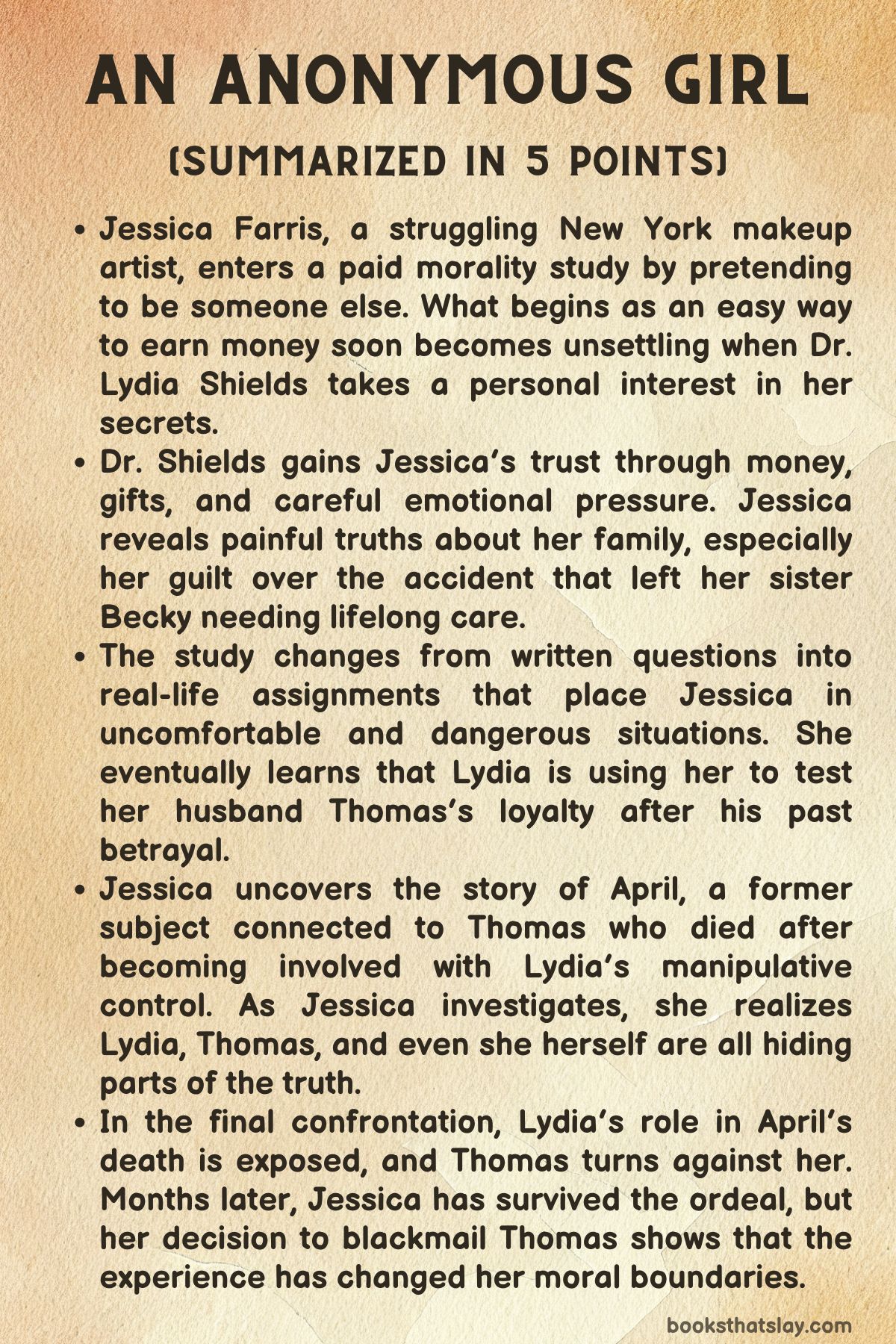
An Anonymous Girl by Sarah Pekkanen and Greer Hendricks is a psychological thriller about Jessica Farris, a struggling New York makeup artist who enters a paid morality study under false pretenses. What begins as a simple way to earn money soon becomes a dangerous relationship with Dr. Lydia Shields, a brilliant and controlling psychiatrist with hidden motives.
The novel examines guilt, truth, manipulation, and the price of secrecy through a tense power struggle between two women. Jessica’s need for money and absolution makes her vulnerable, while Dr. Shields’s obsession with betrayal turns the study into something deeply personal.
Summary
Jessica Farris is a 28-year-old makeup artist living in New York, trying to support herself while quietly helping pay for her younger sister Becky’s medical care. Becky suffered a brain injury as a child, and Jessica carries lasting guilt because the accident happened while she was supposed to be watching her.
Though Jessica loves her family, she keeps emotional distance from them because their pain and need overwhelm her. Money is always tight, and this pressure shapes many of her choices.
While working for two college girls, Jessica overhears that one of them is supposed to attend a paid psychological study on morality and ethics. The girl plans to skip it, so Jessica decides to take her place.
She lies her way into the study and becomes Subject 52. At first, the study seems simple: Jessica answers personal questions on a computer while an unseen researcher, Dr. Lydia Shields, observes her responses.
Jessica is asked about lying, cheating, guilt, and moral choices. The questions unsettle her, but she also feels strangely relieved by the chance to confess things she has never said aloud.
Dr. Shields quickly becomes interested in Jessica. Jessica’s answers reveal a woman driven by guilt, financial need, and loneliness.
She admits that she lies in small ways for work, gets involved with unavailable men, hides financial help from her parents, and avoids facing the truth about Becky’s accident. Dr. Shields sees Jessica as more than just another subject.
She believes Jessica can be useful.
The study soon changes from written questions to real-life assignments. Dr. Shields meets Jessica in person, gives her expensive gifts, pays her generously, and creates an atmosphere of trust.
Jessica, who is short on money and emotionally vulnerable, begins to depend on the attention and approval. Dr. Shields claims the study is evolving into a deeper exploration of morality, but her real purpose is private.
She wants to test her estranged husband, Thomas, whom she suspects of cheating again.
Dr. Shields sends Jessica into situations designed to measure temptation and loyalty. Jessica is asked to dress elegantly, go to a hotel bar, and flirt with a married man.
The man rejects her, proving to Dr. Shields that not all men betray their wives when offered the chance. This forces Lydia to reconsider Thomas’s earlier affair as a choice rather than an unavoidable weakness.
For Jessica, the assignment is humiliating and painful, especially when the man’s behavior reminds her of a past workplace violation by a theater boss named Gene.
Jessica tries to build a normal life outside the study. She reconnects with Noah, a kind man she met earlier, and begins to feel hopeful around him.
Yet Dr. Shields keeps pulling her back in, using money, emotional insight, and promises of help for Jessica’s family. When Jessica’s father loses work, Dr. Shields offers to use her father’s connections to help him.
This makes Jessica even more trapped, because Lydia now appears to be solving problems Jessica cannot solve alone.
The assignments become stranger and more invasive. Dr. Shields asks Jessica to make calls to women from Thomas’s phone records under the pretense of offering free makeup services.
Jessica is sent into uncomfortable and even unsafe encounters, including one with a troubled woman and an aggressive boyfriend. When Jessica realizes Dr. Shields abandoned the call during that frightening visit, she begins to doubt Lydia’s concern for her safety.
Jessica’s confusion grows when she meets Thomas by accident before Dr. Shields’s planned setup. Thomas warns her that Lydia is dangerous.
Jessica does not know whom to trust. Dr. Shields has lied about the study, about her marriage, and about her motives, but Thomas also seems evasive.
Jessica learns that the official study ended earlier, even though Lydia has continued to control her under its name.
Thomas tells Jessica about another former subject, April, who died by suicide after becoming involved with Dr. Shields. Jessica discovers that April received gifts and attention from Lydia in a pattern that resembles Jessica’s own experience.
April had also been connected to Thomas. Jessica begins to fear that she is being drawn into the same destructive pattern.
As Jessica investigates, she breaks into Dr. Shields’s home with Thomas’s help and photographs her own file and April’s file. Her file contains notes, online photos of her family, records of the original study, and chilling signs of Lydia’s possessiveness.
April’s file suggests that April had met Thomas before she became part of Lydia’s study. Jessica realizes that both Thomas and Lydia have hidden important parts of the truth.
Jessica visits April’s mother while pretending to be a friend from college. April’s mother says April had struggled emotionally but had not seemed destined to end her life.
She also says Dr. Shields refused to share April’s records after her death. Jessica begins to suspect that April’s death was not simply the result of despair.
The more she learns, the more it appears that Dr. Shields used April’s pain and Thomas’s secret to push events toward tragedy.
Dr. Shields becomes increasingly unstable as she senses Jessica pulling away. She gets Jessica fired by exposing the unauthorized free makeup sessions.
She also damages Jessica’s relationship with Noah by presenting herself as Jessica’s psychologist and portraying Jessica as a liar. Jessica is isolated, frightened, and angry, but she starts fighting back.
She confesses the truth about Becky’s accident to her parents and is stunned when they respond with compassion rather than blame. This frees her from one of Lydia’s strongest weapons: Jessica’s shame.
On Christmas, Dr. Shields forces Jessica to come to her house by blackmailing her with a recording of Jessica breaking in. Thomas is there too.
Lydia confronts both of them and demands the truth about their connection. She has evidence that could ruin Thomas professionally, and she has evidence against Jessica as well.
Jessica had prepared by buying a recording watch and arranging evidence to be sent out if something happened to her, but the situation shifts when Lydia reveals more than she intends.
Jessica accuses Lydia of giving April access to too many pills and pushing her toward death. Thomas begins to understand that Lydia acted to protect him and preserve her image of their marriage.
Lydia finally breaks down and admits that what she did was for Thomas. Thomas is horrified.
The confession destroys the bond Lydia has tried so desperately to restore. Thomas takes Jessica away and plans to involve the police.
Alone after losing Thomas and facing exposure, Lydia writes a confession that protects Thomas while admitting her role in April’s death. Unable to accept the collapse of her carefully controlled life, she ends her own life in the same manner as April.
Months later, Jessica is working in theater again. Gene has been exposed by others, and Jessica has made some peace with her past.
Her relationship with Noah does not survive everything that happened, but she is stronger and less ruled by guilt. In the final twist, Jessica meets Thomas and blackmails him.
She knows he still carries responsibility for April and benefited from Lydia’s death. Since he inherited Lydia’s estate and kept his career, Jessica demands monthly payments.
Thomas realizes he has little choice. Jessica leaves with power she did not have at the beginning, but the ending leaves open the moral cost of what she has become.
Characters
Jessica Farris
Jessica Farris is the central figure in An Anonymous Girl, and her character is shaped by guilt, money, secrecy, and a deep need to be seen without being judged. She begins as a struggling makeup artist who takes another woman’s place in a paid psychology study because she needs the money, but that decision also reveals her willingness to cross moral lines when pressure builds.
Jessica is not presented as purely innocent; she lies, hides truths from her family, becomes involved in morally questionable situations, and often chooses avoidance over honesty. Yet her flaws come from pain rather than cruelty.
Her guilt over Becky’s accident has controlled her life for years, and Dr. Shields uses that wound to manipulate her. Jessica’s growth comes when she stops letting shame make her submissive.
By confessing the truth to her parents, investigating April’s death, and finally standing up to Lydia, she becomes sharper and more self-protective. The ending complicates her development because she uses blackmail against Thomas, suggesting that survival has changed her into someone more calculating.
Dr. Lydia Shields
In An Anonymous Girl, Dr. Lydia Shields is both intellectual and dangerous, a woman who hides emotional chaos behind elegance, discipline, and clinical language. She is a respected psychiatrist, but she abuses the trust and authority that come with her profession.
Lydia studies Jessica with precision, identifying her guilt, financial stress, loneliness, and desire for approval, then uses those weaknesses to control her. Her obsession with Thomas drives much of her behavior, but her need for control goes beyond jealousy.
She wants to arrange people, predict them, test them, and punish them when they do not behave as she expects. Lydia’s past with her sister helps explain her moral rigidity.
She blames others for their choices while refusing to fully accept her own responsibility. Her treatment of April and Jessica shows how she turns intimacy into possession.
Lydia is frightening because she does not see herself as a villain. She believes she is measuring morality, protecting love, and restoring order, even when her actions become cruel and destructive.
Thomas
Thomas is charming, evasive, and morally weak. As Lydia’s husband and a therapist himself, he should understand boundaries and responsibility, yet he repeatedly avoids accountability.
His affair with April, his lies about the clothing store owner, and his manipulation of both Lydia and Jessica show that he is skilled at self-preservation. Thomas often presents himself as a victim of Lydia’s control, and to some extent he is trapped by her obsession, but that does not erase his own role in the damage around him.
He withholds information, protects his career, and lets others carry emotional consequences for his choices. His warning to Jessica may seem protective, but it also serves his interests by keeping her away from Lydia’s version of the truth.
By the end, Thomas survives with his reputation and inheritance largely intact, which makes Jessica’s final blackmail feel like a harsh form of justice. He is not as openly controlling as Lydia, but his cowardice and dishonesty create much of the danger.
April
April is one of the most tragic figures in the story, even though she is mostly understood through other people’s memories, records, and clues. She was a young woman with emotional struggles, but the account of her death becomes more complicated as Jessica uncovers the truth.
April’s connection to Thomas placed her in Lydia’s path, and Lydia’s response to that connection turned April’s pain into something far more dangerous. April seems to have wanted attachment, understanding, and emotional rescue, but she became trapped between a man who used secrecy to protect himself and a psychiatrist who treated vulnerability as something to control.
Her death haunts the story because it shows what can happen when professional care becomes personal revenge. April also acts as a warning for Jessica.
The gifts, attention, secrecy, and isolation that Lydia once directed toward April begin repeating with Jessica, making April’s past a possible map of Jessica’s future. Through April, the novel shows how easily a vulnerable person can be rewritten by those who survive her.
Becky Farris
Becky is Jessica’s younger sister, and her presence is central to Jessica’s guilt and family identity. Becky’s brain injury left her needing lifelong care, and although she does not control the plot directly, her accident shapes Jessica’s entire emotional world.
Jessica’s secret about locking Becky in the room before the accident becomes one of the deepest sources of shame in her life. Becky also represents innocence and dependency.
She is loved by her family, but her condition forces everyone around her into patterns of sacrifice, denial, and quiet exhaustion. Jessica’s parents try to keep hope alive for Becky, even when that hope is not realistic, and Jessica struggles with whether such hope is kindness or dishonesty.
Becky’s role is important because she reveals the difference between guilt and responsibility. Jessica has punished herself for years, but when she finally confesses, her parents do not respond with the condemnation she expected.
Becky’s character therefore becomes tied to Jessica’s release from silence.
Jessica’s Parents
Jessica’s parents are loving, tired, and burdened by years of caregiving. They are not neglectful, but they are emotionally and financially worn down by Becky’s needs and by the practical strain of their lives.
Jessica sees their stress in small signs, such as her father’s smoking, her mother’s drinking, and their financial uncertainty. Their presence explains why Jessica feels responsible for helping them while also needing to escape them.
She sends money for Becky’s care without telling them, which shows both devotion and fear. She does not want to add to their burdens, but her secrecy also keeps her isolated.
Their reaction to Jessica’s confession is one of the most important emotional turns in her story. Instead of blaming her, they reveal their own guilt and grief, proving that Jessica has carried a punishment no one asked her to carry.
They represent imperfect but real family love, the kind that can survive painful truths.
Noah
Noah serves as Jessica’s chance at a more honest and emotionally healthy life. Their relationship begins casually, marked by Jessica’s false name and her habit of leaving before real intimacy can develop.
When she returns and tells him the truth, it becomes one of her early acts of moral repair. Noah is patient, warm, and more grounded than the people involved in Lydia’s schemes.
He gives Jessica a space where she can imagine being known without being used. His advice about trust is simple but meaningful, because it helps Jessica recognize what she already senses about Lydia and Thomas.
Still, Noah is not just a romantic reward. When Lydia poisons his perception of Jessica, the relationship cannot withstand the damage.
His role shows that even when truth eventually comes out, manipulation can leave lasting harm. By the end, Noah and Jessica cannot fully return to what they might have been, which makes his character part of the story’s cost rather than its rescue.
Lizzie
Lizzie is Jessica’s friend and a link to the life Jessica once imagined for herself in theater. She is social, creative, and affectionate, but Jessica keeps her at a distance because the study’s confidentiality rules and Jessica’s own secrecy prevent honest conversation.
Lizzie’s presence highlights how isolated Jessica becomes. Before Lydia fully controls Jessica, Jessica already has a pattern of withholding parts of herself, and Lizzie suffers from that emotional distance.
Lizzie also represents a normal support system that Jessica fails to use. If Jessica had been able to confide in her earlier, Lydia’s power might have been weaker.
Instead, Jessica’s silence lets Lydia become the person who appears to understand her most deeply. Lizzie is not central to the thriller mechanics, but she matters because she shows what Jessica risks losing: ordinary friendship, creative community, and a life not defined by fear or hidden guilt.
Ben Quick
Ben Quick is Dr. Shields’s assistant, and his nervous behavior suggests that Lydia’s control extends beyond Jessica. At first, he appears to be part of the formal structure of the study, helping give it legitimacy.
Later, when Jessica seeks him out, his fear and reluctance show that he knows something is wrong but is unwilling or unable to fully confront it. Ben’s statement that the study has ended is a major turning point for Jessica because it confirms that Lydia has been acting outside professional boundaries.
He does not become a heroic whistleblower, but his limited help gives Jessica enough information to keep questioning the situation. Ben represents the people who stand near unethical behavior, recognize danger, but only offer partial resistance.
His fear makes Lydia’s influence feel wider and more believable.
Gene
Gene is a predatory figure from Jessica’s past in theater. His abuse left Jessica with shame, anger, and unresolved fear, and the memory resurfaces during one of Lydia’s assignments.
Gene’s importance lies in how his past violation affects Jessica’s present reactions. When Lydia sends Jessica into morally and sexually charged situations, she underestimates or disregards the trauma those situations may trigger.
Gene also represents a professional world where powerful men can exploit women and leave them carrying the emotional aftermath. Jessica’s later relief when Gene is exposed by others suggests that justice is possible, but it arrives late and indirectly.
His character deepens the novel’s concern with consent, power, and the way victims are made to doubt themselves.
Taylor
Taylor is the young woman whose place Jessica takes in the study. She has a small role, but her absence creates the opening for the entire plot.
Taylor’s casual decision to skip the study contrasts with Jessica’s desperate need for money. What means little to Taylor becomes life-changing for Jessica.
Taylor also reminds the reader that Jessica’s first step into danger is based on deception. She is not selected through proper channels; she inserts herself into a situation she does not understand.
Taylor’s role is therefore structural but meaningful. She represents chance, privilege, and the randomness by which one person can avoid danger while another walks directly into it.
Amy
Amy is another former participant who helps Jessica realize that Dr. Shields may know more about her subjects than a normal study should allow. Amy’s experience suggests that Lydia’s questions are not neutral; they are designed to target private moral failures.
Through Amy, Jessica begins to see that the study may have been invasive from the beginning. Amy’s role is brief, but she adds credibility to Jessica’s suspicions.
She also shows that Jessica is not the only person whose secrets may have been used as research material. Her character widens the ethical problem beyond one woman’s experience.
Tiffani
Tiffani appears during one of Jessica’s makeup assignments and becomes a sign of how careless Lydia is with Jessica’s safety. Tiffani seems frightened and controlled by her boyfriend, and Jessica notices signs that she may be in danger.
The encounter unsettles Jessica because she is placed in a volatile home under false pretenses while Lydia listens from a distance and then disconnects. Tiffani’s role is small but important because she reveals the human cost of Lydia’s experiments.
Lydia treats the visit as data collection, while Jessica is forced to confront a real woman’s fear. Tiffani also mirrors Jessica in a quieter way: both are trapped in situations shaped by someone else’s power.
April’s Mother
April’s mother gives emotional weight to April’s story. Her grief is marked by confusion, suspicion, and the pain of not having full answers.
When Jessica visits her under false pretenses, the scene is morally uncomfortable because Jessica lies to a grieving woman, yet she does so in search of a truth that might help her. April’s mother shows the lasting damage caused by secrecy.
Lydia’s refusal to share April’s records leaves the family without closure, and Thomas’s silence protects himself at their expense. Through April’s mother, the story makes clear that manipulation does not end with the immediate victim.
It spreads outward to families who are left trying to understand what happened.
Themes
Morality Under Pressure
In An Anonymous Girl, morality is not treated as a fixed quality that people either have or lack. It is tested through fear, money, guilt, loneliness, and desire.
Jessica enters the study by lying, but the lie is tied to financial need and family responsibility. This makes her first moral failure understandable without making it harmless.
Lydia’s questions are built around ethical choices, yet she herself becomes the most unethical person in the story because she turns moral inquiry into manipulation. The contrast between Jessica and Lydia is important.
Jessica often makes questionable choices, but she is capable of guilt, reflection, and change. Lydia speaks the language of ethics while using people as tools.
Thomas adds another layer because he wants to appear decent while avoiding the consequences of his actions. The novel suggests that morality is revealed less by what people claim to believe and more by what they do when they have power over someone else.
Under pressure, Jessica becomes more honest about her past, while Lydia becomes more controlling, and Thomas becomes more evasive. Their choices show that morality is not abstract; it is practical, costly, and often exposed in moments when people think they can get away with something.
The Power of Secrets and Confession
Secrets control nearly every major relationship in the story. Jessica hides the truth about Becky’s accident, her financial support for her family, her involvement in the study, and later the facts she learns about Lydia and Thomas.
Lydia hides the real purpose of the study, her obsession with Thomas, her role in April’s death, and the full extent of her surveillance. Thomas hides his connection to April and reshapes the truth whenever it protects him.
These secrets do not simply conceal the past; they actively shape the present. Jessica’s silence makes her vulnerable because Lydia can use her shame as leverage.
Lydia’s secrets allow her to maintain authority, but they also feed her paranoia. Thomas’s secrets let him survive, but they reveal his lack of courage.
Confession becomes a form of release for Jessica when she tells her parents the truth about Becky. The moment does not erase the past, but it breaks the hold that shame has over her.
By contrast, Lydia’s final confession comes too late and is still controlled by her desire to protect Thomas. The novel treats confession as powerful but not automatically pure.
It can heal, expose, manipulate, or preserve one last illusion, depending on who is speaking and why.
Manipulation, Control, and Professional Authority
Lydia’s role as a psychiatrist makes her manipulation especially disturbing because she understands vulnerability with trained precision. She knows how to listen, when to offer comfort, when to give gifts, and when to apply pressure.
Jessica initially experiences Lydia’s attention as therapeutic because Lydia seems to understand what no one else does. This creates a dangerous emotional bond.
Lydia does not need physical force to control Jessica; she uses money, praise, secrecy, guilt, and fear. The study gives her behavior a false legitimacy, allowing her to disguise personal obsession as research.
This theme also exposes how authority can become abusive when there is no accountability. Lydia’s education and status make people trust her, but those same qualities make her more effective at harming others.
She studies Jessica’s needs and then uses them as entry points. Her gifts are not generous; they create obligation.
Her questions are not neutral; they are tools of exposure. Her concern is not care; it is possession.
Jessica’s eventual resistance depends on recognizing that Lydia’s authority is not the same as truth. The story warns that intelligence and professional language can hide cruelty when empathy is replaced by control.
Guilt, Responsibility, and Self-Punishment
Jessica and Lydia are both shaped by guilt connected to their sisters, but they respond to that guilt in very different ways. Jessica believes she caused Becky’s accident because she locked her in a room and left her alone.
For years, she punishes herself through secrecy, emotional distance, and constant financial sacrifice. Her guilt is painful, but it also shows that she understands responsibility.
Lydia’s history with her sister is darker because she refuses to fully accept her role. After locking her sister out, she frames the tragedy as the result of her sister’s immoral choices rather than her own act of revenge.
This difference explains much about both women. Jessica’s guilt makes her vulnerable, but it also leaves room for remorse and growth.
Lydia’s guilt hardens into judgment. She turns her unresolved past into a belief that she has the right to measure and punish others.
April’s death repeats this pattern because Lydia again avoids full responsibility by telling herself that April made her own choice. The novel shows that guilt can either push a person toward honesty or become a force of denial.
Jessica moves toward truth, while Lydia protects herself through control until the truth finally destroys the image she has built.