Ask And It Is Given Summary and Analysis
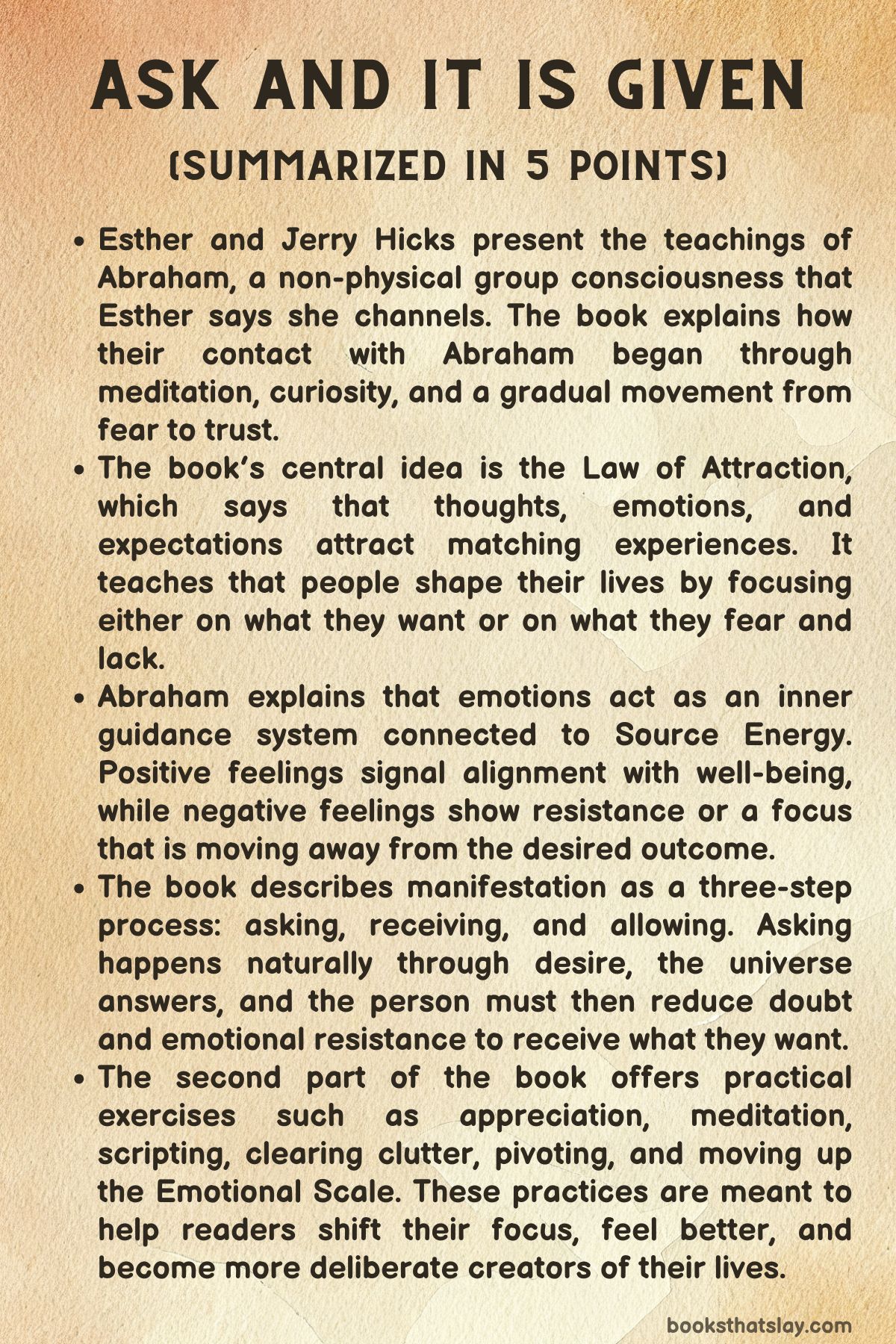
Ask and It Is Given: Learning to Manifest Your Desires is a spiritual self-help book by Esther Hicks and Jerry Hicks, centered on the teachings of Abraham, a non-physical group consciousness Esther says she channels. The book presents the Law of Attraction as a universal principle: people shape their lives through their thoughts, emotions, focus, and level of alignment with Source Energy.
Rather than treating desire as selfish or unrealistic, the book frames wanting as natural and creative. Its main message is that feeling better, trusting inner guidance, and reducing resistance allow people to receive the well-being, abundance, health, and clarity they seek.
Summary
Ask And It Is Given begins by explaining how Jerry and Esther Hicks came to share the teachings of Abraham. Jerry describes himself as the translator of ideas that come through Esther from a non-physical source.
He explains that these teachings are difficult to express in ordinary language because, in Abraham’s view, the non-physical world communicates through vibration rather than words. This is why the book often gives special meanings to terms such as Source, Well-Being, and Emotional Guidance.
Jerry presents Esther as someone unusually able to receive and translate this wisdom, and he connects their work to a long tradition of spiritual figures who have claimed access to higher knowledge.
Esther then tells the story of how she first encountered channeling. At first, she is uneasy about it because of her religious upbringing and her childhood fear of evil or supernatural forces.
Jerry, by contrast, is curious and eager to ask questions about life, purpose, and spiritual reality. When they meet a woman named Sheila, who channels an entity called Theo, Esther is surprised by the calm and intelligent nature of the experience.
Theo tells her to meditate and suggests that she too can receive communication from Source Energy. Esther begins meditating, and over time she senses peaceful thoughts and impulses that do not seem to come from her ordinary mind.
These communications become clearer and identify themselves as Abraham.
Abraham introduces themselves as a group consciousness that exists beyond physical form. Their purpose is to help people remember who they really are: extensions of Source Energy living in physical bodies.
According to Abraham, every person is born connected to Source, but physical life, social conditioning, fear, doubt, and negative thinking often make people forget that connection. The book argues that people are not powerless beings reacting to fixed circumstances.
Instead, they are creators of their own experience, whether they realize it or not.
The central idea of the book is the Law of Attraction, described as the principle that similar energies draw one another together. Thoughts, emotions, expectations, and beliefs are not treated as private events with no effect.
They are described as vibrations that attract matching experiences. If a person focuses on lack, fear, illness, conflict, or frustration, they attract more experiences that match those feelings.
If they focus on abundance, health, love, ease, and appreciation, they become more aligned with those outcomes.
Abraham explains that desire begins naturally through life experience. When people encounter something they do not want, they automatically form a clearer idea of what they do want.
This asking does not always happen through formal prayer or conscious request. It can happen through contrast: a bad relationship creates a desire for harmony, debt creates a desire for freedom, sickness creates a desire for wellness, and boredom creates a desire for excitement.
The universe, according to the book, always answers these requests. The difficult part is not asking or receiving an answer; it is allowing the answer to come.
Allowing means becoming a vibrational match to the desired outcome. The book teaches that people often block their own desires by focusing on the absence of what they want.
Someone who wants money but constantly thinks about debt is aligned with debt, not prosperity. Someone who wants a better relationship but keeps focusing on a partner’s flaws strengthens the unwanted parts of that relationship.
Someone who wants health but gives most attention to illness, fear, and family medical history keeps their focus on sickness. Abraham’s advice is to shift attention toward the wanted result, not as empty pretending, but as a way of changing emotional alignment.
Emotions are presented as the main guidance system. Good-feeling emotions such as joy, appreciation, hope, freedom, and love indicate alignment with Source.
Bad-feeling emotions such as despair, fear, anger, jealousy, and frustration indicate resistance or disconnection. The book does not say that negative emotion is a moral failure.
Instead, it treats negative emotion as useful information. It tells a person that their current thought is moving them away from their true desire.
By noticing this signal, the person can choose a slightly better-feeling thought and slowly shift direction.
The book repeatedly stresses that change does not need to happen all at once. A person in despair may not be able to jump directly into joy, and forcing positivity can feel false.
Abraham recommends gradual emotional movement. Relief is enough.
A thought that feels slightly better than the previous thought is progress. Over time, these small shifts build momentum, and the person becomes more able to feel hope, confidence, and appreciation.
Abraham also teaches that every person is free and that no one can create another person’s reality for them. Trying to control others is seen as a misuse of focus because it places attention on what is unwanted.
The book argues that people are most powerful when they tend to their own alignment rather than attempting to manage other people’s choices. It rejects the idea that one person’s success, health, wealth, or happiness takes anything away from someone else.
In Abraham’s view, the universe is abundant, and each person has direct access to well-being.
The first part of Ask And It Is Given builds this spiritual framework. It explains that humans are both physical and non-physical beings, that they are constantly transmitting and receiving vibration, and that their lives expand through desire.
Physical life is described as valuable because it creates contrast, variety, and new preferences. The universe itself is said to expand through these desires.
Every wish, problem, preference, and emotional response contributes to this ongoing expansion.
The second part of the book gives practical exercises meant to help readers apply these ideas. These practices are designed for different emotional states.
Some are best used when a person already feels good, while others are meant for times of anxiety, discouragement, debt, illness, or resistance.
One practice asks readers to notice and express appreciation for anything positive around them. By looking for things to appreciate, they train their attention toward what feels good and attract more pleasing experiences.
Another practice uses a box filled with images or symbols of desired things, helping the person focus playfully on what they want. A writing exercise asks readers to list desires related to body, home, relationships, and work, then explore why those desires matter.
The goal is to clarify the feeling behind the goal, not just the object itself.
Several exercises use imagination. In one, readers mentally create a scene and enjoy it as if they are living it.
In another, they write a future story as though their desires have already come true. Another asks them to carry a bill in their wallet and mentally spend it many times during the day, building a feeling of financial ease.
A similar money exercise uses imaginary deposits that grow daily, encouraging the mind to expect abundance instead of scarcity.
Other practices focus on relief and trust. Meditation is recommended as a way to quiet resistant thoughts and return to a natural state of connection.
The Place Mat Process asks readers to divide tasks between what they will do and what they will turn over to the universe. Turning things over to a Universal Manager works in a similar way: the person symbolically hands over burdens, details, and worries, allowing unseen support to manage what feels too heavy.
The book also gives methods for handling negative thoughts. Pivoting means noticing what is unwanted and then asking what is wanted instead.
The Focus Wheel helps people build believable thoughts around a desire until the desire feels more possible. “Which thought feels better?” teaches readers to compare thoughts and choose the one that brings even a slight sense of relief.
Moving up the Emotional Scale follows the same principle, guiding people from painful emotions toward better-feeling ones step by step.
Health, debt, clutter, dreams, and daily routines are also addressed. The book encourages readers to view dreams as clues to their dominant vibration, clean physical spaces to create clarity, and set intentions before each new part of the day.
For health, it advises focusing on vitality and memories of feeling well rather than fear of illness. For debt, it recommends softening resistance around money and reaching for thoughts that suggest possibility and relief.
Overall, Ask And It Is Given presents life as a process of asking, receiving, and allowing. Its message is that people do not need to force life into shape through struggle.
They need to notice how they feel, choose thoughts that bring relief, focus on what they want, and trust that well-being is always available. The book’s practical exercises are meant to help readers make that shift daily, until deliberate creation becomes a natural way of living.
Key Figures
Esther Hicks
Esther Hicks is the central human figure in the book because she becomes the channel through whom Abraham’s teachings are presented. Her role is not written like a conventional fictional protagonist, but she still undergoes a clear inner movement: from fear and hesitation to openness, trust, and spiritual receptivity.
At the beginning, Esther is wary of anything connected to spirits or the supernatural. Her childhood religious training has made her associate unseen forces with danger, and this fear is strong enough that she avoids conversations that touch on such subjects.
This makes her later role as Abraham’s channel especially important, because the book presents her transformation as evidence that spiritual communication can be loving, practical, and safe rather than frightening.
Esther’s character is shaped by sensitivity and receptiveness. She is not shown as someone who aggressively seeks mystical experiences.
In fact, she begins as the more cautious partner, while Jerry is the seeker. This gives her credibility within the book’s own framework because her connection to Abraham does not appear to come from ambition or performance.
It grows slowly through meditation, quietness, and trust. Her ability to receive thoughts, impressions, and messages becomes the foundation of the entire work.
In Ask And It Is Given, Esther functions as the bridge between the physical and non-physical worlds, translating Abraham’s vibrational knowledge into language readers can understand.
Esther also represents the reader’s possible journey. She begins with doubt, fear, and inherited beliefs, then gradually learns to recognize a peaceful inner presence.
Through her, the book suggests that spiritual alignment is not limited to prophets, teachers, or unusually confident believers. It can begin with discomfort and uncertainty.
Her growth supports one of the book’s main claims: that every person has access to Source Energy, but many people need to release resistance before they can sense that connection. Esther’s importance lies not only in what she receives, but in how her change models the book’s promise of inner expansion.
Jerry Hicks
Jerry Hicks is presented as the questioner, translator, organizer, and intellectual seeker of the book. While Esther becomes the channel, Jerry is the person whose curiosity opens the path toward Abraham’s teachings.
He is driven by lifelong questions about existence, spiritual truth, and the workings of the universe. Unlike Esther, he is not initially afraid of metaphysical subjects.
He has a strong interest in them and approaches the meeting with Sheila with excitement, even preparing questions he has carried since childhood. This makes Jerry the active seeker whose desire creates the conditions for the teachings to emerge.
Jerry’s character is defined by inquiry. He wants answers, but he also wants those answers to be useful and communicable.
His role as a “translator” is significant because he presents himself as someone trying to make non-physical ideas accessible to ordinary readers. He recognizes that Abraham’s teachings often exceed normal language, so he helps frame them through explanations, examples, and repeated terms.
In this sense, Jerry is not merely Esther’s partner; he is a structuring presence in the book. He helps turn spiritual communication into a teachable system.
Jerry also brings a human warmth to the material. His reflections on Esther, Abraham, and the workshops show admiration and a sense of responsibility.
He treats the teachings as rare and valuable, but he also wants them to become practical guidance for people seeking money, health, relationships, happiness, and direction. In Ask And It Is Given, Jerry stands for the human hunger to understand life’s unseen laws.
His presence balances Esther’s receptivity with analysis, organization, and questioning. Without him, the teachings might remain private experiences; through him, they become a structured book aimed at helping readers apply the Law of Attraction.
Abraham
Abraham is the most powerful and authoritative presence in the book, though not a character in the ordinary physical sense. Abraham is described as a non-physical group consciousness made of energy, intention, and vibration.
The voice of Abraham supplies the book’s philosophy, explains the Law of Attraction, and teaches readers how to align with Source Energy. Abraham’s role is similar to that of a spiritual teacher, guide, and cosmic interpreter.
They do not act within a plot, but they shape the book’s entire worldview.
Abraham’s voice is confident, expansive, and instructive. They speak as though human suffering comes largely from misunderstanding, not from fate or punishment.
They repeatedly remind readers that they are eternal beings, creators of their own reality, and natural receivers of well-being. Abraham’s character is therefore built around reassurance.
Even when addressing fear, illness, poverty, or frustration, Abraham’s message returns to the claim that people can shift their focus, change their emotional alignment, and receive better outcomes.
At the same time, Abraham can seem demanding because their teachings place great responsibility on the individual. If thoughts and emotions attract matching realities, then the reader must become more aware of inner patterns.
Abraham does not encourage blame, but the teaching does insist that people examine how their focus may be sustaining unwanted experiences. This gives Abraham a dual role: comforter and challenger.
They comfort readers by saying that well-being is always available, but they challenge them to stop giving attention to lack, fear, resentment, and resistance.
Abraham also functions as the book’s moral and metaphysical center. Their teachings reject scarcity, competition, and control.
They argue that the universe is abundant, that every person has access to Source, and that one person’s success does not rob another. Through Abraham, the book promotes personal freedom, emotional guidance, and deliberate creation as the foundation of a satisfying life.
Sheila
Sheila is a brief but important figure because she introduces Esther and Jerry to the possibility of channeling. She is not developed as deeply as Esther, Jerry, or Abraham, but her presence is a turning point in the book.
Esther first approaches Sheila with anxiety, expecting something strange or frightening because of her fear of supernatural subjects. Instead, Sheila appears gentle, calm, and welcoming.
This matters because her demeanor helps reduce Esther’s fear and prepares her to experience channeling in a less defensive state.
Sheila’s significance lies in her role as an initiator. Through her channeling of Theo, she allows Esther and Jerry to witness communication with a non-physical entity before Esther experiences it herself.
Sheila’s session gives Jerry a chance to ask his long-held questions and gives Esther a direct example of what channeling can look and feel like. The fact that the voice of Theo seems distinct from Sheila’s ordinary personality convinces Esther that something unusual is taking place.
As a figure in the book, Sheila represents the first doorway into a larger spiritual reality. She does not remain central, but her influence is lasting.
Without her, Esther might not have received the instruction to meditate, and the connection with Abraham might not have unfolded in the same way. Sheila’s role shows how one person’s openness can help another person become open as well.
Theo
Theo is the non-physical entity channeled by Sheila and serves as a precursor to Abraham’s presence in the book. Theo’s role is brief, but the encounter with Theo gives Esther and Jerry their first direct experience of a voice that appears to come from beyond the physical personality of the channel.
Theo answers Jerry’s questions in a way that Esther finds deeper than what Sheila herself would likely say. This makes Theo an important validating figure within the book’s spiritual framework.
Theo’s most important action is directing Esther toward meditation and suggesting that she has the ability to channel Source Energy. This moment changes the direction of Esther’s life.
Theo does not simply provide information; Theo identifies Esther’s potential. In that sense, Theo functions as a messenger who points Esther toward her own spiritual role.
The book uses Theo’s presence to move Esther from fear to possibility.
Theo also helps soften the boundary between skepticism and belief. Because Esther begins the meeting afraid and hesitant, Theo’s calm and intelligent communication becomes part of her gradual reassessment of the unseen world.
The encounter does not immediately make Esther a channel, but it plants the idea that non-physical communication may be loving rather than dangerous. Theo’s importance, then, is catalytic.
Theo helps prepare the way for Abraham.
The Reader
The reader functions almost like an implied character because the book constantly addresses “you” as someone who has forgotten their true nature and needs to remember it. This “you” is not passive.
The reader is treated as an eternal being, a creator, a vibrational transmitter, and a person capable of shaping reality through focus and emotion. In that sense, the book turns its audience into participants in the teaching rather than observers of someone else’s journey.
The reader is described as someone who may feel blocked, discouraged, confused, or separated from Source Energy. Yet the book insists that this separation is never complete.
The reader’s task is to recognize emotional guidance, notice resistance, focus on what is wanted, and gradually move toward better-feeling thoughts. This makes the reader’s development central to the book’s purpose.
The exercises in the second half exist because the reader is expected to practice, not simply believe.
As an implied character, the reader is both vulnerable and powerful. The book acknowledges that people may feel trapped by debt, illness, unhappy relationships, or negative emotional habits.
At the same time, it repeatedly reframes these conditions as changeable through alignment. The reader’s arc is therefore one of remembering: remembering freedom, worth, purpose, and connection to well-being.
The book’s teachings are built around the idea that the reader is not being given a new power, but being reminded of a power they already possess.
Source Energy
Source Energy is not a conventional character, but it operates as a living force in the book’s spiritual world. It is described as the non-physical origin of each person, the stream of well-being that flows through existence, and the higher reality with which people can align.
Source does not speak as a separate personality in the way Abraham does, yet it shapes every claim the book makes about emotion, desire, and manifestation.
Source Energy represents the best, clearest, and most expanded version of the self. When a person feels joy, love, appreciation, freedom, or relief, the book presents that feeling as evidence of alignment with Source.
When a person feels fear, despair, resentment, or powerlessness, the emotion signals resistance to Source. In this way, Source functions as an inner compass.
It is both beyond the person and within the person.
The importance of Source Energy lies in how it changes the meaning of human experience. Problems are not treated as signs of abandonment; they are seen as contrast that creates new desires.
Desire is not treated as greed; it is part of expansion. Emotion is not treated as random; it is guidance.
Source Energy gives the book its sense of optimism because it suggests that well-being is the natural condition beneath fear and resistance.
Themes
Emotional Guidance and Inner Alignment
The book treats emotion as a guidance system rather than a random reaction to outside events. Feelings are presented as signals that reveal whether a person is aligned with Source Energy or resisting it.
Joy, appreciation, love, freedom, and relief indicate movement toward alignment, while fear, anger, despair, jealousy, and frustration show that thought has moved away from the desired direction. This idea gives emotions a practical function.
Instead of judging negative feelings as weakness, the book asks readers to read them as information. A bad feeling means the current thought is not serving the person’s true desire.
A better-feeling thought, even if only slightly better, begins to restore connection. This theme is important because it shifts personal growth away from force and self-punishment.
The goal is not to deny pain or pretend to be joyful at once. The goal is to notice emotional direction and choose thoughts that bring relief.
The book’s exercises support this gradual movement, especially for readers who feel stuck in fear, debt, illness, or discouragement. Emotional alignment becomes the foundation for deliberate creation.
The Law of Attraction and Personal Creation
Ask And It Is Given presents the Law of Attraction as the central force shaping human experience. The principle is that thoughts and emotions attract matching realities.
A person who focuses on lack strengthens the experience of lack, while a person who focuses on abundance becomes more open to receiving abundance. This theme gives the book its practical and controversial power.
It insists that people are not merely reacting to a fixed world; they are constantly participating in the creation of their own conditions through attention, expectation, and belief. The book does not frame asking as a formal ritual.
Asking happens naturally whenever life produces contrast. A difficult relationship creates a desire for harmony.
Financial pressure creates a desire for ease. Illness creates a desire for wellness.
The universe answers these desires, but the individual must allow the answer by becoming emotionally aligned with it. This theme places responsibility on the reader, but it also offers hope.
If focus helps shape experience, then change can begin internally before external circumstances shift.
Desire, Contrast, and Expansion
Desire is treated as a natural and necessary part of existence. The book does not present wanting as selfish, shallow, or spiritually inferior.
Instead, wanting is the engine of growth. Every unwanted experience helps clarify what is wanted, and every desire contributes to personal and universal expansion.
This theme changes how difficulty is understood. Painful or frustrating situations are not meaningless obstacles; they are forms of contrast that sharpen preference.
When people experience what they do not want, they ask more clearly for what they do want. The problem begins when they remain focused on the unwanted condition instead of turning toward the desire born from it.
The book repeatedly encourages readers to use contrast as a starting point, not a permanent identity. Debt can clarify the desire for freedom.
Conflict can clarify the desire for respect. Illness can clarify the desire for vitality.
In this way, the book presents life as an expanding process in which every experience has creative value. Desire becomes proof that the person is still growing, choosing, and participating in the larger movement of the universe.
Allowing, Trust, and Releasing Resistance
The act of allowing is one of the book’s most important spiritual practices. The book argues that asking is automatic and that the universe always answers, but people often block what they want through doubt, anxiety, control, and attention to absence.
Resistance appears when someone wants an outcome but keeps thinking about why it has not arrived, how difficult it will be, or what might go wrong. Allowing means relaxing that resistance and trusting that the desired result can come in ways the conscious mind does not need to control.
This theme is developed through many practical exercises, including meditation, turning problems over to a Universal Manager, choosing better-feeling thoughts, and focusing on appreciation. Allowing does not mean doing nothing.
It means acting from alignment rather than fear. The book suggests that inspired action feels different from forced action; it comes with ease, clarity, and emotional steadiness.
Trust is therefore not passive belief but a practiced emotional state. By releasing the need to manage every detail, the individual becomes more receptive to solutions, opportunities, and well-being.