At the Dark End of the Street Summary and Analysis
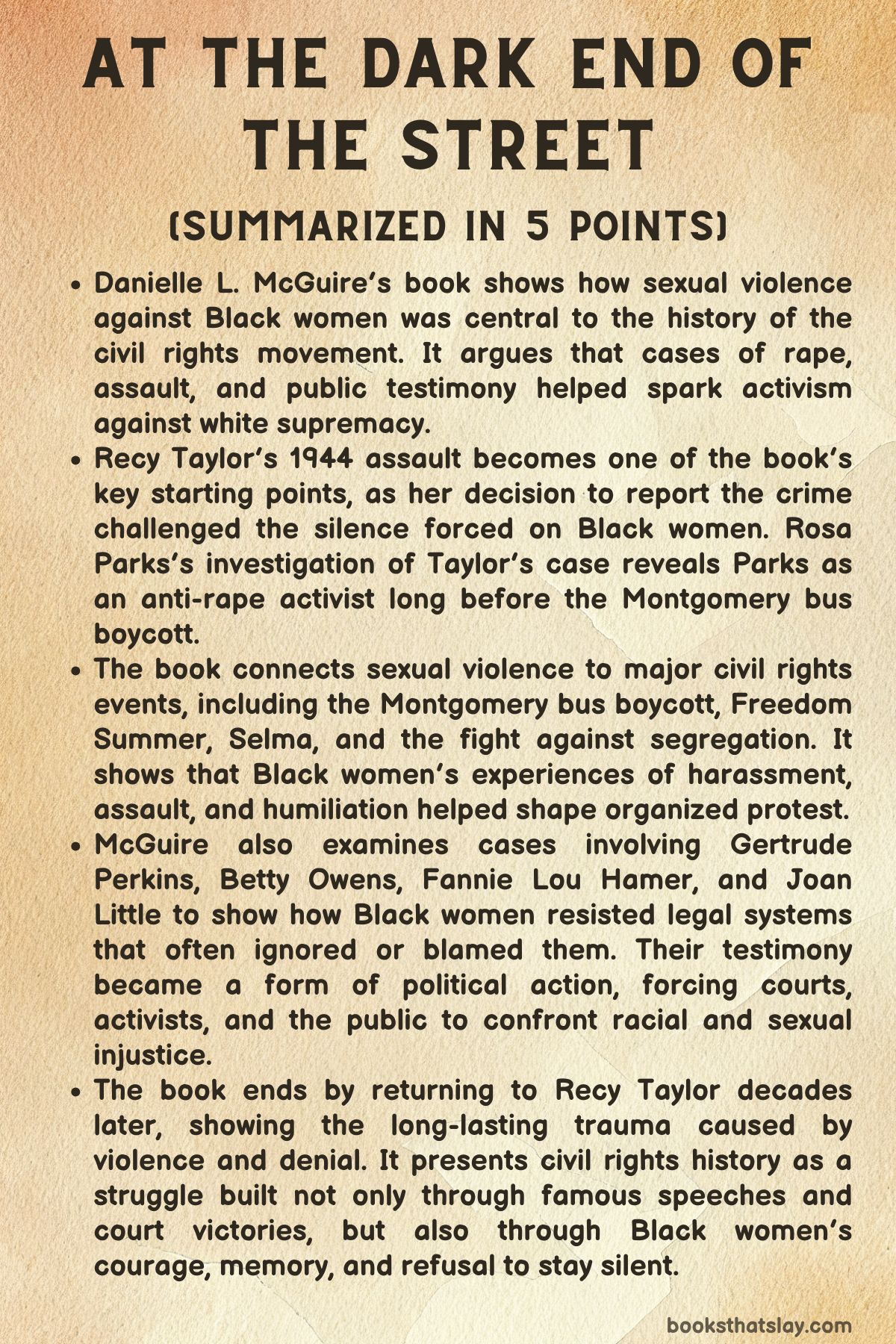
At the Dark End of the Street by Danielle L. McGuire is a work of history that reframes the civil rights movement through the courage of Black women who resisted sexual violence, racism, and legal neglect. Rather than treating the movement as a story driven only by public protests and famous male leaders, the book shows how Black women’s testimony against rape and assault helped fuel wider struggles for justice.
McGuire connects cases such as Recy Taylor’s assault, the Montgomery bus boycott, Freedom Summer, Selma, and Joan Little’s trial to show how battles over bodily safety shaped civil rights activism.
Summary
At the Dark End of the Street begins by challenging the common way the civil rights movement is remembered. Danielle L. McGuire argues that sexual violence against Black women was not a side issue but a central force in the long fight against white supremacy.
From slavery through the Jim Crow era, white men used rape and assault as tools of domination, while the legal system often protected them. At the same time, false accusations of rape against Black men were used to justify lynching and racial terror.
Against this history, Black women built a tradition of testimony, protest, and organized resistance.
The book opens with the case of Recy Taylor, a young Black woman in Abbeville, Alabama. In 1944, Taylor was walking home from church when six white men abducted her at gunpoint and raped her in the woods.
After the assault, she reported the crime, despite the danger of speaking against white men in the Jim Crow South. Sheriff Gamble identified one of the attackers, Hugo Wilson, who named the others but claimed Taylor had agreed to sex for money.
Instead of arresting the men properly, authorities treated the case lightly, showing how little protection Black women received.
The NAACP sent Rosa Parks to investigate Taylor’s case. Parks is often remembered for refusing to give up her bus seat, but McGuire shows that she had already been active for years in anti-rape and civil rights work.
Parks gathered testimony, helped publicize Taylor’s case, and worked with activists to pressure Alabama officials. The Committee for Equal Justice for Recy Taylor organized letter-writing campaigns and drew national attention to the assault.
Governor Chauncey Sparks reopened the investigation, and one attacker, Joe Culpepper, admitted that Taylor had been abducted and raped. Even then, the grand jury refused to indict the men.
The case became a symbol of the larger pattern of sexual terror against Black women.
McGuire then expands the story to the years after World War II, when Black veterans returned from fighting abroad and demanded democratic rights at home. The NAACP pursued legal challenges, and Thurgood Marshall became a leading civil rights attorney.
Yet these advances produced a violent white backlash. White Southerners used intimidation, murder, and sexual violence to maintain segregation.
Black men were falsely accused of sexual crimes against white women, while white men who raped Black women usually faced no punishment. Gertrude Perkins’s case in Montgomery, where police officers raped her and escaped indictment, showed how police power and sexual violence worked together.
Montgomery’s buses became another important site of racial and sexual humiliation. Black women made up much of the bus system’s ridership, and they were regularly insulted, touched, threatened, and forced to follow degrading rules.
The Women’s Political Council, led by Jo Ann Robinson, organized around bus safety and dignity. Robinson warned city officials that Black riders might boycott if conditions did not change.
This history prepared the ground for later mass action.
Before Rosa Parks’s famous arrest, Claudette Colvin, a Black teenager, refused to surrender her bus seat in Montgomery. Inspired by what she had learned about Black resistance, Colvin challenged segregation in court.
Many local activists admired her courage, but some leaders worried that her age, poverty, and pregnancy would make her vulnerable to attacks on her character. The politics of respectability shaped decisions about who could publicly represent the movement.
When Rosa Parks was arrested in 1955, leaders such as E. D. Nixon believed she could become the public face of a bus boycott because her reputation was harder for white officials to attack. Jo Ann Robinson and the Women’s Political Council quickly organized flyers and mobilized the Black community.
On the day of Parks’s trial, Black riders stayed off the buses, and the boycott began. Although women had created much of the foundation for the protest, male ministers formed the Montgomery Improvement Association and selected Martin Luther King Jr. as its leader.
King’s speeches gave the boycott public visibility, but women continued to run much of the practical work, including carpools, fundraising, and daily coordination.
The boycott faced intimidation from city officials and white supremacist groups. Mayor W. A. Gayle supported efforts to punish boycotters, police harassed participants, and the homes of King and Nixon were bombed.
Still, the movement continued for more than a year. The legal victory in Browder v.
Gayle, brought by four Black female plaintiffs, led the Supreme Court to declare bus segregation unconstitutional. McGuire presents this victory as the result of women’s organizing, legal strategy, and collective endurance.
The book then follows the violent white backlash after major civil rights victories. The Brown v.
Board of Education decision and the Montgomery bus victory intensified fears among segregationists, especially fears about interracial contact and sexuality. Politicians such as Herman Talmadge and James Eastland defended segregation as a way to protect white womanhood and racial purity.
White Citizens’ Councils and the Ku Klux Klan used violence to terrorize Black communities.
The murder of Emmett Till revealed the deadly power of these sexual myths. Till, a 14-year-old from Chicago, was killed in Mississippi after being accused of improper behavior toward a white woman.
His mutilated body, shown publicly through photographs, shocked the nation. Yet his killers were acquitted, confirming that white violence against Black people could still go unpunished.
Other incidents, including attacks on integrated rock concerts and the “Kissing Case” involving two young Black boys accused after a children’s kissing game with white girls, showed how segregationists turned even innocent contact into racial panic.
McGuire next describes the rape of Betty Owens, a student at Florida A&M University. In 1959, four white men abducted Owens at gunpoint and repeatedly raped her.
Unlike many earlier cases, the attackers were arrested and tried. FAMU students organized protests, and civil rights leaders demanded equal justice.
At trial, the defense tried to damage Owens’s character and depict the white attackers as decent young men. The jury convicted them but recommended mercy, sparing them the death penalty.
Many Black observers saw the conviction as progress because white men had rarely been punished for raping Black women. Yet the lighter punishment compared with the treatment of Black men exposed the ongoing inequality of the legal system.
The book also examines the sexual violence faced by women activists in jails and prisons. Fannie Lou Hamer, a Mississippi sharecropper and voting rights activist, had already suffered a forced sterilization without her consent.
After she joined civil rights organizing, she was arrested and brutally assaulted in jail. Hamer publicly testified about this violence, turning her suffering into political witness.
Dorothy Height and Jeanne Noble also pushed Black women’s organizations to speak more openly about sexual abuse and police brutality. Through programs such as Wednesdays in Mississippi, women sought to bring wider attention to the violence faced by Black communities, though many middle-class reformers struggled to confront the full reality of sexual terror.
During Freedom Summer, Northern white students joined Black organizers in Mississippi to register voters and support civil rights work. Their presence drew national media attention but also intensified white segregationist paranoia.
Many white Southerners imagined the volunteers as threats to racial and sexual order, especially when white women worked alongside Black men. Despite danger from the Klan and other groups, the campaign helped pressure President Lyndon B. Johnson to sign the Civil Rights Act, outlawing public segregation.
The struggle continued in Selma, Alabama, where Sheriff James Clark used violence to block Black voter registration. After police killed Jimmie Lee Jackson, Martin Luther King Jr. called for a march from Selma to Montgomery.
Police attacked marchers on Bloody Sunday, and the images shocked the country. Congressman William Dickinson tried to discredit activists through sexual rumors and false claims of interracial immorality.
This climate helped lead to the murder of Viola Liuzzo, a white activist killed for riding with a Black man. The period also brought legal progress, including the Loving v.
Virginia decision, which struck down laws against interracial marriage.
The final major case is Joan Little’s trial. Little, a Black woman jailed in North Carolina, killed white jailer Clarence Alligood with an ice pick and escaped.
She said she acted in self-defense after he raped her. Attorney Jerry Paul framed her case within the long history of white sexual violence against Black women.
Angela Davis and feminist activists helped bring national attention to the trial. The defense showed that Alligood and other jailers had harassed women inmates.
Little testified about the assault, and the jury acquitted her. Her case became a powerful moment in both civil rights and feminist anti-rape activism.
The book closes by returning to Recy Taylor decades later. McGuire meets her in Abbeville in 2009, on the day Barack Obama is inaugurated as the first Black president.
Taylor had lived much of her life near the men who raped her, while many white residents denied the crime happened. Her family remembered the fear and trauma clearly.
The ending connects Taylor’s courage to the broader achievements made possible by generations of Black women who resisted violence, demanded justice, and forced the nation to face truths it had long ignored.
Key Figures
Danielle L. McGuire
Danielle L. McGuire is the historian and author who shapes the book’s argument. She does not appear as a conventional character in the events for most of the work, but her role is central because she chooses what histories to recover and how to connect them.
McGuire challenges a familiar version of civil rights history by showing that Black women’s resistance to sexual violence was foundational to the movement. In At the Dark End of the Street, she writes against silence, insisting that rape, testimony, legal injustice, and protest belong at the center of the story.
Her meeting with Recy Taylor near the end gives her work a personal dimension, showing that history is not only archival but also living memory.
Recy Taylor
Recy Taylor is one of the book’s central figures and one of its clearest examples of courage under extreme danger. After being abducted and raped by six white men, she reported the crime in a society that punished Black women for speaking against white men.
Taylor’s decision to testify was politically powerful because it rejected the expectation that Black women should suffer in silence. Her case shows how racist legal systems protected white attackers even when evidence and confession were present.
Taylor’s life after the assault also reveals the lasting burden of trauma. She remained close to the place where her attackers lived, carrying fear that justice never resolved.
Rosa Parks
Rosa Parks appears as much more than the woman who refused to give up her bus seat. In the book, she is an investigator, organizer, and anti-rape activist whose work began long before the Montgomery bus boycott.
Her involvement in Recy Taylor’s case shows her commitment to Black women’s bodily safety and legal dignity. Parks understood that sexual violence was tied to broader systems of racial control.
Her later arrest on the bus becomes part of a longer career of resistance rather than an isolated act. She represents discipline, moral clarity, and political patience, but the book also shows how even her work was sometimes overshadowed by male leadership.
Benny Corbitt
Benny Corbitt, Recy Taylor’s father, represents the fear, anger, and helplessness forced on Black families under Jim Crow. After Taylor’s assault, he searched for her and helped her report the crime, but he also knew the limits placed on Black men confronting white authority.
His rage at the police and the attackers is shaped by the knowledge that direct confrontation could lead to lynching or other retaliation. Corbitt’s role shows how sexual violence against Black women injured entire families.
He is not passive; rather, he is trapped inside a violent racial order that makes even a father’s demand for justice dangerous.
Sheriff Gamble
Sheriff Gamble represents the racist law enforcement structure that repeatedly failed Black victims. Although he identified Hugo Wilson through Taylor’s description, his handling of the case showed indifference and protection toward white suspects.
By allowing Wilson to return home on bond and failing to arrest the other attackers properly, Gamble treated the rape as a problem to contain rather than a crime requiring justice. His actions reveal how sheriffs and police officers in the South often served white power more than law.
In the book, he stands for official neglect disguised as procedure.
Hugo Wilson
Hugo Wilson is one of Recy Taylor’s attackers and an example of how white men relied on racist sexual stereotypes to escape punishment. After being identified, he named the other men but claimed that Taylor had been paid and that no force was used.
This lie drew on a long tradition of portraying Black women as sexually available and therefore impossible to rape. Wilson’s confidence shows how deeply he trusted the legal system to protect him.
His role in the book exposes how attackers used both physical violence and false narratives to control Black women after the assault itself.
Joe Culpepper
Joe Culpepper is significant because he admitted that Recy Taylor had been abducted at gunpoint and raped. His admission should have made prosecution unavoidable, yet the grand jury still refused to indict the men.
Culpepper’s testimony therefore reveals the depth of legal racism. Even when one of the attackers confirmed the crime, Black womanhood was denied the protection of law.
He is important not because he becomes morally redeemed, but because his confession proves that the system did not fail from lack of evidence. It failed because white juries and officials chose to defend white male power.
The Other Men Who Assaulted Recy Taylor
The other men who assaulted Recy Taylor function as a collective portrait of white male impunity. Their attack was not only an individual crime but also an act made possible by social permission.
They could abduct a Black woman, rape her, and expect disbelief or indifference from authorities. Their shared false claim that the encounter was consensual shows how coordinated lies were used to erase Black women’s testimony.
In the book, they represent a broader class of men whose violence was protected by race, gender, and local power.
Chauncey Sparks
Chauncey Sparks, the governor of Alabama, responds to Recy Taylor’s case only after public pressure threatens the state’s reputation. His decision to reopen the investigation is less a sign of deep justice than a reaction to national scrutiny.
Sparks represents the political class that could act when embarrassed but rarely moved by Black suffering alone. His role shows the importance of organized protest, newspapers, and letter-writing campaigns.
Without outside pressure, Taylor’s case would likely have been ignored completely.
Harriet Jacobs
Harriet Jacobs appears as part of the longer tradition of Black women testifying against sexual abuse. As an abolitionist writer, Jacobs exposed the sexual exploitation faced by enslaved women.
Her presence in the book connects the civil rights era to slavery, showing that Black women’s public truth-telling had deep roots. Jacobs matters because she helps establish that resistance to sexual violence was not new in the 1940s or 1950s.
Black women had long used testimony as a weapon against systems that denied their humanity.
Marcus Garvey
Marcus Garvey appears through Rosa Parks’s early political education. Parks’s grandfather introduced her to radical Black thinkers, including Garvey, helping shape her sense of racial pride and resistance.
Garvey’s influence in the book is indirect but meaningful. He represents a tradition of Black self-respect and political consciousness that informed later activism.
His presence helps explain that Parks’s courage came from years of exposure to ideas about freedom, dignity, and collective struggle.
The Scottsboro Men
The Scottsboro men represent the danger of false rape accusations against Black men and the way sexual politics shaped racial injustice. Their case deeply influenced Rosa Parks and helped move her toward activism.
Accused of raping white women, they became symbols of a legal system willing to sacrifice Black lives to protect white myths. Their role in the book balances the discussion of sexual violence by showing two connected realities: Black women were disbelieved when raped by white men, while Black men were presumed guilty when accused by white women.
Southern Negro Youth Congress
The Southern Negro Youth Congress appears as an organizing force in Recy Taylor’s case. Its members helped Rosa Parks publicize the assault and connect local injustice to national activism.
The group represents young, educated, left-leaning Black activism that was willing to speak openly about racial and sexual violence. Its role shows that civil rights campaigns often depended on networks of organizers rather than single heroic figures.
The SNYC helped transform Taylor’s assault from a local crime into a national demand for justice.
Gertrude Perkins
Gertrude Perkins is another Black woman whose rape exposed the violence of white authority. She was assaulted by two police officers, making her case especially disturbing because the attackers were agents of the law.
The refusal of an all-white, all-male jury to indict the officers showed that police power could shield sexual abuse. Perkins’s case helped anger and mobilize Montgomery’s Black community before the bus boycott.
Her experience shows that Black women’s safety was central to civil rights activism, even when later histories gave more attention to buses and court rulings.
The Police Officers Who Assaulted Gertrude Perkins
The police officers who assaulted Gertrude Perkins represent the fusion of state power and sexual violence. Their uniforms did not protect the public; instead, they gave them greater access to abuse.
Their escape from indictment shows how white male officers could rely on racial loyalty from courts and juries. In the book, they are not isolated villains but examples of a system in which police brutality included sexual assault and humiliation, especially against Black women.
Thurgood Marshall
Thurgood Marshall represents the legal strategy of the civil rights movement. As an NAACP attorney, he fought segregation and helped open political participation for African Americans.
His presence in the book shows that courtroom victories were crucial, but McGuire places them alongside grassroots activism and women’s testimony. Marshall’s work gave legal shape to demands for equality, while cases of sexual violence showed how deeply racism operated outside formal law.
He stands for disciplined constitutional challenge, even as the book reminds readers that law often lagged behind lived suffering.
Jo Ann Robinson
Jo Ann Robinson is one of the book’s most important organizers. As a leader of the Women’s Political Council, she recognized that Montgomery’s buses were places of daily insult and danger for Black women.
She threatened a boycott before Rosa Parks’s arrest and later acted quickly to turn Parks’s case into mass action. Robinson’s importance lies in her strategic skill, speed, and practical leadership.
Although men later became the public face of the boycott, Robinson and other women made it work. She represents the hidden labor behind famous movements.
Women’s Political Council
The Women’s Political Council functions almost like a collective character in the story. Its members listened to Black women riders, challenged bus mistreatment, printed flyers, organized communication, and sustained the boycott’s early momentum.
The WPC shows how women’s organizations created the infrastructure for mass protest. In At the Dark End of the Street, the council also demonstrates that the Montgomery bus boycott was rooted not only in seating rules but also in Black women’s need for safety, respect, and freedom from harassment.
Claudette Colvin
Claudette Colvin is a courageous young activist whose refusal to give up her bus seat came before Rosa Parks’s famous arrest. She challenged segregation with remarkable bravery, especially given her age and social position.
Yet leaders hesitated to make her the public face of the boycott because she was poor, young, unmarried, and pregnant. Colvin’s treatment reveals the politics of respectability within the movement.
Her courage was real, but public strategy favored figures who could withstand racist attacks on morality. She exposes both the strength and the limitations of civil rights organizing.
E. D. Nixon
E. D. Nixon is a key male leader in Montgomery who recognized the political value of Rosa Parks’s arrest. He helped push the boycott forward and worked to create organized leadership around it.
At the same time, his rejection of Claudette Colvin as the central test case reflects the movement’s respectability politics. Nixon was strategic, experienced, and committed to civil rights, but his choices also show how class, gender, and public image shaped leadership decisions.
He stands at the intersection of practical organizing and the movement’s internal compromises.
James F. Blake
James F. Blake, the bus driver who ordered Rosa Parks to give up her seat, represents everyday segregation enforced through petty authority. His power over Black riders came from a system that allowed drivers to act almost like police officers.
Blake’s confrontation with Parks was not a random incident; he had harassed her before. In the book, he symbolizes the daily humiliations that made the bus system unbearable.
His role matters because he shows how segregation depended on ordinary officials enforcing racial submission in routine public spaces.
Martin Luther King Jr.
Martin Luther King Jr. emerges as a powerful speaker and public leader during the Montgomery bus boycott. His speeches gave moral force and visibility to the protest, and his arrest and conviction helped build his national image.
However, the book places King within a wider network of women organizers, legal plaintiffs, and community members. He is important, but he is not presented as the sole creator of the movement.
His role shows both the power of charismatic leadership and the danger of forgetting the women whose labor made that leadership possible.
W. A. Gayle
W. A. Gayle, Montgomery’s mayor, represents official resistance to Black protest. His administration supported intimidation against boycotters and tried to restore the racial order by punishing those who challenged it.
Gayle’s role shows that segregation was not maintained only by mobs but also by city governments, police, courts, and economic pressure. He becomes a figure of institutional backlash, using public office to defend white authority rather than protect citizens equally.
White Citizens’ Councils
The White Citizens’ Councils appear as organized defenders of segregation. They used intimidation, economic pressure, propaganda, and sometimes violence to resist civil rights gains.
Their members framed integration as a threat to white womanhood and racial purity, turning sexual fear into political action. In the book, they represent respectable-looking white supremacy: not only hooded terror, but business leaders, officials, and citizens who defended racial hierarchy through public campaigns and private threats.
Emmett Till
Emmett Till is one of the book’s most tragic figures. A 14-year-old boy murdered after being accused of improper behavior toward a white woman, Till became a national symbol of racial terror.
His death exposed how even a child could be destroyed by the sexual myths of segregation. The publication of photographs of his body forced many Americans to confront the brutality of white supremacy.
In the book, Till’s murder shows how accusations involving white women could justify extreme violence against Black males.
The White Store Owner and His Wife in the Emmett Till Case
The white store owner and his wife represent the deadly power of white accusation in the Jim Crow South. The wife’s alleged interaction with Till became the excuse for violence, while the store owner’s retaliation showed how white men claimed ownership over white womanhood.
Their role in the book is less about private emotion than public racial control. The accusation became a social weapon, and Till’s murder revealed how quickly Southern racial codes could turn a minor encounter into a death sentence.
Nat King Cole
Nat King Cole appears as an example of how Black cultural success unsettled segregationists. His performances attracted integrated audiences, especially young people, which threatened white efforts to maintain racial separation.
The attack on him during a performance shows that even entertainment became a battleground over race, bodies, and public space. Cole’s presence in the book reminds readers that civil rights conflict was not limited to courts and marches; music halls and youth culture also challenged segregation.
The Two Boys in the Kissing Case
The two young Black boys in the “Kissing Case” show how racist sexual panic could be imposed even on children. After a kissing game with white girls, they were accused of molestation and sent to a juvenile detention center.
Their ages made the injustice especially clear. The case shows how Southern authorities treated Black childhood as threatening when it crossed racial boundaries.
Their release after national pressure demonstrates the importance of publicity, but their suffering reveals how deeply the fear of interracial contact shaped law and punishment.
Betty Owens
Betty Owens is central to one of the book’s most important courtroom episodes. As a Black college student abducted and raped by four white men, she became the focus of student protest and national attention.
Her testimony required immense courage, especially as the defense tried to shame and discredit her. Owens’s case was historically significant because her attackers were convicted, a rare outcome in Florida for white men who raped a Black woman.
Yet the jury’s mercy recommendation showed that equality remained incomplete. Owens represents both progress and the painful limits of legal justice.
Patrick Scarborough
Patrick Scarborough, one of Betty Owens’s attackers, represents the casual confidence of white men who assumed they could assault a Black woman without serious consequence. His role as part of the group matters because the crime was planned through shared racial and sexual entitlement.
At trial, men like Scarborough relied on claims of consent and on attacks against Owens’s character. He stands for the type of offender whose violence was protected by racist assumptions about Black women.
David Beagles
David Beagles is another of the men convicted in Betty Owens’s rape. Like the others, he participated in an attack that began with the deliberate search for a Black woman to assault.
His role shows how group violence can strengthen individual cruelty, as each man acts with the reassurance that the others share his guilt and racial assumptions. Beagles’s conviction marked a legal break from past impunity, though his spared life also showed the unequal application of punishment.
William Collinsworth
William Collinsworth’s role in Betty Owens’s assault further shows how white male defendants tried to convert obvious violence into a claim of consent. Armed abduction, threats, and repeated rape were reframed by the defense as if Owens’s word could not be trusted.
Collinsworth represents the legal strategy of denying Black women’s victimhood. His conviction mattered, but the mercy shown to him and the others revealed that white defendants were still treated with a sympathy rarely extended to Black men.
Ollie Stoutamire
Ollie Stoutamire is part of the same group of attackers in the Owens case. His role reinforces the book’s argument that sexual violence was both personal and political.
The men did not attack Owens by accident; they targeted a Black woman in a society that had long excused such crimes. Stoutamire’s presence in the trial helps show why the case became larger than one assault.
It forced Florida and the nation to confront whether white men could finally be held accountable for raping Black women.
Florida A&M University Students
The Florida A&M University students are crucial collective actors in Betty Owens’s case. After the assault, they immediately reported the crime, protested, and demanded justice.
Their response turned Owens’s suffering into a public civil rights issue. They used the language of protecting womanhood, reversing the rhetoric often used by white men to justify violence against Black men.
The students represent a younger generation willing to confront sexual violence directly and to connect campus activism with racial justice.
W. May Walker
Judge W. May Walker presided over the emergency grand jury meeting and later became part of the legal machinery surrounding the Owens case. His role matters because the case moved forward with unusual speed compared with many earlier assaults against Black women.
While the system still showed racial inequality, Walker’s handling of the proceedings reflects the pressure created by protest and publicity. He represents a legal system beginning to respond, though not yet with full fairness.
Fannie Lou Hamer
Fannie Lou Hamer is one of the book’s strongest examples of testimony as resistance. A sharecropper turned voting rights activist, she endured both reproductive abuse and jailhouse violence.
Her forced sterilization shows how Black women’s bodies were controlled by medical and racist systems, while her assault in jail reveals how police used sexualized brutality against activists. Hamer refused silence.
By speaking publicly, she transformed private pain into political evidence. Her courage made visible the violence that segregation tried to hide.
Dorothy Height
Dorothy Height appears as a major Black women’s club leader who helped bring attention to sexual violence and police brutality. Her work shows the importance of middle-class Black women’s organizations in civil rights activism.
Height understood that silence around rape protected abusers and weakened the struggle for justice. Through meetings and programs, she tried to mobilize women across racial lines.
Her role is complex because some reform efforts were limited, but her willingness to address sexual violence publicly marked an important shift.
Jeanne Noble
Jeanne Noble, like Dorothy Height, represents Black women’s institutional leadership. As a president of a major women’s organization, she used her platform to discuss the abuse faced by civil rights activists.
Noble’s significance lies in her break from traditions that avoided public discussion of sexuality. Her presence in the book shows how respectable organizations gradually confronted topics once treated as shameful.
She helped expand the movement’s language so that sexual assault and police brutality could be named openly.
Northern White Freedom Summer Volunteers
The Northern white volunteers who came to Mississippi during Freedom Summer played a complicated role. Their presence brought media attention and some federal concern, because white lives were valued by authorities in ways Black lives often were not.
They helped register voters and support local organizing, but they also became symbols in segregationist propaganda. White Southerners imagined them as agents of sexual and racial disorder.
Their role shows both the usefulness and the tension of interracial activism in a violent society.
Lyndon B. Johnson
Lyndon B. Johnson appears as the president who signed the Civil Rights Act into law. His role in the book is tied to the pressure created by years of activism, violence, testimony, and national embarrassment.
Johnson’s action mattered legally because it outlawed public segregation, but the book makes clear that legislation came after sustained struggle from ordinary people. He represents federal power responding to movement pressure rather than creating justice on its own.
James Clark
Sheriff James Clark of Selma represents open segregationist violence in law enforcement. His opposition to integration was public, and his officers used force to stop Black citizens from registering to vote or protesting.
Clark’s brutality helped create the conditions that led to national attention on Selma. He is a clear example of police authority used to defend white supremacy.
His role in the book shows how voting rights activism was met not only with bureaucracy but with beatings, intimidation, and murder.
Jimmie Lee Jackson
Jimmie Lee Jackson is remembered in the book as a victim of police violence whose death helped spark the Selma-to-Montgomery march. He was killed while trying to protect his mother from being beaten, which makes his death both political and deeply personal.
Jackson’s murder revealed the danger Black people faced when demanding voting rights. His role is brief but powerful because his death became a catalyst for mass protest and national attention.
William Dickinson
Congressman William Dickinson represents the use of sexual slander as a political weapon against civil rights activists. By spreading claims that Selma protestors were immoral and driven by interracial sex, he tried to shift public attention away from police brutality and voting rights.
His book Sex and Civil Rights used rumor and false imagery to inflame white fear. Dickinson’s role shows how segregationists fought not only with violence but also with propaganda.
Viola Liuzzo
Viola Liuzzo is a white civil rights activist murdered by Ku Klux Klan members after the Selma campaign. Her killing was tied to the racist panic around interracial cooperation, especially the sight of a white woman riding with a Black man.
Liuzzo’s death shows the danger faced by white allies who crossed Southern racial boundaries. In the book, she also reveals how white womanhood was policed by segregationists when it aligned with Black freedom rather than white supremacy.
Norman Cannon
Norman Cannon appears as an example of changing legal responses to white men who raped Black women. His quick arrest and trial in Mississippi marked a contrast with earlier decades, when police often ignored such crimes.
Cannon’s role shows that civil rights activism had begun to alter the expectations of law enforcement. Yet his presence also reminds readers that the violence itself had not disappeared.
Legal progress came alongside the continuing vulnerability of Black women.
Richard Loving
Richard Loving is part of the challenge to Virginia’s anti-miscegenation laws. As a white man married to Mildred Jeter, he became one half of a case that struck down bans on interracial marriage.
His role in the book connects sexual regulation, marriage law, and white supremacy. Loving’s marriage was treated as a crime because it violated the racial boundaries Southern states tried to enforce.
His case shows how the law controlled intimacy as part of the broader racial order.
Mildred Jeter
Mildred Jeter, later Mildred Loving, is central to the Supreme Court case that ended laws against interracial marriage. As a Black woman married to a white man, she stood at the center of the state’s attempt to police race, gender, and sexuality.
Her role is especially important in a book concerned with Black women’s bodily autonomy. The case affirmed not only marriage rights but also the right to choose love and family without state punishment.
Joan Little
Joan Little is one of the most important figures in the later part of the book. Imprisoned in North Carolina, she killed jailer Clarence Alligood with an ice pick and said she acted in self-defense after he raped her.
Her case became a national symbol because it joined civil rights activism with feminist anti-rape politics. Little’s testimony challenged the assumption that a Black woman, especially one with a criminal record, could not be believed.
Her acquittal marked a rare legal recognition of a Black woman’s right to defend her body.
Clarence Alligood
Clarence Alligood, the jailer killed by Joan Little, represents the sexual power jail officials held over incarcerated women. Through Little’s defense and testimony from other inmates, he is associated with harassment, abuse, and the exploitation of women under confinement.
His role shows how prisons and jails could become places where white male authority operated with little oversight. In the book, Alligood is not merely an individual victim of violence; he is part of a structure that made sexual coercion possible.
Jerry Paul
Jerry Paul is Joan Little’s attorney and a key figure in transforming her case into a national cause. He understood that Little’s defense had to address more than the immediate killing; it had to explain the history of racialized sexual violence that made her fear credible.
Paul moved the trial, challenged jury selection, used social science, and drew on Black women’s historical testimony. His legal strategy treated rape as violence and self-defense as a legitimate response.
He represents law used creatively in service of racial and gender justice.
Angela Davis
Angela Davis helped bring Joan Little’s case to national feminist and civil rights attention. Her article about Little connected the case to broader struggles against racism, sexism, prisons, and sexual violence.
Davis’s role shows the growing influence of Black feminist thought in the 1970s. She understood that Little’s case could not be separated into race on one side and gender on the other.
Her support helped frame Little as a symbol of resistance rather than as the criminal figure prosecutors tried to create.
George Wallace
George Wallace represents the white backlash of the late 1960s and early 1970s. His political success showed that segregationist feeling remained strong even after major civil rights laws passed.
Wallace’s presence in the book helps explain the atmosphere surrounding Joan Little’s case. Legal victories had not ended racism; they had often provoked new forms of resentment.
Wallace stands for the persistence of public, organized resistance to racial equality.
Barack Obama
Barack Obama appears near the end as a symbol of historical change. His inauguration as the first Black president provides the backdrop for McGuire’s meeting with Recy Taylor.
Obama’s role is not developed as a political biography but as a marker of how far the country had moved since the era when Taylor’s attackers escaped justice. His presence creates a contrast between national celebration and the unresolved pain carried by Black women whose courage helped make such progress possible.
Michelle Obama
Michelle Obama appears through Recy Taylor watching the inauguration. Her place as First Lady becomes a powerful image of Black womanhood recognized at the highest level of American public life.
McGuire connects that image to the long, often unacknowledged struggles of women like Taylor. Michelle Obama’s presence at the end suggests progress, but it also highlights the cost paid by earlier generations.
She becomes a symbol of dignity made possible by women who endured and resisted humiliation.
Recy Taylor’s Family
Recy Taylor’s family carries the emotional aftermath of her assault. They remember the fear, anger, and trauma that shaped their lives long after the legal case ended.
Their accounts show that rape was not an isolated event but a wound that affected parents, siblings, children, and community memory. They also reveal the difference between Black remembrance and white denial in Abbeville.
Through them, the book shows how private family history preserves truths that public institutions tried to erase.
Abbeville’s White Community
Abbeville’s white community appears near the end as a force of denial. While Taylor’s family and Black residents remembered the assault clearly, many white residents denied that it happened.
This refusal is significant because it shows how communities protect themselves from moral responsibility. Their denial extends the original injustice by refusing even memory to the victim.
In the book, they represent the social silence that allowed sexual violence and racism to continue across generations.
Themes
Sexual Violence as a Tool of Racial Control
Sexual violence in At the Dark End of the Street is shown as a political weapon rather than only a series of individual crimes. White men’s assaults on Black women were used to reinforce racial hierarchy, remind Black communities of their vulnerability, and maintain white male dominance.
The legal system often strengthened this violence by refusing to indict attackers, attacking victims’ character, or treating Black women’s testimony as unreliable. At the same time, white society used the imagined threat of Black male sexuality to justify lynching, imprisonment, and segregation.
This double standard created a brutal racial order: Black women could be raped with impunity, while Black men could be killed or imprisoned based on false claims. The book shows that sexual violence was woven into police conduct, courtroom decisions, prison abuse, public transportation, and political propaganda.
By centering this theme, McGuire changes how the civil rights movement is understood. The fight was not only about voting, schools, buses, or public facilities.
It was also about whether Black people, especially Black women, had the right to bodily safety, dignity, and belief.
Testimony as Resistance
Speaking publicly about sexual violence becomes one of the most powerful forms of resistance in the book. Recy Taylor, Gertrude Perkins, Betty Owens, Fannie Lou Hamer, and Joan Little all challenge systems that expected Black women to remain silent.
Their testimony carried enormous risk. They faced retaliation, public shame, disbelief, racist insults, and legal defeat.
Yet by telling the truth, they turned private suffering into public evidence of white supremacy. Testimony forced communities, newspapers, courts, and activists to confront realities that were often hidden or deliberately denied.
It also created connections across generations. Harriet Jacobs’s abolitionist witness, Rosa Parks’s investigative work, Hamer’s public accounts of jailhouse abuse, and Little’s courtroom testimony all belong to a tradition in which Black women used speech to challenge power.
The theme matters because the book treats voice as action. Testimony does not always bring immediate legal justice, as Taylor’s case shows, but it can build movements, expose hypocrisy, and preserve truth against denial.
In McGuire’s account, speaking is not passive memory. It is a political act that can reshape history.
The Hidden Labor of Black Women in the Civil Rights Movement
Black women are shown as organizers, strategists, investigators, plaintiffs, witnesses, and intellectual leaders whose work has often been pushed behind the public image of male leadership. Rosa Parks’s anti-rape activism, Jo Ann Robinson’s planning, the Women’s Political Council’s organizing, and the female plaintiffs in Browder v.
Gayle all show that women made the Montgomery bus boycott possible. Yet men often became the public faces of the movement, while women carried the daily work.
This pattern appears throughout the book. Women formed committees, wrote letters, printed flyers, raised funds, testified in court, organized clubs, supported victims, and challenged police brutality.
Their labor was practical, emotional, and political. McGuire does not simply add women to an existing civil rights story; she changes the story’s foundation.
The movement’s major victories depended on women’s experiences of harassment and violence, as well as their ability to organize around those experiences. This theme also reveals the limits of recognition.
Black women were essential to the movement, but their leadership was often minimized because of sexism, respectability politics, and later historical memory.
Law, Justice, and the Limits of Legal Progress
The book repeatedly shows that legal change is necessary but incomplete. Courts, juries, police departments, and lawmakers often protected white supremacy, especially in cases involving sexual violence.
Recy Taylor’s attackers avoided indictment despite confession. Gertrude Perkins’s police attackers were not charged.
Betty Owens’s rapists were convicted, but the mercy recommendation exposed unequal punishment. Joan Little’s acquittal was a major victory, but it came only after intense organizing, careful legal strategy, and national attention.
These cases show that law does not operate outside society; it reflects the racial and gender values of those who enforce it. At the same time, the book does not dismiss legal struggle.
Browder v. Gayle, the Civil Rights Act, the Voting Rights Act, and Loving v.
Virginia all mattered deeply. They changed public rules and gave activists tools to challenge oppression.
Still, McGuire shows that written rights did not automatically create safety or equality. The gap between law and justice is one of the book’s strongest concerns.
Real justice required testimony, protest, organizing, publicity, and the courage of people willing to challenge institutions that had failed them.