The Astral Library Summary, Characters and Themes
The Astral Library by Kate Quinn is a fantasy novel about Alix Watson, a lonely young woman whose life has been shaped by abandonment, poverty, and a lifelong hunger for escape through books. When she discovers a hidden magical library that allows desperate readers to live inside literary worlds, she believes she has found the perfect refuge.
Yet the library is not merely a doorway to comfort; it is a sanctuary under threat. Through Alix’s journey, the book explores chosen belonging, the purpose of libraries, survival, censorship, and the courage it takes to stop running.
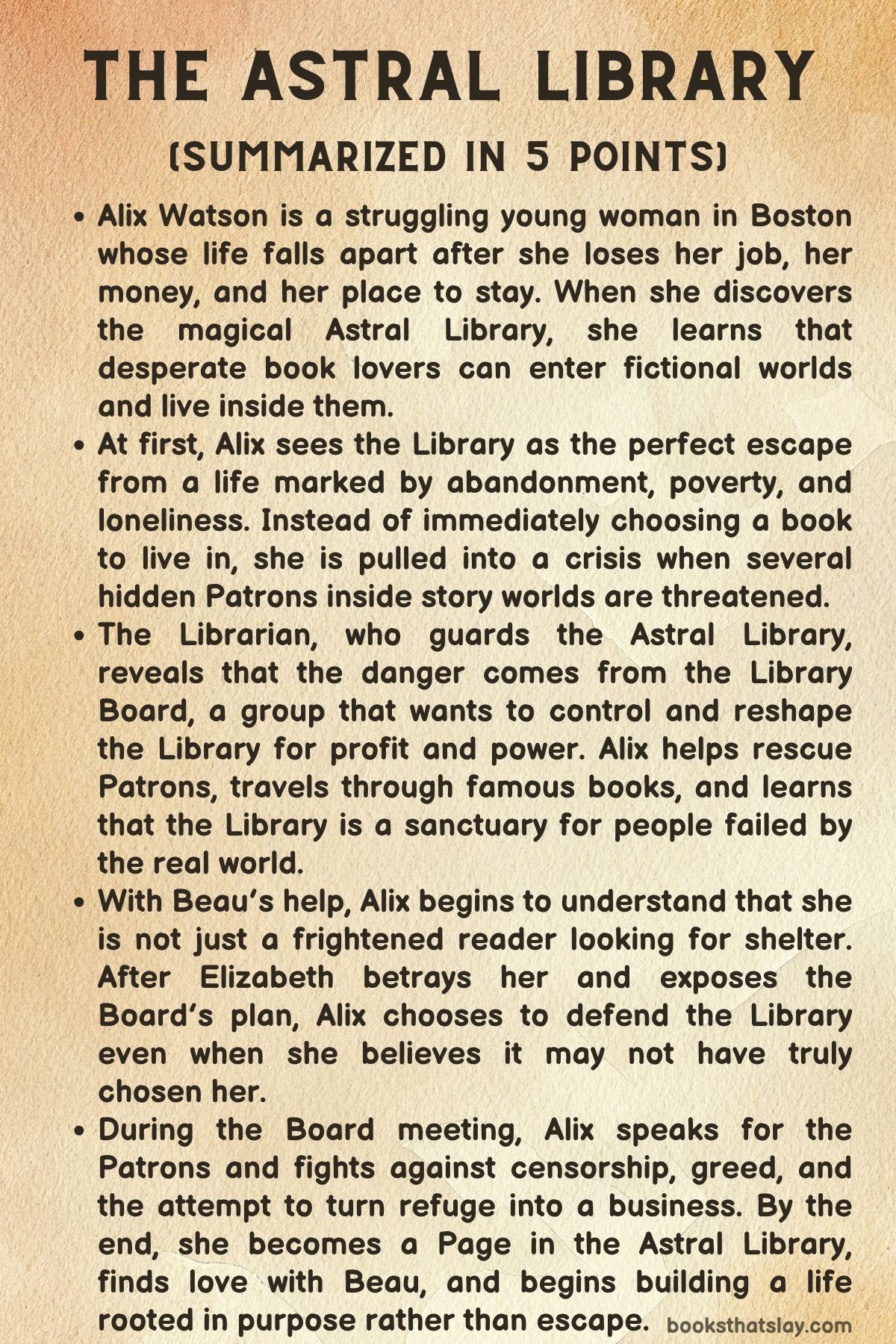
Summary
Alix Watson grows up dreaming of living inside a book because ordinary life has never felt safe or welcoming to her. Her mother abandoned her when she was a child, leaving her to move through foster homes where neglect and abuse taught her that the real world offered little protection.
The one possession that follows her through those years is a worn copy of The Voyage of the Dawn Treader. That book becomes more than entertainment; it becomes proof that somewhere, at least in imagination, there are worlds where a lonely girl might be wanted.
As an adult, Alix is twenty-six and barely holding her life together in Boston. She works part-time at a coffee shop and part-time as a Page at the Boston Public Library.
Her finances are fragile, her housing is unstable, and her sense of self-worth has been worn down by years of being treated as disposable. On one terrible day, her bank card is declined, she is humiliated at the grocery store, fired from the coffee shop after snapping at a rude customer, and told there are no extra library hours available.
Her roommate then kicks her out, leaving her facing homelessness.
In the middle of this collapse, Alix goes to the Boston Public Library, the one place that still feels close to safety. While wandering among the stacks, she finds a plain wooden door she has never seen before.
Hoping only for a place to hide, she opens it and enters a vast, impossible library. This strange place resembles a grand reading room but stretches endlessly, filled with restless books, strange clocks, green-glass windows, and maps of unknown worlds.
There she meets the Librarian, a sharp, ancient, practical woman who explains that Alix has entered the Astral Library.
The Astral Library exists beyond ordinary space and can be reached through libraries around the world. It offers refuge to people who are lost, desperate, and devoted to books.
Those invited inside may enter certain books and live within their worlds as background characters. They cannot replace the main characters or control the plot, and each person lives in a private version of the chosen story.
Once the known story ends, they may leave, stay, or continue into whatever life the book world becomes afterward. The Library can offer escape, but not perfect safety.
A person can be injured or killed inside a book, and time spent in a story passes in the real world as well.
For Alix, the choice seems simple. She has no stable job, no home, no family, and no reason to believe the real world wants her.
She begins considering which book might be best: safe enough to survive, but exciting enough to satisfy the longing that has sustained her since childhood. She plans to enter Around the World in Eighty Days and briefly leaves the Astral Library to visit Beau Sato-Jones, her friend and crush, who owns a handmade costume shop.
Beau is elegant, talented, and surrounded by beautiful people, which has always made Alix feel out of place beside him. Still, he treats her with warmth and respect, fitting her for a historically appropriate outfit and making her feel seen in a way she rarely has before.
Before Alix can begin her new life inside fiction, the Library is disturbed by a strange warning. A red catalog card appears, signaling that a Patron inside a book world may be in danger.
The Librarian hurries into a copy of The Adventures of Sherlock Holmes, and Alix impulsively follows. They arrive in London to rescue Sarah, a woman hiding from an abusive husband by living as Mrs. Hudson’s American niece.
Sarah refuses to leave at first because her book life has become real to her, but the threat forces the Librarian to act. Sherlock Holmes himself offers assistance, treating the situation as a mystery.
More warnings follow. Alix and the Librarian race through other book worlds, rescuing Patrons who have escaped violent spouses, abusive parents, transphobic families, and other dangers.
Alix learns that the Library is not simply a fantasy playground. It is a shelter for people whom the real world failed to protect.
The Librarian also reveals that, long ago, violent men tried to force their way into the Library to reclaim people who had escaped them, and the books defended themselves. This history makes the current attack feel less like an accident and more like a coordinated assault.
The Librarian calls for help from two other magical caretakers. The Gallerist, a beautiful gender-fluid figure, runs the Astral Gallery, where people may live within paintings.
The Programmer runs a similar refuge through video game worlds. The Gallerist hides endangered Patrons inside paintings, while the Programmer agrees to shelter others in games.
Their arrival shows that the Astral Library is part of a wider network of sanctuaries built from imagination, art, and story.
As the danger grows, Alix starts to notice something important: the red cards may not be warnings at all. They seem to be weapons designed to exhaust the Librarian.
Her suspicion proves correct when she and the Librarian are attacked by thousands of razor-sharp cards in the world of Wuthering Heights. The Librarian protects Alix and then reveals her true nature by transforming into a massive book dragon.
For Alix, who once imagined riding dragons to escape childhood pain, the moment is terrifying and wondrous. The Librarian carries her back to the Astral Library, wounded and drained.
The Library seals itself for protection, but the Librarian collapses. A message arrives from the Library Board, announcing that it intends to take control and force her retirement.
At the same time, Beau unexpectedly enters the Astral Library after finding a doorway at his local library branch. Alix explains the crisis to him.
At first he is startled, especially because he is under intense pressure to complete an important red-carpet dress for a plus-size actress playing Belle. Yet he soon helps Alix unlock the Library’s tablet, which grants her temporary Page privileges.
Alix and Beau decide to distract the Board by moving through books. They enter The Great Gatsby, where they are pursued by strange copies of two Boston Public Library guards, Chad and Chester.
Beau reveals a hidden sword inside his walking stick and fights them off, while Alix uses her knowledge of the story’s events to outwit them. They continue through several books, including The Three Musketeers, where Beau’s childhood love of costume, elegance, and adventure becomes clearer.
Alix realizes that Beau’s confident appearance hides his own exhaustion, loneliness, and pain. Their bond deepens, and they kiss.
The Board then turns its attention to Beau, threatening his business. Panicked by the time he has lost inside the books, he leaves the Astral Library through a door that briefly opens for him.
Alix feels abandoned again. Soon after, she receives a note that appears to be from her mother, claiming that she is also in danger.
Desperate for proof that her mother once chose a book world rather than simply rejecting her, Alix leaves the Astral Library and goes to the Boston Public Library. The note is a trap.
She accidentally injures Chad and is taken by Chester to a locked room.
Elizabeth, Alix’s supervisor at the library, reveals the truth. She is the President of the Library Board and has been manipulating Alix from the beginning.
She arranged Alix’s identity theft under the false name Libby Bibb, chose her because she seemed vulnerable, and forged a letter in Alix’s mother’s handwriting. Elizabeth wants to modernize the Astral Library according to a business model, replacing its sanctuary function with profit, programming, control, and efficiency.
She threatens Alix with arrest unless Alix opens the Library for the Board.
Broken by the discovery that the Library’s invitation may have been engineered, and by confirmation that her mother is alive with a new family, Alix feels more unwanted than ever. She wanders the city in despair until she finds a little free library and is pulled back into the Astral Library.
There, surrounded by the beauty and life of the place, she remembers that even if she was not chosen in the way she imagined, she can still choose. She chooses the Library.
The tablet grants her full Librarian access.
Alix contacts the Gallerist and Programmer and begins preparing for the Board meeting. She studies the Library’s bylaws, realizing that the best way to fight bureaucrats is to use their own procedures against them.
Beau returns, admitting he was wrong to leave her. He offers his help and brings her the completed Belle dress: a magnificent book dress made from recycled leather spines and vellum pages.
Wearing it, Alix faces the Board not as a frightened victim, but as the acting Librarian.
The Board meeting begins with formal procedures, censorship proposals, and Elizabeth’s attempt to restructure the Library. Alix files complaints against the Board for its violent attack and brings forward testimony from Patrons whose lives were saved by the Library.
People speak about abuse, isolation, fear, and the safety they found in book worlds. Alix argues that libraries should not be businesses.
They are among the few public places where people can exist without paying, learn without permission, and find protection when other systems fail them.
For a moment, it seems she may have reached the Board. Then Elizabeth proposes charging membership fees, selling book-world access in tiers, and evicting current Patrons.
Darla, another Board member, begins stamping books for removal, killing them with a red discard stamp. The Board’s true purpose becomes clear: it wants power, profit, censorship, and control, not stewardship.
When Elizabeth summons more false guards, the Library itself responds. Books attack the intruders, and Alix uses the Librarian’s great command of silence to awaken the Library’s defense.
Elizabeth is thrown out into the parchment sea, Darla is killed after attacking, and the remaining Board members flee.
A week later, the Librarian awakens and learns what Alix has done. She thanks her for saving the Library and admits that she underestimated the Board’s danger.
The rescued Patrons return to their chosen worlds, Beau continues visiting and working in the Wardrobe Department while maintaining his shop, and Alix realizes that she no longer wants to disappear permanently into a book. She wants to belong to the Library, but she also wants a life with Beau.
One year later, Alix works as a Page in the Astral Library and trains to become a full Librarian. She spends her days helping others find sanctuary and her evenings with Beau.
She has also begun developing her own book dragon form, marked by blue scales appearing on her back. Her future may eventually require hard choices, but for now she has something she never had before: a place, a purpose, and people who choose her.
She also begins reaching out to living authors for permission to open copyrighted worlds, carrying the Library into a new era without surrendering its soul.
Characters
Alix Watson
Alix Watson is the emotional center of the book, and her story is built around the painful question of what it means to be chosen. Her childhood abandonment leaves her with a deep fear that no one will ever prioritize her.
This fear shapes the way she moves through adulthood: underpaid, insecure, ashamed of needing help, and convinced that she is always one rejection away from losing everything. Books become her oldest survival tool, not because they erase pain, but because they give shape to hope when her real life offers little of it.
When she enters The Astral Library, she first sees it as a perfect escape, a place where she can finally stop fighting. Her growth begins when she realizes that escape is not the same as belonging.
She does not become heroic because she is fearless or powerful; she becomes heroic because she is observant, stubborn, compassionate, and deeply literate. Her knowledge of books becomes practical intelligence, and her history of survival gives her insight into the needs of other Patrons.
Alix’s most important transformation happens when she stops waiting for proof that she has been chosen and decides to choose something herself. By defending the Library, she claims agency over a life that has often made her feel powerless.
Her ending is not simple wish fulfillment. She does not vanish into fiction forever.
Instead, she finds a way to live between wonder and responsibility, love and work, imagination and reality.
The Librarian
The Librarian is a stern, ancient, protective figure whose sharpness hides deep devotion. At first, she seems almost anti-mystical in her refusal to treat Alix as a special chosen heroine.
She is practical, dry, impatient, and often dismissive, especially when Alix asks too many questions or behaves impulsively. Yet her severity comes from long experience.
She has seen countless desperate people enter the Library, and she understands the rules, risks, and costs of letting people live inside stories. Her role is not to romanticize escape, but to guard a system that can save lives while still being dangerous.
Her dragon form reveals the truth beneath her human exterior: she is not only a manager of books, but a creature of books, bound to their defense. The Librarian’s flaw is her habit of dismissing bureaucratic danger as nonsense.
Because she has survived more obvious forms of violence, she underestimates committees, restructuring plans, and official language until those forces become physically destructive. In The Astral Library, she represents old guardianship: powerful, principled, and devoted, but sometimes too isolated and too proud to ask for help.
Her relationship with Alix gradually shifts from irritation to trust. By offering Alix a place in the Library, she recognizes not only Alix’s bravery but also her suitability for stewardship.
Beau Sato-Jones
Beau Sato-Jones appears at first to be everything Alix is not: elegant, socially confident, professionally talented, and surrounded by beauty. His costume shop is a place of transformation, and he understands clothing as a way to imagine oneself into history, story, and possibility.
To Alix, who often feels too large, too poor, and too ordinary to belong in his glamorous world, Beau seems almost unreachable. Yet the book slowly reveals that his confidence is not the same as ease.
As a bisexual man of Black and Japanese heritage whose family does not fully understand his identity or career, Beau also carries the burden of being misread and underestimated. His love of historical fashion and The Three Musketeers is tied to childhood longing: he wanted elegance, drama, and beauty without being punished for wanting them.
Beau’s craftsmanship matters because it is not superficial. He dresses people into fuller versions of themselves.
The book dress he gives Alix before the Board meeting is both armor and recognition; he sees the queenly courage in her before she fully sees it in herself. His temporary departure after the Board threatens his business is painful, but it also makes him more human.
He is not a flawless romantic savior. He is a person under pressure who makes a frightened choice, regrets it, and returns.
His love for Alix is meaningful because it comes with respect for her mission, not a demand that she abandon it.
Elizabeth
Elizabeth is the novel’s clearest example of institutional cruelty hidden behind professionalism. Before her reveal, she appears to be an ordinary supervisor at the Boston Public Library, someone with authority over Alix’s precarious work life.
That ordinary position makes her betrayal especially cruel. She has watched Alix struggle and has deliberately used that struggle as leverage.
As President of the Library Board, Elizabeth believes in modernization, but her version of modernization is stripped of care. She speaks in the language of business models, monetized programming, restructuring, and efficiency, turning a sanctuary into a product.
Her villainy is not chaotic; it is administrative. She steals Alix’s identity, engineers her financial crisis, studies her abandonment wounds, forges her mother’s handwriting, and threatens her with the legal consequences of an accident.
Elizabeth’s danger lies in how well she understands systems and how little compassion she has for the people harmed by them. In The Astral Library, she stands for a worldview that treats public good as wasted potential unless it can be controlled or sold.
Her defeat is not only personal revenge for Alix; it is a rejection of the idea that safety, knowledge, and imagination should be available only to those who can pay or comply.
Sarah
Sarah is one of the most morally complicated Patrons in the book. She has escaped an abusive husband by living inside the Sherlock Holmes world, where she has built a life as Mrs. Hudson’s American niece.
Her terror when danger approaches is real, and her refusal to leave shows how deeply her book world has become home. Sarah is not presented as perfectly gentle or grateful.
She can be suspicious, harsh, and openly self-protective. Her warning to Alix not to trust the Library, and her statement that she would let it burn if that meant staying safe, reveal the survival logic of someone who has learned that institutions often fail victims.
This does not make her cruel in a simple sense; it makes her damaged and pragmatic. Alix recognizes this because she understands that suffering can crush softness out of people.
Sarah’s later decision to speak for the Library during the Board meeting matters because it shows that distrust and gratitude can exist together. She may not fully believe in any system’s goodness, but she knows what the Library gave her.
Her character prevents the story from making survivors unrealistically noble. She is afraid, defensive, and sometimes selfish, yet still deserving of safety.
The Gallerist
The Gallerist brings elegance, calm, and a wider sense of magical possibility to the story. As the keeper of the Astral Gallery, they show that books are not the only art form capable of sheltering human longing.
Paintings, like stories, can become worlds where people hide, heal, or begin again. The Gallerist’s gender-fluid presentation also fits the broader purpose of the sanctuary spaces: they protect people whose identities or needs have been rejected by ordinary society.
Unlike the Librarian, the Gallerist seems more socially graceful and more willing to intervene when help is needed. They understand the Librarian’s stubbornness but do not let it prevent action.
Their decision to contact the Programmer, despite the Librarian’s resistance, shows practical wisdom and emotional intelligence. The Gallerist also treats frightened Patrons with care, placing them into paintings that suit their needs rather than treating them as problems to be managed.
Their presence expands the book’s argument about imagination. Art is not decorative here; it is refuge.
The Gallerist represents the healing power of visual beauty, chosen identity, and collaborative protection.
The Programmer
The Programmer is another guardian of refuge, but his domain is digital rather than literary or visual. He runs a video game server where Patrons can live, showing that the need for imagined sanctuary continues into newer forms of storytelling.
His presence broadens the book’s definition of meaningful narrative. A game world can protect, absorb, and sustain people just as a classic novel or painting can.
His relationship with the Librarian carries hints of old affection and unresolved tension, which adds warmth and humor to the crisis. He is practical, capable, and willing to help even when the Librarian’s pride makes cooperation awkward.
The Programmer’s role also challenges narrow ideas about what belongs in a library. Elizabeth wants modernization through profit and control, but the Programmer embodies another kind of modernization: expansion without betrayal.
His games suggest that libraries can grow with technology while still serving imagination, access, and refuge. He becomes important not because he replaces books, but because he stands beside them.
Darla
Darla represents the censorious side of institutional power. While Elizabeth focuses on profit and control, Darla is obsessed with banning, discarding, and restricting books.
Her red discard stamp becomes one of the novel’s most violent symbols because it turns bureaucratic removal into murder. When she stamps a book and it dies, the story makes literal what censorship does metaphorically: it silences a living source of thought, memory, and possibility.
Darla’s concern for children is especially revealing because she uses protection as a mask for control. She claims to care about safety, but her actions narrow what people are allowed to read, imagine, and become.
She is the kind of character who treats discomfort as danger and difference as contamination. Her attack on the Library is not only physical but ideological.
She wants a world where books obey approved limits. Her death during the confrontation is brutal, but it follows her own escalation.
By trying to destroy living books and attack Alix, she becomes part of the violence the Library has the right to resist.
Alix’s Mother
Alix’s mother is mostly absent, but that absence shapes Alix’s entire inner life. For years, Alix tries to make sense of being abandoned by imagining possibilities that hurt less than the truth.
Maybe her mother disappeared into a book world. Maybe she had a reason.
Maybe she chose escape because life was unbearable, not because Alix was unwanted. These imagined explanations show how children often protect themselves from rejection by creating stories that soften it.
When Elizabeth reveals that Alix’s mother is alive, married, and raising another daughter, the wound becomes sharper. Alix is forced to face not a magical disappearance but an ordinary abandonment.
Her mother’s role in the story is therefore less about who she is as a person and more about what her absence has done. She becomes the first unanswered question in Alix’s life: Why wasn’t I enough to keep?
Alix’s growth depends on realizing that her mother’s failure does not define her worth. The book does not require a reunion or apology to heal Alix.
Instead, it lets her build belonging elsewhere.
Chad and Chester
Chad and Chester function both as ordinary antagonists in the Boston Public Library and as distorted weapons of the Board inside book worlds. In real life, Chester treats Alix like a nuisance, reinforcing her sense that even public spaces can become hostile when guarded by people without compassion.
Chad’s role becomes more serious when Alix accidentally injures him, giving Elizabeth legal leverage. Their copied versions inside books are more symbolic than personal.
The simulacra of Chad and Chester are crude instruments of pursuit, control, and intimidation. They represent the way authority can reproduce itself across spaces, following vulnerable people even into places meant for refuge.
Beau’s sword fights with them and Alix’s use of plot knowledge against them add adventure and humor, but the underlying meaning remains serious. These figures show how easily institutional power turns guards into threats when protection is aimed at property, rules, or hierarchy rather than people.
Themes
Libraries as Sanctuary
Libraries in this story are not treated as quiet rooms filled with shelves; they are living shelters for people who have nowhere else to go. The Astral Library offers something more radical than entertainment.
It gives abused spouses, endangered children, isolated readers, and rejected young people a place where imagination becomes survival. This matters because the real world of the book repeatedly fails vulnerable people through family neglect, financial precarity, workplace cruelty, and legal threats.
The Library’s power lies in its refusal to demand payment, status, beauty, or usefulness from those who enter. Alix’s speech during the Board meeting makes this idea clear: a library is one of the few places where a person can exist without buying something.
The fantasy premise heightens a real social truth. Public libraries often serve people whose needs are ignored elsewhere, including children, unhoused people, workers, students, and lonely readers seeking warmth or knowledge.
The Board wants to convert that sanctuary into a managed product, but the story insists that care cannot be measured only through profit. A true library protects access, privacy, curiosity, and rest.
Its purpose is not merely to store books, but to defend the human right to seek refuge in knowledge and story.
Choosing Belonging After Abandonment
Alix’s deepest wound is not poverty alone, but the belief that no one has ever chosen her. Her mother leaves, foster homes fail her, employers treat her as disposable, her roommate pushes her out, and even the magical invitation seems, for a time, to have been manipulated by the Board.
This repeated rejection teaches her to see herself as temporary in every room she enters. The fantasy of living inside a book is so powerful because it appears to offer permanent escape from that feeling.
Yet the story gradually shifts the meaning of belonging. Alix begins by wanting to be chosen by a place, a person, or a destiny.
By the end, she understands that belonging can also begin with her own choice. When she says, in effect, that even if the Library did not choose her, she chooses it, she stops letting rejection define the limits of her life.
This is not a simple cure for abandonment. The pain of her mother’s new family still matters, and Beau’s temporary departure still hurts.
But Alix learns that being wanted is not the only source of identity. She can act, protect, love, and commit.
Her place in the world forms through responsibility as much as rescue.
The Violence of Bureaucracy and Profit
The Board’s threat is frightening because it arrives in polished language. Elizabeth does not present herself as a monster; she speaks of modernization, restructuring, programming, membership models, and business efficiency.
This makes her especially dangerous. The book shows how harm can be carried out through meetings, policies, forms, and official decisions as easily as through open violence.
Elizabeth steals Alix’s identity, manipulates her trauma, and threatens her with arrest, yet she frames her larger plan as administrative improvement. Darla’s discard stamp works the same way.
It looks like a tool of routine library management, but in the magical reality of the story, it kills books. This literalizes the damage caused when institutions hide cruelty behind procedure.
The Board’s profit model also attacks the moral foundation of the Library. Charging people for access to safety would turn refuge into a privilege.
Evicting Patrons in the name of liability would punish the very people the Library exists to protect. The story does not reject change or technology; the Gallerist and Programmer prove that imaginative spaces can expand.
What it rejects is modernization without ethics. Systems become violent when rules matter more than people and profit matters more than care.
Censorship, Knowledge, and Resistance
Censorship appears through Darla’s desire to ban and discard books, but the theme extends beyond one character. The Board wants a Library that avoids controversy, limits risk, and controls access.
That desire reflects a fear of what books can do: comfort the rejected, educate the excluded, anger the powerful, and give language to people who have been silenced. When Darla kills books with her stamp, the act turns censorship into visible death.
A banned or destroyed book is not just an object removed from a shelf; it is a possibility denied to a reader who might have needed it. Alix’s defense of the Library is therefore also a defense of intellectual freedom.
She understands that tyrants target knowledge because knowledge helps people imagine alternatives to obedience. The story connects reading with resistance, especially for those trapped by abuse, prejudice, poverty, or loneliness.
Books do not solve every danger in the novel, and some book worlds are risky in their own right, but they create space for thought and choice. The Library’s final act of self-defense suggests that knowledge is not passive.
When threatened by those who would censor, sell, or control it, story has the power to fight back.