I Came Back for You Summary, Characters and Themes
I Came Back for You by Kate White is a psychological suspense novel about a mother forced to question the story she has lived with for years. Bree Winter has tried to rebuild her life in Uruguay after the murder of her daughter, Melanie, at Carter College in New York.
When new information suggests that the convicted serial killer blamed for Melanie’s death may not have killed her, Bree returns to the place where her life broke apart. The novel follows her search for the truth, her strained bond with her ex-husband, and the painful secrets hiding beneath a polished college community.
Summary
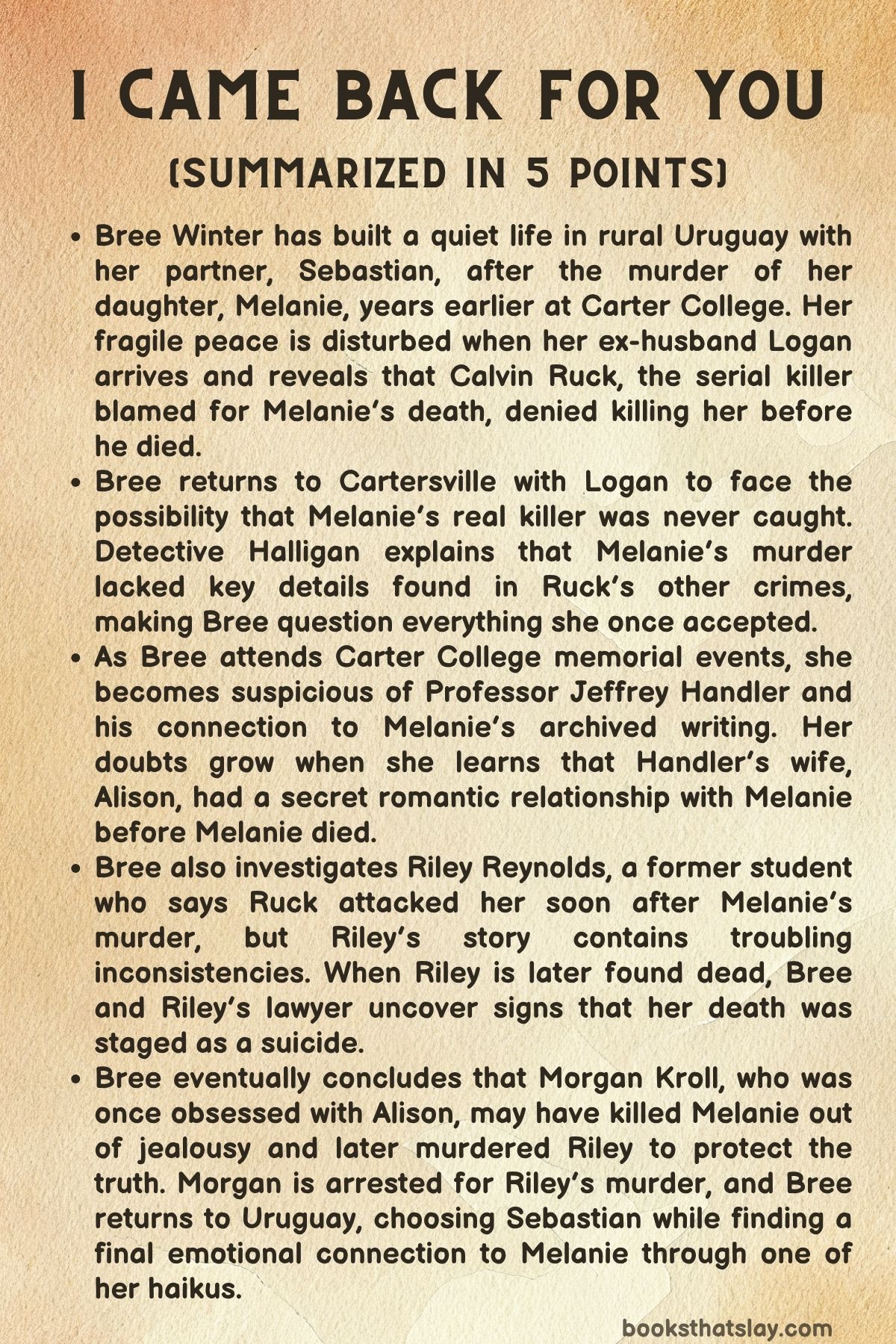
Bree Winter has built a quiet, guarded life in rural Uruguay with her partner, Sebastian. Years earlier, her daughter, Melanie, was murdered while attending Carter College in Cartersville, New York, and Bree’s old life collapsed under the weight of grief.
The man believed responsible was Calvin Ruck, a serial killer whose crimes seemed to explain the horror that had taken Melanie from her. Bree has tried to accept that version of events because it gave the tragedy a shape, even if it never gave her peace.
At the start of I Came Back for You, Bree is already uneasy. Sebastian has gone to Buenos Aires on family business, leaving her alone at their home.
Her anxiety worsens when their dog, Poco, becomes sick and has to stay overnight at the vet. In this vulnerable moment, Bree receives an unexpected visit from her ex-husband, Logan, who has traveled from the United States.
His arrival shakes her, partly because of their shared past and partly because he represents the life she fled after Melanie’s death.
Logan first claims he has come to ask Bree to attend a Carter College reception honoring Melanie’s memory. The college has established scholarships in Melanie’s name and renovated the office of a literary magazine connected to her interests.
Bree is reluctant, but Logan soon admits that the reception is not the real reason for his visit. Before dying, Calvin Ruck confessed to several murders, but he insisted that he did not kill Melanie.
Logan believes Bree needs to know, even if the news reopens the worst wound of her life.
Bree resists the possibility at first. She sees Ruck’s denial as one final act of cruelty from a man who damaged many lives.
Yet the doubt begins to take hold after she speaks with David Schmidt, Ruck’s former lawyer. Schmidt believes there may be truth in what Ruck said.
Bree can no longer ignore the question that follows: if Ruck did not murder Melanie, then someone else did, and that person may have been much closer to Melanie than anyone realized.
Bree decides to return to Cartersville. Sebastian offers to accompany her, but she chooses to go alone.
The journey is not only a search for facts but also a return to the setting of her greatest loss. In New York, Logan meets her, and they begin speaking with Detective Halligan, who is willing to revisit the old case.
Halligan explains that the details of Ruck’s confirmed crimes do not fully match Melanie’s murder. His other victims were hidden after death and had bite marks on their right index fingers.
Melanie’s body did not fit that pattern, and she had no such marks. These differences raise the possibility that her death may have been wrongly attributed to Ruck.
As Bree and Logan attend Carter College events honoring Melanie, Bree begins to observe the people around the campus with new suspicion. Professor Jeffrey Handler, one of Melanie’s former teachers, unsettles her.
He seems uncomfortable when Bree asks about Melanie’s archived writing, and Bree notices him behaving closely with a female student. Because Melanie had been a talented young writer, her poems and haikus become important clues for Bree.
At a dinner hosted by college president Maya Williams, Bree meets Handler’s wife, Alison, an artist. Bree learns that the Handlers live on Birch Street, which causes her to rethink one of Melanie’s haikus about “returning to birch.” Bree had once hoped the line referred to herself, but now she fears it may point to another relationship or place in Melanie’s life.
The investigation takes a new turn when Halligan introduces Bree and Logan to Riley Reynolds, a former Carter student. Riley says that two nights after Melanie was murdered, Ruck raped and nearly killed her in a nearby park.
According to Riley, she never reported the attack because she came from a strict religious family and feared their reaction. She says she told only one person at the time: Morgan Kroll, who had been a teaching assistant in the English department.
Riley’s account seems important because it connects Ruck to the area around Melanie’s death, yet Bree begins to notice problems in the story.
Bree looks into Morgan, but her doubts about Riley also grow. Certain details do not seem to add up, including the date of the attack and Riley’s claim that the creek could have carried her away.
When pressed, Riley admits that she lied about the date. She also says one person knew the truth.
Before Bree can meet with her again and learn more, Riley is found hanged in the house where she has been staying. At first, the death appears to be suicide, but Bree and Riley’s lawyer, Hilary, notice details that suggest otherwise.
There are extra coffee pods, an extra mug, and signs that the dishwasher was run to destroy evidence. These clues point toward murder.
While trying to understand Melanie’s final months, Bree visits Alison Handler’s studio. There she discovers paintings of Melanie and learns a devastating secret: Alison and Melanie had been lovers in the fall before Melanie died.
This revelation changes Bree’s understanding of her daughter’s life. Melanie had been keeping parts of herself hidden, and the emotional landscape around her was more complicated than Bree knew.
Bree also begins to see Morgan Kroll in a darker light. Morgan had once been obsessed with Alison, and Melanie may have seemed like a rival for Alison’s affection.
Bree forms a theory. Riley had told Morgan details about Ruck’s attack.
Morgan could have used those details to kill Melanie in a way that made the crime look connected to Ruck, even though Melanie’s murder did not fully match his later pattern. If Morgan was jealous of Melanie because of Alison, she had both motive and access to information that could confuse the investigation.
When Bree approaches Morgan indirectly, Morgan’s behavior becomes alarming. Bree senses danger and manages to get away, then tells Logan what she believes.
The case against Morgan begins to strengthen after Riley’s death. Police find evidence linking Morgan to Riley’s murder, including security footage of her buying orange electrical cord.
Toxicology results also show that Riley had been drugged with clonazepam. These findings support the idea that Riley did not kill herself and that Morgan staged the scene.
Morgan is arrested for Riley’s murder, though the evidence tying her directly to Melanie’s death is still developing. Detective Halligan believes the case may continue to build as more proof is found.
Throughout the investigation, Bree and Logan are drawn back into the emotional closeness created by their shared loss. They are both shaken by what they learn and by the possibility that the truth about Melanie was missed for years.
In the middle of the ordeal, they sleep together. Yet Bree understands that this does not mean they can rebuild their marriage.
Their connection is real, but it belongs to grief, history, and the desperate search for answers. Bree ultimately rejects the idea of returning to Logan.
After Morgan’s arrest, Bree goes back to Uruguay. She tells Sebastian enough about what happened for him to understand the emotional and physical betrayal, and he agrees to move forward with her.
Their relationship is not magically repaired, but it remains alive. Bree also learns that more evidence is emerging to support Morgan’s guilt.
The truth about Melanie’s murder, though still painful, finally feels closer than it has in years.
Back home, Bree decides to publish Melanie’s writings privately. This choice allows her to honor her daughter not only as a victim but as a young woman with thoughts, talent, secrets, and a voice of her own.
Logan later tells Bree that one of Melanie’s haikus was indeed about Bree after all. The knowledge wounds and comforts her at the same time.
It gives Bree a final connection to Melanie, not through the investigation or the crime, but through love.
By the end of I Came Back for You, Bree has not erased her grief, but she has reclaimed part of the truth. The novel closes with a sense of hard-won clarity.
Melanie’s death was not what Bree had been told, and the people around her daughter had hidden painful secrets. Still, Bree comes away with something more than a solved case.
She gains a fuller picture of Melanie’s life, a renewed understanding of her own choices, and a fragile path forward.
Characters
The characters in I Came Back for You are shaped by grief, guilt, secrecy, obsession, and the painful need for truth. Each character contributes to the emotional and psychological tension of the story, either by helping Bree Winter uncover the truth about Melanie’s death or by revealing how deeply the past continues to affect the present.
Bree Winter
Bree Winter is the emotional center of the book, a grieving mother whose life has been permanently altered by the murder of her daughter, Melanie. At the beginning of the story, Bree has built a quiet and somewhat isolated life in rural Uruguay with Sebastian, suggesting that her peace is fragile rather than complete.
Her decision to live far from the United States reflects her desire to escape the memories, institutions, and unanswered pain connected to Melanie’s death. However, when Logan arrives with the news that Calvin Ruck may not have killed Melanie, Bree is forced back into the very past she has tried to survive.
Her character is defined by both vulnerability and determination. She initially resists the possibility that the old explanation was wrong because accepting it would mean reopening her grief, but once doubt enters her mind, she cannot ignore it.
Bree’s investigation shows her intelligence, emotional sensitivity, and courage. She notices small inconsistencies, reads people carefully, and follows emotional clues as much as factual ones.
Her grief also makes her deeply human; she wants Melanie’s haikus to contain a message for her, and this desire shows how badly she longs for a final connection with her daughter. Bree’s journey is not simply about solving a crime, but about confronting uncertainty, accepting painful truths, and choosing life after loss.
By the end, she does not return to who she was before Melanie’s death, but she gains a clearer understanding of the past and a more honest foundation for her future with Sebastian.
Melanie Winter
Melanie Winter is physically absent from the present action, but her presence shapes nearly every major event in the story. She is remembered as Bree and Logan’s murdered daughter, yet the book gradually reveals that she was more than just a victim.
Through her writing, her relationships, and the memories others hold of her, Melanie emerges as creative, emotionally complex, and private. Her haikus become especially important because they give Bree a way to feel close to her, while also creating uncertainty about what Melanie was thinking and whom she was writing about before her death.
Melanie’s relationship with Alison adds another layer to her character, showing that she had a hidden emotional and romantic life that her mother did not fully know. This secrecy does not make Melanie deceptive in a simple way; instead, it makes her feel like a young woman trying to understand her own desires, attachments, and identity.
Her death becomes even more tragic because it was not only the loss of a daughter, but the loss of a person whose inner life was still unfolding. Melanie’s character also exposes the limits of parental knowledge.
Bree loved her deeply, but she did not know everything about her, and that gap becomes one of the painful truths Bree must accept.
Logan Winter
Logan Winter is Bree’s ex-husband and Melanie’s father, and his role in the story is closely tied to shared grief, regret, and unfinished emotional history. His unexpected arrival in Uruguay disrupts Bree’s carefully protected life, but it also shows that he still feels connected to her through their daughter’s death.
Logan is not simply a messenger; he is someone who has also lived under the weight of Melanie’s murder and the belief that Calvin Ruck was responsible. His willingness to travel to Bree and involve her in the new information suggests that he understands the seriousness of what Ruck’s final confession could mean.
Throughout the investigation, Logan becomes Bree’s companion in revisiting the past, and their shared pain temporarily draws them close again. Their emotional and physical intimacy during the ordeal reveals the lingering bond between them, but it also shows how grief can blur boundaries.
Logan represents both comfort and danger for Bree: he understands her loss in a way Sebastian cannot, yet returning to him would also mean becoming trapped in the past. By the end, Bree’s rejection of reconciliation with Logan is important because it shows that she can honor their shared grief without rebuilding her life around it.
Sebastian
Sebastian is Bree’s partner in Uruguay and represents the quieter, more stable life Bree has tried to create after Melanie’s murder. He is caring and supportive, especially when Bree becomes anxious about being alone and when Poco falls ill.
His offer to accompany Bree to New York shows his loyalty, but Bree’s choice to go alone suggests that the journey into Melanie’s past is something she must face personally. Sebastian’s character is significant because he is not part of the original tragedy, yet he must live with its emotional consequences.
He loves Bree, but he also has to accept that there are parts of her grief and history that he cannot fully enter. This makes him a figure of patience and emotional maturity.
When Bree returns and confesses enough for him to understand what happened with Logan, Sebastian’s willingness to move forward shows that his love is grounded in realism rather than illusion. He is not portrayed as dramatic or forceful; instead, his strength lies in steadiness.
In the story, Sebastian represents the possibility of life after devastation, but only if that life is built on honesty.
Poco
Poco, Bree and Sebastian’s dog, has a small but meaningful role in the story. His illness at the beginning increases Bree’s sense of vulnerability and isolation while Sebastian is away.
Because Poco has to stay overnight at the vet, Bree is left alone at a moment when she already feels uneasy, creating the emotional atmosphere for Logan’s sudden arrival. Poco also helps reveal Bree’s need for comfort and companionship.
In her rural life, he is part of the fragile peace she has built, and his absence makes that peace feel less secure. Although Poco is not central to the mystery, his presence adds domestic realism to Bree’s life in Uruguay and highlights how even ordinary disruptions can feel threatening to someone carrying deep grief.
Calvin Ruck
Calvin Ruck is the serial killer long believed to have murdered Melanie, but his final confession changes the direction of the entire story. Even after death, he remains a disturbing presence because his words force Bree, Logan, and the police to question what they thought they knew.
Ruck is frightening not only because of the murders he committed, but because of the uncertainty he leaves behind. Bree’s first reaction is to believe that he is lying in order to torment them, which fits the cruelty associated with his character.
Yet the possibility that he told the truth makes him more complicated as a plot force. He becomes both a monster and an accidental source of truth.
His known crimes also create the pattern that allows investigators to compare Melanie’s death with his confirmed victims. The absence of the details found in Ruck’s other crimes becomes crucial, making him central to the process of clearing away a false explanation.
Ruck’s role shows how easily a convenient answer can harden into accepted truth, especially when that answer seems to fit a terrifying criminal.
David Schmidt
David Schmidt, Ruck’s former lawyer, plays an important role in pushing Bree toward doubt. Because he believes Ruck may have been telling the truth, he gives weight to a claim Bree initially wants to reject.
Schmidt’s position is uncomfortable because he is connected to a criminal, yet his perspective cannot simply be dismissed. As a lawyer, he has had access to Ruck in a way others have not, and his belief that the confession may be meaningful forces Bree to take the matter seriously.
His character functions as a bridge between the old certainty and the new investigation. He does not solve the mystery himself, but he helps open the door to the possibility that Melanie’s case was misunderstood.
Schmidt’s importance lies in the fact that he challenges Bree’s emotional instinct to protect herself from further pain.
Detective Halligan
Detective Halligan represents the official investigative side of the story, but he is not portrayed as careless or dismissive. When Bree and Logan meet him, he explains the differences between Melanie’s murder and Ruck’s confirmed crimes, especially the missing details involving hidden bodies and bite marks.
His willingness to consult further experts suggests that he is open to reconsidering the case rather than defending the old conclusion blindly. Halligan’s role is important because he gives structure and credibility to the investigation.
While Bree follows emotional and personal leads, Halligan provides forensic and procedural grounding. Later, his belief that the case against Morgan may build shows that he recognizes the significance of the new evidence even when everything has not yet been proven.
He is a stabilizing figure in a story filled with uncertainty, and his carefulness helps prevent the investigation from becoming only a matter of suspicion.
Jeffrey Handler
Professor Jeffrey Handler is one of the characters who initially attracts Bree’s suspicion. As Melanie’s former teacher, he is connected to her college life and therefore to the world Bree must reexamine.
His uneasiness when Bree asks about Melanie’s archived writing makes him appear evasive, and his close interaction with a female student adds to the sense that there may be something inappropriate or hidden about him. Handler is important because he represents the academic environment where Melanie lived, wrote, formed relationships, and may have kept secrets.
His behavior encourages Bree to question the people around Melanie, even though he is not ultimately the central villain. As a character, Handler helps create misdirection and tension.
He also reveals how easily suspicion can fall on someone who seems uncomfortable, secretive, or morally questionable. Through him, the story explores the atmosphere of power, intimacy, and ambiguity that can exist between professors and students.
Alison Handler
Alison Handler is one of the most emotionally revealing characters in the book because she exposes a hidden part of Melanie’s life. As Jeffrey Handler’s wife and an artist, Alison first appears connected to Bree’s suspicions through her marriage and her home on Birch Street.
However, the discovery of paintings of Melanie in her studio transforms her role. Alison’s admission that she and Melanie were lovers shows that Melanie had a deeply private relationship before her death, one that complicates Bree’s understanding of her daughter.
Alison is not merely a source of information; she is someone who loved Melanie and preserved her image through art. Her paintings suggest longing, memory, and perhaps guilt.
She also becomes central to understanding Morgan’s motive, since Morgan’s obsession with Alison may have turned Melanie into a perceived rival. Alison’s character adds emotional depth to the mystery by showing that love, secrecy, and jealousy were all present around Melanie before she died.
Maya Williams
Maya Williams, the president of Carter College, represents the institution’s public face and its attempt to honor Melanie through scholarships and a renovated literary magazine office. Her dinner gathering places Bree among people connected to Melanie’s past and allows important social tensions to surface.
Maya’s role is not as personally intense as Bree’s, Logan’s, or Alison’s, but she helps show how the college has turned Melanie’s memory into a formal legacy. This is meaningful because public memorials can never fully capture private grief.
To the college, Melanie is a remembered student whose name can be attached to scholarships and literary spaces; to Bree, she is a daughter whose life and death remain painfully unresolved. Maya’s character therefore helps contrast institutional remembrance with personal mourning.
She also helps bring together people whose connections to Melanie may otherwise have remained separate.
Riley Reynolds
Riley Reynolds is one of the most tragic characters in the story because she survives violence only to become a victim later. As a former Carter student, she claims that Ruck raped and nearly killed her shortly after Melanie’s murder.
Her account initially appears to strengthen the idea that Ruck was active near the college, but inconsistencies in her story begin to trouble Bree. Riley’s lie about the date does not make her unsympathetic; instead, it shows how trauma, fear, shame, and family pressure can distort the way a survivor tells the truth.
Her strict religious parents help explain why she did not report the assault, and her decision to confide in Morgan becomes devastating in hindsight. Riley’s character is important because her suffering becomes part of the pattern Morgan manipulates.
She is both a survivor and a witness, someone whose private pain is exploited by another person. Her death by staged hanging is especially cruel because it attempts to erase her voice just as she is close to revealing the truth.
Riley’s character shows how vulnerable people can be harmed not only by violence itself, but by the silence and secrecy that follow it.
Morgan Kroll
Morgan Kroll is the most disturbing and morally corrupt character in the story because her actions appear to grow out of obsession, jealousy, manipulation, and self-protection. As a former teaching assistant in the English department, she had access to the college world surrounding Melanie, Alison, and Riley.
Her obsession with Alison gives her a motive for seeing Melanie as a rival, and her knowledge of Riley’s assault gives her the material she needs to shape Melanie’s murder in a way that could later resemble Ruck’s crimes. This makes Morgan especially chilling because she does not act out of sudden rage alone; she appears capable of planning, imitation, and emotional deception.
Her later behavior toward Bree becomes frightening because Bree is getting too close to the truth. Morgan’s murder of Riley shows her willingness to kill again to protect herself, and the evidence involving the orange electrical cord, clonazepam, coffee pods, and erased traces reveals a calculating mind.
Morgan is not just a hidden killer; she is someone who uses other people’s trauma as a tool. Her character gives the story its darkest psychological dimension because she turns intimacy, confidence, and personal knowledge into weapons.
Hilary
Hilary, Riley’s lawyer, plays a practical but important role after Riley’s death. She helps Bree notice the clues that suggest Riley did not die by suicide, including the extra coffee pods, the extra mug, and the dishwasher being run to remove evidence.
Hilary’s presence gives Riley some dignity after death because she does not allow the scene to be accepted too quickly at face value. She supports Bree’s growing belief that Riley was murdered and helps shift attention toward the possibility of staged evidence.
As a character, Hilary represents careful observation and advocacy. Her connection to Riley also shows that Riley was not completely alone, even though much of her trauma had been hidden.
Hilary’s role may be smaller than Bree’s or Morgan’s, but she contributes directly to uncovering the truth.
Themes
Grief and the Need for Truth
Bree’s life has been shaped by the loss of Melanie, but her grief is not still or complete. It follows her into Uruguay, into her relationship with Sebastian, and into every choice she makes when new doubts appear about the murder.
The possibility that Calvin Ruck may not have killed Melanie forces Bree to face a painful question: whether the story she has accepted for years was only a shield against uncertainty. In I Came Back for You, grief is shown as something that can settle into daily life while still remaining unfinished.
Bree does not return to Cartersville simply because she wants answers from the police; she returns because a mother’s love cannot rest when her child’s death may have been misunderstood. Her search for truth becomes a way of honoring Melanie, even though each discovery reopens old wounds.
The theme shows that healing is not the same as forgetting, and that truth, however painful, can become necessary for survival.
Memory and the Search for Connection
Melanie exists in the present through fragments: her writings, her haikus, the memorial events, the scholarship in her name, and the memories held by others. Bree’s emotional journey is driven by her need to understand who Melanie was beyond the role of daughter.
Each new revelation complicates Bree’s memory of her, especially the discovery of Melanie’s relationship with Alison. Rather than weakening Bree’s love, these discoveries expand it, because they allow her to see Melanie as a full person with desires, secrets, and private experiences.
The haikus become especially important because they carry emotional meaning that Bree longs to decode. Her hope that one poem might refer to her reveals the deep ache of a parent who wants proof that love was returned and understood.
This theme shows how memory can both comfort and torment. Bree is not only solving a crime; she is trying to recover an emotional bond with someone who can no longer explain herself.
Deception and Hidden Motives
The mystery depends on the difference between what people say and what they conceal. Riley’s false statement about the date of her attack, Morgan’s hidden obsession, Alison’s secret relationship with Melanie, and even Logan’s delayed confession about the real reason for his visit all show how truth can be buried under fear, shame, desire, or self-protection.
Deception is not presented as one simple act of lying; it appears in layers, often beginning with silence. Some characters hide facts to avoid judgment, while others hide facts to protect themselves from guilt or suspicion.
Morgan’s deception is the darkest because it uses another person’s trauma as cover for murder. By borrowing details from Riley’s attack, Morgan turns knowledge into a weapon and allows suspicion to fall in the wrong direction.
This theme gives the story its moral tension. The danger does not come only from violence, but from the way hidden motives can distort reality until the innocent are forgotten and the guilty remain close.
Love, Loyalty, and Emotional Betrayal
Love in the story is rarely simple. Bree loves Melanie with a devotion that survives death, yet she must accept that her daughter had a private life she did not fully know.
Sebastian loves Bree enough to offer support without forcing himself into her investigation, while Logan’s presence brings both shared grief and unresolved emotional history. Bree and Logan’s brief return to intimacy reveals how trauma can pull people together, especially when they are the only ones who fully understand a particular loss.
Yet Bree’s decision not to reunite with him shows emotional clarity. Shared pain is powerful, but it is not the same as a future.
The theme also appears in darker forms through Morgan’s obsession with Alison and resentment toward Melanie. Love becomes dangerous when it turns possessive and refuses another person’s freedom.
Through these relationships, the story suggests that real loyalty requires honesty, restraint, and the courage to let people exist beyond one’s own need for them.