The Calamity Club Summary, Characters and Themes
The Calamity Club by Kathryn Stockett is a historical novel set in Depression-era Mississippi, where poverty, social judgment, racial prejudice, and restrictive laws determine which women are considered respectable and which are treated as disposable.
The story follows Birdie Calhoun, a practical rural woman trying to save two families from financial ruin, and Margot “Meg” Lefleur, an intelligent orphan fighting to escape an abusive institution. Their lives become connected through Charlie Lefleur, Meg’s determined mother, and Garnett Pittman, a powerful reformer who uses religion and eugenics to disguise personal cruelty. Through scandal, secrecy, friendship, and rebellion, the novel examines how vulnerable women create their own forms of protection.
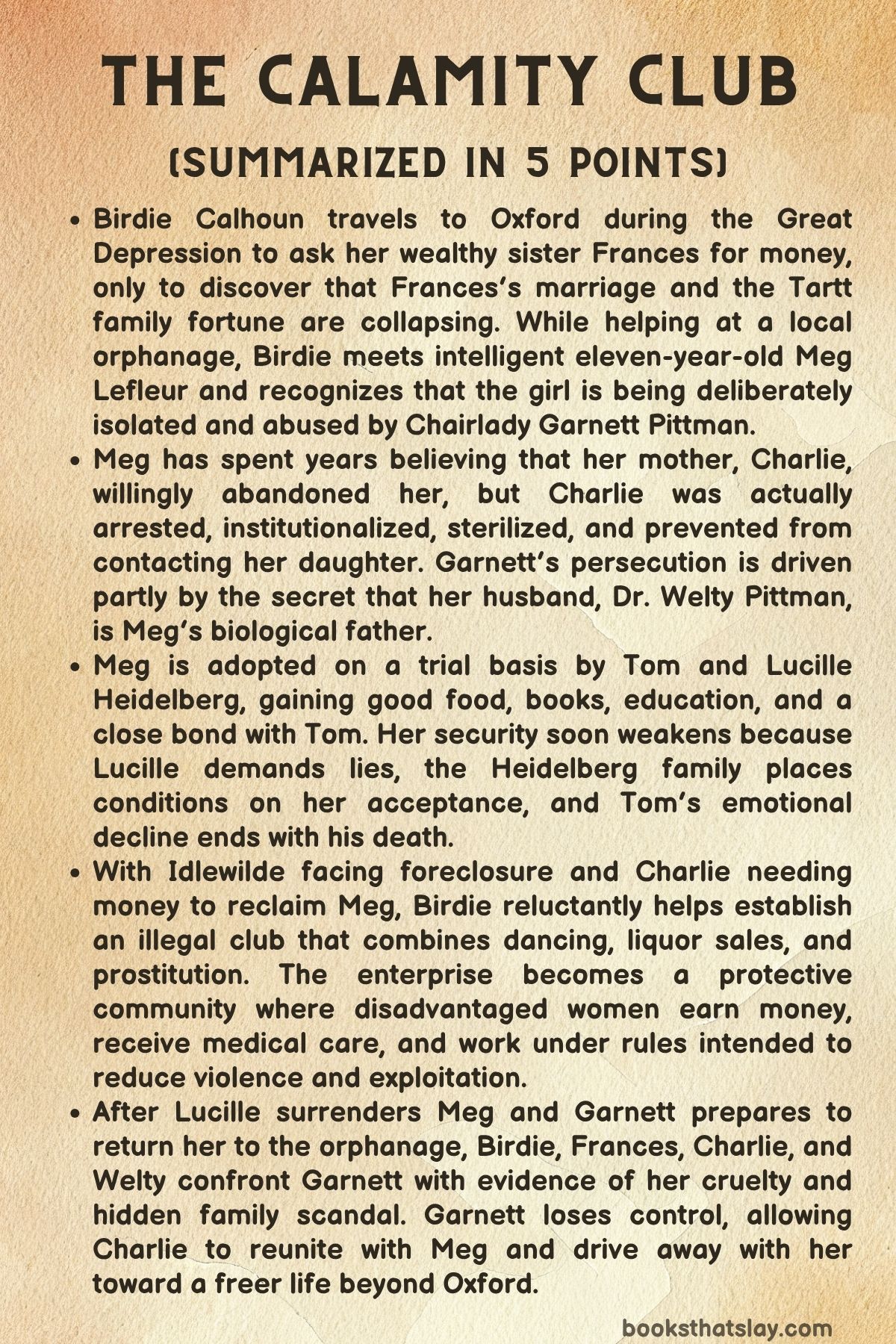
Summary
In September 1933, Birdie Calhoun enters an Oxford drugstore on a secret errand and purchases ninety-nine contraceptive devices known as Merry Widows. Although she is an unmarried, churchgoing woman, she insists that the devices are intended for someone else, and her nervousness makes it clear that she has become involved in a dangerous enterprise.
Two years earlier, eleven-year-old Margot “Meg” Lefleur is living at the Lafayette County Orphan Asylum for Girls. She once believed that her mother, Charlie, would return for her, but her best friend Ava forced her to accept that abandoned children rarely see their mothers again.
The orphanage presents a pleasant public image while treating its older girls with neglect and contempt. Babies and toddlers receive clean rooms, toys, and adoption opportunities, whereas girls such as Meg sleep in poor conditions, eat inadequate meals, and face removal to factory work when they turn twelve.
Chairlady Garnett Pittman exercises strict control over the institution and regards Meg as the daughter of an immoral, supposedly feebleminded woman. She removes Meg from school after a satirical drawing is declared blasphemous, confines her to a moldy office, blocks her access to letters, and repeatedly punishes her for curiosity or disobedience.
Before entering the orphanage, Meg lived with Charlie, an intelligent and unconventional woman who taught her to read, dance, behave confidently, and lie when survival required it. Charlie worked for a wealthy family until an anonymous accusation destroyed her employment, after which poverty gradually forced her toward sex work.
Birdie, meanwhile, lives in Footely with her mother Doris and her grandmother Meemaw. The family is falling behind on property taxes, so Birdie is sent to Oxford to ask her estranged sister Frances for money.
Frances has married wealthy banker Roderick “Rory” Tartt and lives at Idlewilde, an enormous family mansion. Birdie arrives expecting comfort and prosperity but quickly notices that Frances is lonely, Rory avoids intimacy, bills are being ignored, and the household’s polished appearance conceals serious disorder.
Frances is embarrassed by Birdie’s homemade clothes, rural manners, and bare feet because she fears that Oxford society will discover her humble background. Nevertheless, she takes Birdie to the orphanage, where Birdie is assigned to repair the financial records before an inspection.
Birdie immediately recognizes that Garnett’s charitable system is unfair. Donations are spent on volunteer comforts and attractive nursery rooms, while older girls receive almost nothing, and Meg’s so-called office is clearly a place of isolation and punishment.
Birdie begins sharing food with Meg, involving her in the accounting work, and treating her intelligence as an asset rather than a defect. Together they clean the moldy office, remove the boards covering the window, paint the room pale blue, and create a space in which Meg briefly feels useful and respected.
Meg’s painful history gradually becomes clearer. Charlie left their cottage shortly before Christmas, promising to return, but Meg remained alone during a severe freeze until Dr. Welty Pittman found her starving, feverish, and burning household objects for warmth.
Meg believes Charlie abandoned her, although the truth is far more complicated. Charlie was arrested after approaching a Black man at a train station and was sent to the Ellisville institution as a supposedly feebleminded woman.
During a public adoption day, a glamorous woman named Lucille Heidelberg unexpectedly chooses Meg after arriving too late to adopt a baby. Garnett attempts to stop the placement, but Miss Mildred invokes the rules stating that adoption must take priority over factory placement.
Meg leaves with Lucille and her husband, Tom Heidelberg, members of a wealthy Mississippi family. Their luxurious red house, abundant food, private bedroom, library, and household staff seem almost miraculous after the orphanage.
Tom is awkward but kind, and Meg quickly becomes attached to him. He reads with her, answers her endless questions, teaches her to swim, and encourages her interest in literature and college.
Lucille’s affection is less dependable. She orders Meg to claim that she came from a prestigious Memphis adoption society rather than the Oxford orphanage because admitting the truth would expose Lucille and Tom’s financial irresponsibility.
Back at Idlewilde, Birdie learns that Charlie has been released and has repeatedly tried to see Meg. Garnett has threatened her with arrest, and Welty’s frightened reaction to Meg’s name suggests that the Pittmans are hiding a personal connection to Charlie.
The financial crisis inside the Tartt household soon becomes public. Rory has lost his bank position, mortgaged Idlewilde, mishandled investments, taken money, and concealed overdue payments from Frances and his mother, Viktoria.
Rory flees after stealing jewelry, silver, guns, paintings, and family heirlooms. His private room reveals a hidden and troubled life, while the history of his older brother Joseph suggests that the Tartt family has long responded cruelly to men whose sexuality did not match social expectations.
Birdie takes control of the collapsing household by cooking, cleaning, managing bills, and arranging the sale of valuable possessions. Viktoria and Frances surrender furniture, jewelry, wedding rings, and heirlooms, but the money raised is still insufficient to protect Idlewilde.
Charlie secretly moves into the mansion and makes herself useful through sewing, cleaning, gardening, and household repair. She tells Birdie that Garnett and Welty helped classify her as mentally defective and that state officials sterilized her without meaningful consent.
Charlie finally reveals that Welty is Meg’s biological father. Garnett intercepted Charlie’s letters, used racial and sexual accusations against her, and built a public campaign against supposedly immoral women partly to protect her husband’s reputation.
When Birdie learns that Garnett plans to revoke Meg’s trial adoption, the need for money becomes urgent. Charlie proposes opening a dime-a-dance club at Idlewilde, but Birdie gradually discovers that the dancing will serve as a front for prostitution.
Charlie argues that respectable society has already rejected every woman involved. The Tartts are about to lose their home, the Calhouns cannot pay their taxes, several sex workers are being abused by a violent employer, and Charlie cannot reclaim Meg without financial independence.
Although Birdie initially refuses, she eventually accepts the plan. Charlie, Flossy, Ruby, Esmeralda, and the twins Trixie and Dixie establish rules intended to reduce violence, disease, theft, and exploitation, while Birdie manages food, accounts, supplies, and the public dance floor.
Virginia Cunningham, a poor medical student facing discrimination, creates a makeshift clinic and examines the women. Polly and Picador return to manage laundry and household order, turning Idlewilde into a strange but organized community of women who have been excluded from respectable employment.
The club’s opening is nearly a disaster because few customers arrive. Business improves only after authorities raid a rival establishment and warn university students against traveling far from campus.
Idlewilde becomes the closer and apparently safer destination. College students fill the dance floor, liquor and cigarette sales increase, upstairs appointments multiply, and the women begin earning enough money to address their debts.
During this period, Birdie develops a romantic relationship with banker Jack Walsh. He admires her loyalty and competence, but Birdie hides the club, Charlie’s identity, Rory’s disappearance, and the many responsibilities that make a conventional future difficult.
Meg’s life with Tom also becomes unstable. Lucille drinks heavily, mocks Tom’s writing, spends recklessly, destroys parts of his manuscript, and creates constant conflict with the Heidelberg family.
Tom’s mother, Isabelle, discovers the truth about Meg’s adoption. Although she believes Meg has improved Tom’s life, she asks the child to report drinking, gambling, financial misconduct, and other dangerous behavior inside the household.
Meg accepts because she is terrified of being returned to Garnett. Her new home therefore becomes another place where security depends on silence, observation, and carefully controlled lies.
Tom’s emotional condition deteriorates under financial pressure, Lucille’s cruelty, and his family’s disappointment. After drinking heavily, he walks into a lake and drowns, destroying the fragile sense of safety Meg had finally begun to trust.
Lucille responds to Tom’s death with anger, alcohol, and neglect. Meg assumes responsibility for cooking, cleaning, preventing fires, hiding evidence of drinking, and managing Lucille’s changing moods.
Isabelle eventually declares Lucille unfit and offers her money in exchange for leaving and surrendering Meg. Lucille accepts with little hesitation, while Isabelle plans to return Meg to Oxford because she assumes the orphanage is the proper legal destination.
Meanwhile, Frances and Viktoria return unexpectedly to Idlewilde and nearly expose the club. Frances reacts with disgust when she learns what Birdie and Charlie have created, but the women remind her that the income has saved her home and helped preserve the Calhoun property.
Viktoria discovers the truth after encountering the crowded dance floor and seeing customers emerge from upstairs rooms. Rather than closing the establishment, she chooses practical denial after learning how much money it has earned and how close Idlewilde came to foreclosure.
Rory is eventually arrested in Biloxi after a drunken automobile incident and charges connected to his relationships with men. He agrees to enter a hospital rather than face prison, while Frances clings to the belief that treatment may restore their marriage.
As the club reaches its final nights, the women discuss their futures. Virginia hopes to attend medical school, Esmeralda plans to join the woman she loves in Paris, Flossy considers a life beyond exploitation, and Charlie prepares to reclaim Meg and take her away from Mississippi.
Welty secretly visits Charlie at Idlewilde and admits that Garnett intercepted their correspondence. He confesses his cowardice but cannot repair the years in which Charlie was imprisoned, sterilized, separated from her daughter, and publicly branded as defective.
Birdie and Frances confront Garnett before she can retrieve Meg. Birdie offers to adopt the child, and when Garnett refuses, the sisters threaten to expose Welty’s relationship with Charlie and reveal that Meg is his daughter.
Welty finally supports them after seeing the mold-covered office in which Garnett imprisoned Meg. Faced with public scandal and the collapse of her moral authority, Garnett is forced to surrender control.
Meg prepares to leave the Heidelberg home believing she is returning to the orphanage. She packs her belongings, hides her bathing suit beneath her dress, and leaves a written mark inside one of Tom’s favorite books so that some evidence of her life will remain.
At Cottonwood, Meg watches an automobile approach and assumes Garnett has come for her. Instead, Charlie steps out, kneels before her, and explains that she never abandoned her willingly.
Meg initially resists the hope she has trained herself to reject. She finally falls into Charlie’s arms, and mother and daughter drive away together toward Memphis and the possibility of a life beyond Garnett’s control.
Characters
Margot “Meg” Lefleur
Meg is the emotional center of The Calamity Club, and her experiences show how institutional cruelty can force a child to become observant, guarded, and prematurely independent. Her intelligence is obvious in her love of reading, quick humor, detailed questions, and ability to understand the weaknesses of the adults around her.
Her rebellious behavior is not evidence of corruption, as Garnett claims, but a response to confinement and humiliation. Drawing insulting pictures, stealing reading material, hiding letters, and challenging authority allow her to maintain a private identity inside a system designed to erase it.
Meg’s deepest conflict concerns her mother. She longs for Charlie while also believing that hope is dangerous, especially after Ava forces her to repeat that mothers who leave do not return.
This conflict shapes her relationship with every potential parent. She watches Birdie, Tom, Lucille, Isabelle, and Charlie for signs of abandonment because affection has repeatedly been followed by separation or betrayal.
Tom gives Meg her first experience of a father who values her curiosity. Their reading, swimming lessons, conversations, and shared humor allow her to imagine a future based on education rather than labor or institutional control.
His death is therefore more than another personal loss. It confirms Meg’s fear that even sincere love may disappear without warning, leaving her responsible for surviving the consequences.
Meg’s talent for lying also carries moral complexity. Charlie originally teaches her that deception may be necessary for protection, and Lucille later uses the same lesson to force Meg into maintaining a false social identity.
By the conclusion, Meg does not simply recover her mother; she chooses to risk believing again. Her acceptance of Charlie represents a victory over Garnett’s attempt to convince her that she was born damaged and destined to be unwanted.
Birdie Calhoun
Birdie is the practical and moral force of The Calamity Club, although her morality changes as circumstances expose the inadequacy of simple rules. She begins as a hardworking rural bookkeeper who believes in responsibility, honesty, and respectable conduct, yet she gradually learns that institutions often use those values selectively.
Her mechanical skills, financial knowledge, cooking ability, and physical confidence make her essential wherever she goes. Unlike Frances, she does not depend on appearance or status, and unlike many Oxford volunteers, she notices the actual conditions hidden beneath charitable language.
Birdie’s relationship with Meg reveals her instinctive respect for intelligence. Rather than treating the child as defective, she shares food, assigns meaningful work, praises her efforts, and transforms the office into a place of dignity.
Her decision to join Charlie’s enterprise marks the greatest change in her character. Birdie does not suddenly approve of prostitution, but she recognizes that obeying the law would leave vulnerable women at the mercy of foreclosure, institutional abuse, violent employers, and corrupt officials.
She becomes capable of operating within moral uncertainty without losing compassion. She manages money, establishes boundaries, protects the women, confronts customers, purchases contraceptives, and accepts damage to her reputation because practical help matters more than social approval.
Her romance with Jack demonstrates the cost of her loyalty. Birdie wants love, but she cannot easily leave people who depend on her, and she fears that marriage may require abandoning the responsibilities through which she has built her identity.
Birdie also helps repair her relationship with Frances. Their renewed honesty allows both sisters to acknowledge jealousy, shame, resentment, and affection without pretending that their different lives have not harmed them.
Charlie Lefleur
Charlie is resourceful, loving, angry, and unwilling to accept the powerless role assigned to her. Although Garnett describes her as immoral and mentally defective, the story repeatedly shows her intelligence through her planning, adaptability, financial calculations, household skills, and understanding of human behavior.
Her separation from Meg results from state violence rather than maternal indifference. She is arrested under racist and sexual accusations, institutionalized without justice, sterilized without genuine consent, and prevented from communicating with her daughter.
Charlie’s involvement in sex work is presented as an economic consequence of exclusion. Once respectable employers reject her, she uses the only profitable work available to feed Meg, pay rent, and remain independent.
Her plan for the club is both dangerous and rational. She understands that women already working in prostitution need clean rooms, medical precautions, control over customers, predictable fees, and freedom from pimps or abusive employers.
Charlie sometimes manipulates Birdie and conceals important details, particularly when she presents the operation as a dance club. Nevertheless, her dishonesty grows from urgency and from her awareness that respectable people often reject uncomfortable solutions while offering no workable alternative.
Her relationship with Welty exposes her remaining vulnerability. She has survived prison, poverty, forced sterilization, and public judgment, yet his confession of cowardice still wounds her because it confirms that he allowed fear to outweigh responsibility.
Charlie’s reunion with Meg completes her main purpose but does not erase the damage done to them. Their escape offers hope because Charlie finally regains the right to define herself as a mother rather than allowing Garnett or the state to define her.
Frances Calhoun Tartt
Frances constructs her identity around beauty, wealth, marriage, and social acceptance. Her embarrassment over Birdie’s clothes and manners reflects her fear that the Tartt family and Oxford society will discover how far she has tried to distance herself from Footely.
Her marriage to Rory initially appears to be the successful escape she desired. In reality, she lives in an emotionally empty mansion, waits for affection that rarely arrives, spends money to reassure herself, and ignores signs that Rory’s financial and personal life is collapsing.
Frances often behaves selfishly, particularly when her family needs money or when Birdie’s presence threatens her public image. Her hesitation to help Footely and her willingness to repeat Garnett’s claims about Meg show how easily she accepts social authority when it protects her position.
The loss of money, servants, furniture, jewelry, and marital security gradually forces her to confront reality. Her expensive clothes and carefully arranged meals cannot create intimacy, repair debt, or change Rory’s sexuality.
Frances’s reaction to the club is initially judgmental because it threatens the identity she has built. She eventually recognizes, however reluctantly, that Birdie and the other women have saved the house she treated as proof of her superiority.
Her decision to help confront Garnett shows significant development. For once, she uses social scandal as a weapon against someone more powerful rather than as a reason to remain silent.
Frances remains flawed at the end. Her belief that doctors may cure Rory demonstrates how deeply she remains influenced by the prejudices of her society, but her renewed bond with Birdie suggests that she is becoming more honest about love, failure, and dependence.
Garnett Pittman
Garnett is the principal human antagonist and represents the danger of personal hatred supported by institutional authority. She disguises jealousy, racism, sexual fear, and class prejudice beneath the language of religion, charity, science, and moral reform.
Her treatment of Meg is especially cruel because she understands the child’s connection to Welty. The moldy office, beatings, educational deprivation, blocked letters, and planned factory placement allow Garnett to punish Charlie through her daughter.
Garnett’s eugenic beliefs give her private resentment a public purpose. By labeling unmarried, poor, sexually active, or racially transgressive women as feebleminded, she can advocate sterilization and confinement while presenting herself as a defender of society.
Her authority depends on controlling information. She intercepts Charlie’s letters, hides the identity of Meg’s father, prevents welfare communication with the Heidelbergs, and manipulates adoption procedures.
The restored office threatens Garnett because it proves that the older girls deserve comfort and attention. Her fury is not really about paint or spending; it comes from seeing Birdie challenge the idea that neglect is morally justified.
Garnett is defeated when her own secret becomes vulnerable to exposure. Her moral power cannot survive public knowledge that her husband fathered a child with the woman she has spent years condemning.
Tom Heidelberg
Tom is gentle, educated, imaginative, and emotionally fragile. His relationship with Meg reveals his capacity for patient affection, even though he has little experience caring for children.
He treats Meg’s intelligence as something to encourage. Reading with her, teaching her to swim, discussing literature, and answering questions allow him to become the father she has always imagined.
Tom is also deeply dependent on family money and approval. His gambling, debts, weak resistance to Lucille, and fear of disappointing his parents show that education and privilege have not prepared him for responsibility.
His unfinished novel represents his desire to create something meaningful and independent. Lucille’s mockery of the manuscript attacks not only his work but also his hope that he can become more than a disappointing son.
Tom’s death results from accumulating emotional pressure rather than one isolated event. Financial failure, marital hostility, alcohol, creative frustration, and family judgment gradually leave him unable to imagine recovery.
For Meg, his importance lies in the authenticity of his love. Although he cannot save himself, he gives her a genuine experience of paternal care that changes what she believes she deserves.
Lucille Heidelberg
Lucille is glamorous, impulsive, manipulative, and deeply insecure. She adopts Meg partly because she wants to satisfy the Heidelberg family’s expectations without admitting that she and Tom failed to obtain the baby they were supposed to adopt.
Her early kindness toward Meg is real but unstable. Clothes, comfort, and promises of belonging quickly become tools for demanding obedience and maintaining a false public story.
Lucille depends on performance. She creates lies about European travel, prestigious adoption agencies, wealth, romance, and family happiness because appearances allow her to avoid confronting debt and failure.
Her cruelty toward Tom grows from contempt for weakness and fear of poverty. She attacks his writing, pressures him to drink, spends money they do not have, and turns every financial limitation into evidence that he has failed her.
After Tom’s death, Lucille’s grief becomes destructive rather than nurturing. She drinks constantly, neglects Meg, searches for valuables, and accepts Isabelle’s payment to leave without seriously fighting for the child.
Lucille is not portrayed as incapable of affection, but her love remains subordinate to comfort, excitement, and self-preservation. She repeatedly abandons responsibility whenever it requires sacrifice.
Viktoria Tartt
Viktoria begins as a wealthy matriarch accustomed to servants, investments, family history, and unquestioned financial security. Her confidence is shaken when she learns that Rory has mortgaged Idlewilde and destroyed much of the family fortune.
She initially has little practical understanding of money because she trusted the men managing it. Signing documents without reading them leaves her vulnerable, and selling generations of possessions teaches her how little social prestige matters during a financial emergency.
Despite her privilege, Viktoria proves more adaptable than expected. She accepts cheap meals, learns household work, gives up jewelry, and eventually recognizes Charlie as a person rather than merely a socially unsuitable stranger.
Her response to the club is one of deliberate practicality. Rather than destroy the source of income saving her home, she chooses not to demand details she would feel obliged to condemn.
Viktoria’s grief for Rory is complicated by family history. She remembers how her husband failed Joseph and fears that medical treatment will now harm another son under the claim of correction.
Her development shows that older beliefs can change under pressure. She never becomes openly radical, but she learns to value survival, labor, and loyalty over appearances.
Rory Tartt
Rory is largely defined by secrecy, fear, and the destruction caused by living a life that his family and society refuse to accept. He avoids Frances, hides in a locked room, mismanages money, steals valuables, and eventually flees rather than confessing what is happening.
His financial crimes are serious, but they are connected to emotional panic and a need to escape. Rory appears trapped between a marriage he cannot fulfill, a family reputation he must preserve, and desires that can lead to imprisonment or forced treatment.
The history of Joseph shows Rory what may happen to men accused of same-sex attraction. Instead of receiving support, Joseph was institutionalized and permanently damaged, leaving Rory with a clear reason to hide.
Rory’s actions devastate Frances, Viktoria, the servants, and the entire household. The novel does not excuse the theft or deception, but it places them within a system that makes honesty extremely dangerous.
His decision to enter a hospital rather than face prison offers no clear safety. The proposed cure represents another form of institutional control similar to the treatment imposed on Charlie and other people declared socially defective.
Jack Walsh
Jack represents the possibility of a stable, affectionate future for Birdie. He respects her intelligence, enjoys her company, and responds to her directness rather than expecting polished femininity.
Their relationship also reveals how much Birdie has learned to conceal. Jack knows only fragments of her life, while the club, Charlie, Meg, Rory, and the financial crisis remain outside the relationship.
Jack’s love is sincere, but marriage would require Birdie to decide whether she can place her own happiness ahead of family duty. Her hesitation is not a rejection of him so much as recognition that romantic love cannot automatically resolve conflicting responsibilities.
Unlike many men in the story, Jack does not try to dominate or correct Birdie. His willingness to acknowledge her loyalty as part of her identity makes him a credible partner, even though their future remains uncertain.
Dr. Welty Pittman
Welty is Meg’s biological father and one of the novel’s clearest examples of passive wrongdoing. He may feel affection for Charlie and horror at Meg’s treatment, but he allows Garnett’s authority and his own fear of scandal to determine his behavior.
His silence gives Garnett the opportunity to imprison Charlie, intercept correspondence, control Meg, and publicly promote eugenic policies. By refusing to act, he becomes part of the system harming the woman and child he claims to care about.
His visit to Idlewilde shows regret but not heroism. He admits his cowardice only after years of irreversible damage, including Charlie’s sterilization and Meg’s abuse.
Welty’s final support helps defeat Garnett, yet it comes only when Birdie and Frances create the conditions in which silence is more dangerous than confession. His character demonstrates that private sympathy has little value when it is not accompanied by public action.
Isabelle Heidelberg
Isabelle is controlling, socially powerful, and genuinely concerned about her family. She initially treats Meg as part of a failed financial arrangement, but she gradually recognizes that the child has helped Tom become happier and more responsible.
Her proposal that Meg spy on Tom and Lucille is morally troubling. Although intended to protect the household, it forces a frightened child to carry adult responsibility and makes her security conditional on surveillance.
Isabelle is capable of warmth, particularly when she assures Meg that Tom’s death was not her fault. She also correctly recognizes Lucille’s neglect, alcoholism, and danger to the child.
Her plan to return Meg to Oxford reveals the limits of privileged concern. Isabelle assumes that a legal institution must be safer than an unstable home because she does not understand what Garnett has done there.
Virginia Cunningham
Virginia represents women seeking entry into professional fields controlled by men. Her poverty and determination make medical education both a personal ambition and an act of resistance.
She brings scientific knowledge and practical protection to the women at Idlewilde. By conducting examinations, monitoring disease, and teaching precautions, she reduces some of the dangers ignored by official society.
Virginia’s work exposes the hypocrisy of a culture that excludes women from medicine while promoting false theories about female weakness. She is treated as unsuitable for professional authority even though her competence is essential to the club.
Her ambition offers one of the clearest possibilities for lasting change. Money from the enterprise may allow her to gain the education through which she can help women openly rather than secretly.
Flossy, Ruby, Trixie, Dixie, and Esmeralda
The women working at Idlewilde prevent prostitution from being treated as an abstract moral issue. Their histories include abuse, poverty, coercion, lost children, racial prejudice, dangerous customers, and limited employment choices.
Flossy is particularly important because she challenges Birdie’s instinct to judge the profession. Her experience shows how entering sex work at a young age can permanently restrict a woman’s future even after she wants to leave.
Ruby is bold and confrontational, using confidence to defend herself and energize the club. Trixie and Dixie bring humor and resilience, but their stories also show how constant movement and public performance can hide economic insecurity.
Esmeralda faces prejudice because her racial identity does not fit the rigid categories institutions demand. Her hope of joining the woman she loves in Paris connects racial restriction with the story’s wider concern about relationships condemned by society.
Together, the women form a community based on rules, shared meals, protection, labor, and financial cooperation. Their household challenges the claim that respectability is the only basis for loyalty or dignity.
Polly and Picador
Polly and Picador are household workers whose labor has long supported the Tartt family without giving them financial security. Rory’s collapse leaves their wages unpaid, revealing how easily wealthy employers treat domestic workers as expendable.
When they return to help the club, they do so under clearer practical conditions. They establish rules about laundry, sanitation, plumbing, and respect, refusing to let the household’s chaos create additional exploitation.
Their competence is essential to Idlewilde’s survival. The mansion’s famous family name proves useless without the Black women who know how to manage its daily life.
Miss Mildred
Miss Mildred provides a moral alternative to Garnett within the orphanage system. She questions the belief that poverty, illegitimacy, or unconventional behavior proves mental defect.
Her willingness to cite the adoption rules prevents Garnett from immediately sending Meg to the cannery. Although she lacks the power to reform the entire institution, she demonstrates how even limited resistance can create an opening for escape.
Ava
Ava is Meg’s closest friend at the orphanage and the person who forces her to confront abandonment. Her insistence that Meg stop waiting for Charlie appears harsh, but it is an attempt to protect her from endless disappointment.
Her departure for factory work shows what awaits older girls who are not adopted. Ava’s absence increases Meg’s isolation and makes the threat of turning twelve terrifyingly real.
Ophelia Lee
Ophelia gives Meg one of the few stable homes of her early childhood. Her food, music, dogs, and friendship with Charlie create a period in which Meg feels safe and cared for.
She also represents support across racial boundaries in a society determined to criminalize such relationships. The accusation against Charlie and the later arrest at the train station show how dangerous even ordinary interracial contact can become.
Doris and Meemaw
Doris and Meemaw represent Birdie’s obligations to Footely and the family home. Their financial dependence helps explain why Birdie cannot treat Oxford’s problems as separate from her own survival.
Meemaw’s sharp humor and secret weapon suggest a practical distrust of polite solutions. Both women send Birdie north because they believe her competence may succeed where pride, distance, and unanswered letters have failed.
Themes
Respectability and Moral Hypocrisy
Respectability functions as a system of power rather than a reliable measure of character. Garnett appears charitable, religious, and socially responsible, yet she abuses children, intercepts letters, supports forced sterilization, and uses public morality to hide jealousy and protect her marriage.
Charlie, Flossy, Esmeralda, and the other women are condemned because their work violates accepted sexual standards, even though their household develops rules based on consent, health, payment, mutual protection, and accountability. The supposedly respectable orphanage and Tartt mansion conceal more neglect, violence, deception, and exploitation than the illegal club.
Frances also discovers that appearance cannot create security. Her expensive clothes, prestigious marriage, elegant home, and carefully prepared meals provide no protection against loneliness, debt, theft, or public disgrace.
In The Calamity Club, morality is tested through actions rather than reputation. Birdie’s participation in an illegal enterprise causes scandal, but her work feeds people, pays servants, protects vulnerable women, saves homes, and helps rescue Meg.
The contrast does not present every illegal act as justified. Instead, it asks why society criminalizes the survival strategies of poor women while granting authority to wealthy or religious figures whose conduct causes greater harm.
Motherhood, Abandonment, and Chosen Care
Meg’s fear of abandonment shapes nearly every relationship in the story. She spends years trying to stop believing in Charlie’s return because hope has become inseparable from hunger, cold, loneliness, and disappointment.
Charlie’s absence is eventually revealed as forced separation rather than rejection. Her imprisonment, sterilization, blocked letters, poverty, and fear of rearrest show how institutions can destroy families and then blame mothers for the damage.
Several adults claim parental authority over Meg, but their behavior differs sharply. Garnett controls her without affection, Lucille provides material comfort but demands deception, Isabelle protects her while turning her into an informant, and Tom offers sincere love without possessing the stability to guarantee her future.
Birdie becomes a maternal figure through attention rather than legal status. She feeds Meg, restores her room, recognizes her intelligence, investigates Charlie’s disappearance, and offers to adopt her when Garnett threatens to reclaim her.
The story therefore separates motherhood from biology alone. Charlie remains Meg’s mother because she continues fighting for her, but Birdie, Tom, Willy May, Miss Mildred, and others also perform acts of care that help the child survive.
Meg’s final embrace of Charlie is meaningful because trust is not automatic. She must decide whether to believe that love can remain real even after years of enforced absence.
Women, Money, and Economic Survival
Money determines where nearly every woman can live, work, speak, and belong. The Calhouns may lose their home, the Tartts face foreclosure, Charlie cannot reclaim Meg without financial security, and the women from Priscilla’s establishment cannot escape abusive conditions without another source of income.
Conventional employment offers little protection. Birdie receives very low wages despite her bookkeeping and mechanical skills, Virginia struggles to enter medicine, Charlie loses respectable work after an accusation, and domestic workers such as Polly and Picador remain unpaid when their employer collapses.
The club becomes a business shaped by necessity. Its accounting, medical examinations, advertisements, supply purchases, rent agreements, customer rules, entertainment, and household management demonstrate the women’s capacity to organize a profitable operation.
Their labor contradicts claims that they are irresponsible or incapable. The main difference between their enterprise and respectable businesses is not discipline or intelligence but legality, social approval, and access to capital.
Financial independence also changes relationships. Viktoria can protect Idlewilde, Charlie can retrieve Meg, Virginia can imagine medical school, and several workers can consider leaving violent employers.
The income does not erase danger or exploitation, but it gives the women choices they previously lacked. Economic survival becomes a condition for personal freedom rather than a separate practical concern.
Institutional Control and Resistance
The orphanage, mental institution, medical system, bank, police, church organizations, and courts all claim to preserve order. In practice, they often protect wealth, racial hierarchy, male authority, heterosexual marriage, and approved forms of femininity.
Garnett uses the orphanage to punish children for their mothers’ supposed sins. Ellisville confines and sterilizes Charlie, while the Anti-Vice League advocates similar treatment for other women who fail to meet its standards.
Rory faces imprisonment or forced medical correction because of his sexuality. Joseph’s earlier institutionalization shows that such treatment can destroy a person while allowing the family to describe the violence as care.
Resistance begins through small acts. Meg steals reading material, Birdie removes boards from a window, Mildred cites adoption rules, Charlie returns to Oxford, Virginia borrows medical equipment, and the women create financial systems outside approved institutions.
Their resistance later becomes collective. Servants, sex workers, rural women, wealthy widows, sisters, and even Welty temporarily combine their knowledge and social leverage to defeat Garnett.
The victory remains incomplete because the larger systems continue to exist. Nevertheless, rescuing Meg proves that institutional authority is not absolute when people share information, expose hidden motives, provide material support, and refuse to accept cruelty merely because it has been given a legal or religious name.