Not What It Seems Summary, Characters and Themes
Not What It Seems by Nicky James is a romantic suspense novel centred on River Jenkins, a man accused of several brutal murders, and Dr. Cyrus Irvine, the psychiatrist assigned to assess his mental condition.
Their situation becomes complicated when Cyrus recognizes River as the man with whom he previously shared an intimate weekend. What begins as a professional evaluation develops into a dangerous attempt to expose a calculated conspiracy. The book combines a murder investigation with a relationship shaped by mistrust, emotional damage, personal sacrifice, and the difficult process of believing another person when every visible fact suggests guilt.
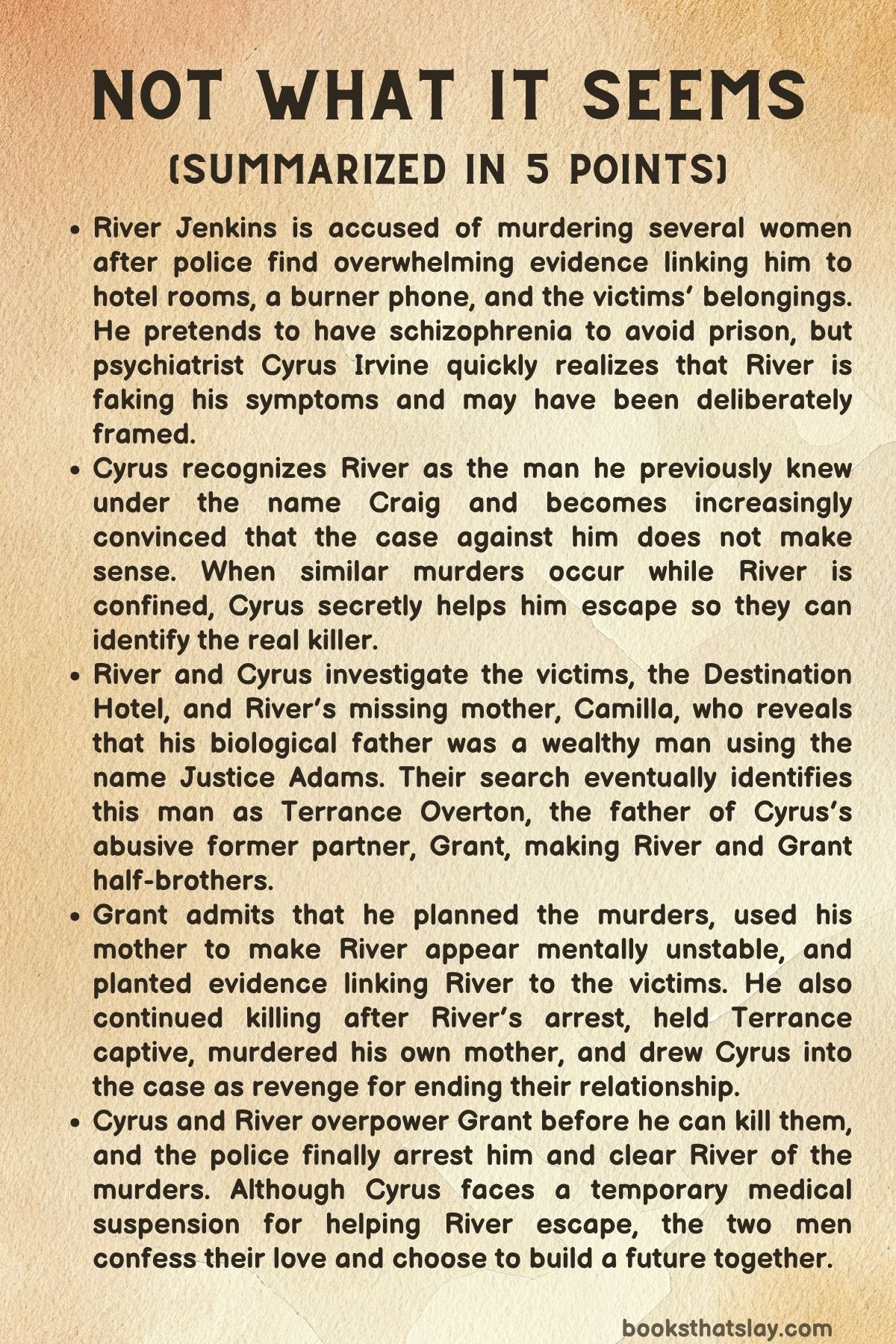
Summary
River Jenkins usually approaches relationships as temporary encounters that require no emotional investment. During a visit to the Tool Shack, a gay bar near his London apartment, he notices an anxious older man named Cyrus who appears uncomfortable in the unfamiliar surroundings.
River introduces himself as Craig because he has no intention of allowing the meeting to become personal. Nevertheless, the attraction between them develops into an intimate weekend that affects Cyrus far more deeply than River initially understands.
Two months later, Dr. Cyrus Irvine arrives at New Horizon Psychiatric Institute to assess a murder suspect. River has been accused of killing three young women and provisionally diagnosed with schizophrenia, but Cyrus immediately recognizes him as Craig.
River pretends not to know Cyrus and performs exaggerated symptoms of mental illness. Cyrus notices inconsistencies in his behaviour, including his organized thinking, controlled reactions, and doubtful attitude toward the supposed hallucinations he describes.
River admits that he has encouraged the diagnosis because the physical evidence against him appears impossible to overcome. He believes that remaining inside a psychiatric facility is safer than being transferred to prison, where he may spend the rest of his life.
Although River has been pretending to take medication, he insists that strange events genuinely occurred before his arrest. Objects repeatedly struck his bedroom window, someone whispered his name, and a distant woman appeared in the alley behind his apartment.
Whenever River pursued the woman, she disappeared. After several of these incidents, he returned home to find bleach-soaked personal items hanging near his door, including objects that were later identified as property belonging to murdered women.
During the final pursuit, the mysterious woman dropped a burner phone. River picked it up, believing it might reveal her identity, but the police later recovered deleted conversations showing that meetings had been arranged with the murder victims.
River’s fingerprints were found on the device, while hotel surveillance placed him near the crime scene on the nights of the killings. The victims had been drowned in bleach inside a Destination Hotel room reserved under River’s real name.
Cyrus recognizes that the evidence is severe but also notices how obviously it appears to implicate River. A careful murderer would not normally reserve a room under his own name, keep the victims’ belongings, and store the phone used to arrange the meetings inside his apartment.
Cyrus examines River’s medical records and confirms that he has not been taking his medication. River has also shown no continuing symptoms since being removed from his apartment, making the original schizophrenia diagnosis increasingly doubtful.
While investigating independently, Cyrus learns that two homeless women recently found dead were assumed to have overdosed. At the morgue, he notices chemical injuries around their mouths and faces, suggesting that bleach may have been used.
Both women resemble the earlier victims, and their deaths occurred after River was placed in custody. Cyrus reports his concerns, but the police dismiss them because they consider the hotel murders solved.
Convinced that River may be innocent, Cyrus deliberately leaves a facility key card where River can reach it. River studies the institution’s security routines, escapes successfully, and makes his way to the hotel where Cyrus is staying.
Cyrus is horrified when River appears at his door because helping him escape could destroy his medical career. River argues that freedom from the institution is useless unless they identify the person who framed him and prevent further killings.
As they examine the case, Cyrus reveals that the Destination Hotel chain is connected to Grant Overton, his abusive former partner. Grant’s wealthy family has influence over the business, although neither Cyrus nor River initially understands how directly the Overtons are connected to the murders.
River and Cyrus also confront their unfinished personal relationship. River apologizes for disappearing after their weekend, while Cyrus admits that he felt humiliated and rejected because he believed their connection had meant something.
Their investigation becomes closely tied to Cyrus’s emotional history. Grant spent years criticizing his appearance, profession, family, habits, and sexual preferences, leaving Cyrus convinced that vulnerability makes him weak and undesirable.
River treats Cyrus with patience and acceptance, although their circumstances make any relationship ethically and legally dangerous. Their renewed intimacy gradually becomes an expression of trust rather than a repetition of their earlier casual encounter.
Cyrus returns to New Horizon and submits an assessment declaring River mentally competent. Detective Anderson questions him about the escape and becomes suspicious of his unusual interest in the murder investigation.
Cyrus nearly decides to abandon River and return home. Before leaving, however, he discovers a note on his car signed “C.J.” warning that River is in danger.
The initials may belong to Camilla Jenkins, River’s mother, who disappeared years earlier and was presumed dead. Cyrus returns to the hotel, and the two men begin searching shelters, bars, streets, and homeless communities for information about her.
Camilla leaves another message directing them to an address. River finds her alive but physically damaged by years of addiction and becomes furious that she allowed him to believe she was dead.
Camilla explains that River’s biological father was a wealthy client who called himself Justice Adams. When she became pregnant, he demanded that she end the pregnancy, but she refused and later blackmailed him by threatening to expose the affair.
The man paid for rehabilitation and occasionally gave Camilla money before eventually cutting her off. Camilla continued watching him and saw him leaving Destination Hotels with young blonde women.
After Camilla threatened him again, he warned that he would kill River. When several women were murdered and River was arrested, she assumed that his father had committed the crimes to eliminate evidence of his affairs and remove his unwanted son.
Camilla’s information is difficult to verify because Justice Adams appears to be an alias. River and Cyrus search hotel records, property files, and public databases without finding anyone legally connected to that name.
The case changes when another young woman, Bianca Rolland, is murdered. Bianca had searched for Justice Adams at a Destination Hotel, and her death occurs while River is still officially connected to New Horizon, further weakening the claim that he committed the entire series.
Cyrus speaks with Bianca’s sister, Rose. She explains that Bianca met a wealthy married man through a companionship application, became pregnant, and intended to confront him after he demanded an abortion and ended their relationship.
Rose possesses a photograph of the man beside a black Bentley. Cyrus recognizes him as Terrance Overton, Grant’s father and a part-owner of Destination Hotels.
Cyrus also notices the physical resemblance between Terrance, Grant, and River. The discovery establishes that River and Grant are half-brothers, although River remains unaware of the connection when he locates Terrance’s property and goes there alone.
Inside Terrance’s house, River finds large quantities of bleach and photographs confirming that Terrance is his biological father. He also discovers Terrance’s wife bound to a chair with her throat cut.
River recognizes her as the woman who stalked him, whispered his name, struck his window, and lured him through the streets. Her actions helped make him appear mentally unstable while giving someone else opportunities to plant evidence.
Cyrus reaches the property and concludes that Terrance’s wife participated in the framing but was not the person controlling the plan. Her murder suggests that she became a liability to the true killer.
Cyrus begins suspecting Grant. Grant understands psychiatric procedures, possesses detailed knowledge of Cyrus’s weaknesses, has access to his family’s hotels, and has enough influence to arrange Cyrus’s involvement in River’s assessment.
River and Cyrus trace Terrance’s Bentley to the house Cyrus once shared with Grant. Inside, they find Terrance bound and badly beaten while Grant calmly waits for them.
Grant admits that he discovered Terrance had fathered River during an affair with Camilla. His mother already resented Terrance’s repeated infidelity, so Grant persuaded her to participate in a revenge plan against River.
Grant’s mother created the false appearance of hallucinations by stalking River and leading him away from his apartment. While River chased her, Grant planted bleach-soaked belongings and arranged evidence linking him to the victims.
Using Terrance’s hotel access and companionship accounts, Grant contacted women who had previously been involved with his father. He booked rooms under River’s name, murdered the women with bleach, and ensured that River appeared on nearby surveillance recordings.
Grant also held Terrance captive and forced him to watch recordings of the murders. After River was arrested, Grant continued killing because the violence had become personally satisfying rather than merely useful to the original plan.
He killed homeless women, Bianca, and eventually his own mother when she attempted to restrain him. Grant also arranged for Cyrus to evaluate River because he wanted to punish the former partner who had escaped his control.
Grant plans to murder River, Cyrus, and Terrance and stage their deaths as a family tragedy. He expects to inherit Terrance’s fortune while presenting himself as the only innocent survivor.
Cyrus refuses to remain controlled by fear. He throws a dart into Grant’s arm, disrupting his aim and allowing River to attack him.
River gains control of Grant’s gun but refuses to kill him, even when Grant attempts to provoke him. The police arrive, Grant is arrested, and Terrance is taken to the hospital.
River protects Cyrus during questioning by denying that Cyrus knowingly assisted his escape. Even so, Cyrus faces professional discipline for concealing information, violating ethical boundaries, and failing to report River’s location.
After his release, Cyrus assumes that River’s feelings were created by danger and dependence. He leaves a farewell note and returns home, believing River will no longer want him once the case is resolved.
River later confronts Terrance, who admits that he rejected responsibility for his son and allowed Camilla and River to suffer the consequences of his choices. River cannot forgive him immediately, although he does not completely close the possibility of future contact.
Three weeks later, River visits Cyrus with flowers. He explains that interviews, legal proceedings, and the aftermath of the case delayed him, but none of those events changed his feelings.
River declares that he loves Cyrus and wants a relationship based on respect, openness, and emotional safety. Cyrus admits that he loves River as well, allowing himself to believe that he can be valued without hiding his needs.
Cyrus eventually learns that his medical license will be suspended for three months rather than permanently revoked. With Grant facing justice and River’s innocence established, the two men begin building a future no longer defined by deception, fear, or emotional avoidance.
Characters
River Jenkins
River is the central accused man and one of the most adaptable figures in Not What It Seems. His initial decision to imitate symptoms of schizophrenia reveals both desperation and intelligence, since he recognizes that the evidence against him makes a conventional defence appear almost hopeless.
His casual approach to relationships serves as a form of protection. By using a false name and leaving Cyrus without explanation, River prevents emotional attachment before another person can abandon or disappoint him.
River’s upbringing in foster care and his mother’s disappearance have taught him to rely primarily on himself. His humour, confidence, and sexual openness often conceal deep fears about rejection, family, and personal worth.
His treatment of Cyrus gradually exposes his capacity for loyalty and emotional sensitivity. River recognizes how Grant damaged Cyrus and repeatedly challenges the belief that vulnerability deserves ridicule.
River also maintains an important moral boundary during his confrontation with Grant. Even after learning that Grant murdered several women, framed him, and planned to kill him, River refuses to execute him and therefore rejects the violent identity Grant tries to impose upon him.
Dr. Cyrus Irvine
Cyrus provides the moral and emotional counterweight at the centre of Not What It Seems. He is professionally cautious, intellectually disciplined, and strongly aware of ethical responsibilities, yet his growing belief in River forces him to choose between formal rules and what he considers morally necessary.
His decision to help River escape cannot be presented as professionally correct. Nevertheless, it grows from his recognition that the institutions responsible for justice have stopped examining evidence once they found a convenient suspect.
Cyrus’s deepest conflict comes from the lasting effects of Grant’s emotional abuse. Years of criticism have made him suspicious of his desires, ashamed of his emotional needs, and convinced that hesitation proves weakness.
His relationship with River allows him to experience acceptance without control or humiliation. Cyrus does not immediately overcome his insecurity, but he begins challenging the internal voice that continues repeating Grant’s judgments.
His attack during the final confrontation marks an important transformation. Instead of waiting for River to protect him, Cyrus acts decisively and creates the opportunity that saves all three captives.
Grant Overton
Grant is the primary antagonist and the architect of the conspiracy against River. His intelligence, family access, personal knowledge of Cyrus, and willingness to manipulate others allow him to create a case that appears almost impossible to disprove.
His original motivation combines hatred toward Terrance, resentment over River’s existence, and a desire to control Cyrus after their relationship ends. River becomes a target because his existence represents Terrance’s betrayal, while Cyrus becomes involved because Grant cannot tolerate losing authority over him.
Grant uses his mother’s anger rather than respecting her pain. He transforms her resentment into criminal participation, then murders her when she becomes inconvenient.
His violence eventually develops beyond revenge. Once River is arrested, Grant continues killing women, demonstrating that the original plan has become a justification for sadistic pleasure and personal power.
Grant’s belief in his own brilliance becomes a weakness. He explains his crimes in detail because he wants admiration for the plan, giving River and Cyrus time to resist him.
Terrance Overton
Terrance is River’s biological father and the origin of many conflicts within the story. His repeated affairs, dishonesty, and refusal to accept responsibility create the conditions from which Grant’s revenge develops.
He treats Camilla as a temporary problem rather than as a vulnerable young woman carrying his child. His payments and rehabilitation support appear generous on the surface, but they also function as attempts to preserve secrecy and avoid public responsibility.
Terrance is later transformed from a powerful businessman into Grant’s captive. Being forced to watch the murders confronts him with an extreme consequence of the selfishness and secrecy that shaped his family.
His victimhood does not erase his earlier failures. River recognizes that Terrance suffered terribly under Grant, but he also understands that this suffering cannot restore the twenty-eight years of parental care Terrance withheld.
Terrance’s request for future contact suggests regret, although the story leaves forgiveness uncertain. His relationship with River can only develop if he accepts responsibility without expecting immediate absolution.
Camilla Jenkins
Camilla is River’s mother and a deeply conflicted figure whose choices cause both pain and progress. Her addiction, unstable life, and disappearance leave River believing that he was unwanted and permanently abandoned.
She also demonstrates persistence in following Terrance and recognizing the pattern surrounding his affairs. Her suspicions about River’s framing are incomplete, but they bring River and Cyrus closer to identifying the Overton family.
Camilla’s use of blackmail complicates her moral position. She attempts to obtain money from Terrance, but her actions also arise from poverty, addiction, resentment, and his refusal to accept responsibility for their child.
Her decision to contact Cyrus shows that she still cares whether River survives. However, this late intervention cannot repair the years during which he believed her dead.
River’s inability to forgive her immediately is therefore understandable. Camilla provides necessary information, but she cannot demand emotional reconciliation as payment for finally helping him.
Grant’s Mother
Grant’s mother is an unnamed but important participant in River’s persecution. Years of enduring Terrance’s infidelity leave her angry, humiliated, and emotionally prepared to support Grant’s plan against the illegitimate son she views as evidence of her husband’s betrayal.
Her actions against River are calculated and cruel. She imitates the behaviour of a supernatural or imagined figure, repeatedly luring him away and creating circumstances that make witnesses believe he is hallucinating.
At the same time, she is also manipulated by Grant. He directs her anger toward River rather than Terrance and uses her until she becomes unwilling to accept further killings.
Her eventual attempt to restrain Grant suggests that she did not anticipate the full extent of his violence. Grant’s decision to murder her confirms that family loyalty never mattered to him as much as control.
She remains morally responsible for helping destroy River’s life. Her suffering within her marriage explains her anger but does not justify transferring that anger to an innocent person.
Dr. Cole Brady
Dr. Cole Brady is the medical professional who gives Cyrus’s suspicions scientific credibility. Unlike the police officers who dismiss the deaths of homeless women as routine overdoses, he is willing to examine physical evidence that challenges the accepted explanation.
His cooperation demonstrates the importance of professional curiosity. Once Cyrus points out the facial injuries and possible chemical exposure, Brady treats the concern seriously rather than protecting an earlier assumption.
Brady remains uneasy about Cyrus’s unauthorized involvement, which shows that he understands the ethical risks involved. However, he does not allow procedural discomfort to prevent further testing.
His findings become essential because they establish that similar murders continued while River was confined. Brady therefore helps move the case from personal suspicion toward medically supported evidence.
Detective Anderson
Detective Anderson represents the official investigation’s scepticism toward Cyrus. He recognizes that a psychiatrist has become unusually involved in a criminal case and correctly suspects that Cyrus may be hiding information about River’s escape.
His questioning places Cyrus under serious pressure because Cyrus must conceal his role while attempting to redirect attention toward the continuing murders. Anderson’s suspicion is reasonable, even though the police investigation initially relies too heavily on the evidence against River.
He also illustrates the danger of professional certainty. Because River has already been arrested, alternative explanations are treated as unnecessary distractions.
Anderson is not portrayed as deliberately corrupt. His failure comes from accepting a convincing case too quickly and viewing Cyrus’s concerns primarily as interference.
Detective Jasmine Allen
Detective Jasmine Allen becomes important when Cyrus finally identifies Terrance Overton as Justice Adams. Cyrus contacts her because River may be approaching Terrance’s property alone and could be walking directly into the killer’s control.
Allen represents the point at which Cyrus begins cooperating with law enforcement rather than attempting to solve everything independently. Her involvement helps ensure that officers reach the final location before Grant can complete his plan.
Unlike the earlier dismissive responses, the later police action reflects a growing willingness to reconsider River’s guilt. Allen’s role is limited, but it supports the transition from private investigation to official intervention.
Rose Rolland
Rose is Bianca’s sister and the person who provides the visual evidence identifying Justice Adams. Her knowledge of Bianca’s relationship with the wealthy married man gives Cyrus the first reliable connection between the alias and a real individual.
Rose also humanizes Bianca beyond her position as another victim. Through her account, Bianca becomes a young woman dealing with pregnancy, abandonment, fear, and a determination to confront the person who mistreated her.
Rose’s decision to share the photograph demonstrates courage and trust. Without her cooperation, Cyrus and River might never have connected the black Bentley, the companionship application, and the Overton family.
Bianca Rolland
Bianca is one of Grant’s later victims and the person whose death causes the investigation to shift significantly. She becomes involved with Terrance under the name Justice Adams and becomes pregnant before being rejected.
Her intention to confront him at the hotel places her in Grant’s reach while Terrance is being held captive. Grant uses the situation to continue his murders and strengthen the false association between River and Justice Adams.
Bianca’s death is especially important because it occurs after River has been confined. It demonstrates that the killer remains active and forces investigators to reconsider the earlier case.
Although Bianca appears mainly through other people’s accounts, her story reflects the wider pattern of powerful men exploiting women and attempting to erase the consequences.
Dalton
Dalton is one of River’s occasional partners and a witness to his behaviour before the arrest. He sees River searching the alley and responding to a person who appears invisible to everyone else.
His testimony unintentionally supports the diagnosis of schizophrenia. Dalton cannot know that River is reacting to a carefully staged deception rather than a hallucination.
He also represents River’s former approach to intimacy. Their connection is familiar, physical, and deliberately uncomplicated, contrasting with the emotional responsibility River develops toward Cyrus.
Molly Steinway
Molly Steinway is associated with River’s assessment and the administration at New Horizon. She reacts with surprise when Cyrus declares River mentally competent shortly after his escape.
Her response reflects the professional concerns surrounding Cyrus’s conduct. From her perspective, the timing of his report makes his judgment appear compromised and possibly connected to the escape.
Molly’s role reinforces the fact that Cyrus’s belief in River does not remove the consequences of his choices. Even when his conclusions prove correct, his behaviour still raises legitimate questions about medical ethics and professional boundaries.
Christine
Christine works at the Destination Hotel and assists Cyrus while he investigates Justice Adams. She reveals that Bianca recently visited the hotel searching for the same man.
Her information confirms that the alias remains connected to the victims. It also increases the danger to Cyrus because she begins suspecting that his questions relate to River’s escape.
Christine behaves reasonably by considering contact with the police. Her suspicion reminds Cyrus that he cannot investigate openly without attracting attention from both law enforcement and the killer.
Jimmy and Chase
Jimmy and Chase are bartenders at the Tool Shack who help Cyrus search for information about wealthy older patrons. Jimmy cannot identify the person Cyrus describes but directs him toward Chase.
Chase recognizes Cyrus from news coverage of River’s escape. Rather than reporting him immediately, he provides the message left by Camilla.
Their limited involvement demonstrates how River and Cyrus’s investigation depends upon people who notice unusual behaviour and preserve information. Chase’s decision to deliver the note allows them to locate Camilla and learn about Justice Adams.
Tim
Tim is the man living with Camilla when River finally finds her. He has little direct influence over the investigation, but his presence gives insight into Camilla’s current circumstances.
He represents the unstable environment in which Camilla has continued living after disappearing from River’s life. His connection to her also confirms that she has formed a life apart from the son who believed her dead.
Because the story does not present Tim as either a rescuer or an aggressor, he remains primarily a contextual figure. His role helps establish the physical and emotional distance between Camilla and River.
Cyrus’s Parents
Cyrus’s parents provide a contrast to Grant’s emotionally destructive behaviour. Their affectionate communication reveals that Cyrus comes from a family capable of warmth, concern, and steady support.
Cyrus worries that his choices will embarrass or disappoint them, demonstrating how strongly he values their opinion. Their presence also exposes a gentler side of him that River does not initially see during the clinical assessment.
The invitation for River to meet them near the end represents a movement toward ordinary life. After a relationship formed through danger and secrecy, meeting Cyrus’s parents suggests openness, stability, and long-term commitment.
Themes
Appearance, Evidence, and Misleading Certainty
Every major accusation against River appears to be supported by objective evidence. His fingerprints are on the burner phone, the hotel rooms are reserved in his name, the victims’ belongings are found near his apartment, and security footage places him close to the crime scenes.
The power of the conspiracy comes from Grant’s understanding that people trust visible evidence more readily than complicated explanations. River’s innocence sounds irrational because accepting it requires investigators to believe that several separate details were intentionally manufactured.
Not What It Seems repeatedly demonstrates that facts can be genuine while the interpretation placed upon them remains false. River truly chased a woman, kept the bleach-soaked objects, touched the phone, and appeared near the hotel, but none of those actions carries the meaning the police initially assign to it.
Cyrus becomes effective because he studies the relationship between the facts rather than treating each one as final proof. He questions why a careful killer would preserve so much incriminating material and why River’s symptoms vanish without medication.
The story therefore distinguishes healthy scepticism from denial. River is not cleared because Cyrus ignores evidence; he is cleared because Cyrus examines whether the evidence forms a logical account of human behaviour.
Emotional Abuse and the Survival of Internal Control
Grant’s control over Cyrus continues long after their relationship ends. His criticism has become an internal voice that shapes how Cyrus interprets fear, affection, desire, and professional uncertainty.
Cyrus repeatedly assumes that needing reassurance makes him pathetic. Even when Grant is physically absent, Cyrus anticipates ridicule and begins attacking himself before another person has the opportunity.
This lasting influence shows why emotional abuse cannot be reduced to isolated insults. Grant systematically weakens Cyrus’s trust in his own judgment, making him easier to control and less likely to believe that he deserves a respectful relationship.
River challenges that conditioning by responding differently to the qualities Grant mocked. He treats Cyrus’s caution as evidence of intelligence, his loyalty as strength, and his emotional openness as something valuable rather than embarrassing.
Recovery does not occur through praise alone. Cyrus must gradually choose actions that contradict Grant’s version of him, including helping River, confronting danger, and acting during the final attack.
His growth reaches its clearest point when he stops waiting for someone else to rescue him. By attacking Grant, Cyrus proves to himself that fear and courage can exist at the same time.
Responsibility, Secrecy, and Family Damage
Terrance’s refusal to accept responsibility produces consequences across two generations. His affair with Camilla, abandonment of River, repeated infidelity, and efforts to protect his reputation create resentment that Grant later turns into violence.
Terrance does not intend for anyone to become a murderer, but intention does not remove responsibility for the damage caused by his choices. His secrecy divides his family into legitimate and hidden lives, leaving River without a father and Grant surrounded by resentment.
Camilla also contributes to River’s pain through addiction, disappearance, and blackmail. Her circumstances make her sympathetic, but the story does not allow those circumstances to erase the emotional harm River experiences.
Grant responds to family betrayal by treating innocent people as objects of revenge. Instead of holding Terrance accountable through exposure or separation, he targets River, manipulates his mother, murders vulnerable women, and attempts to claim his father’s fortune.
River ultimately rejects this inherited pattern. He refuses to kill Grant and does not immediately forgive either parent, choosing boundaries rather than revenge or forced reconciliation.
The novel presents responsibility as the willingness to acknowledge consequences without demanding quick forgiveness. Terrance and Camilla may regret their choices, but River retains the right to decide whether either relationship can be rebuilt.
Trust, Vulnerability, and Chosen Commitment
River and Cyrus begin their relationship by hiding essential parts of themselves. River provides a false name and avoids emotional attachment, while Cyrus conceals his insecurity behind professional control and careful behaviour.
Their reunion occurs under conditions that make trust appear almost impossible. River is accused of murder, Cyrus has authority over his psychiatric assessment, and both men have reasons to question the other’s honesty.
Trust develops through repeated choices rather than immediate certainty. Cyrus risks his career because he believes River deserves a genuine investigation, while River protects Cyrus during questioning and refuses to expose his role in the escape.
Their relationship also challenges their previous understandings of vulnerability. River learns that emotional distance does not protect him from loneliness, and Cyrus learns that expressing need does not automatically invite humiliation.
The final separation shows how deeply their old fears remain active. Cyrus assumes River will leave once the danger ends, while River mistakenly believes that encouraging Cyrus to protect his career is an act of love that requires distance.
Their reunion succeeds because River states his feelings directly and Cyrus allows himself to accept them. Commitment becomes possible when both men stop treating emotional dependence as defeat and begin regarding honesty, reassurance, and mutual care as deliberate strengths.