A Taste of Magic Summary, Characters and Themes
A Taste of Magic by Tricia O’Malley is a magical small-town romance centered on Lyra MacGregor, a gifted cook whose newly awakened powers become dangerously unpredictable just as a televised baking competition arrives in Briarhaven.
Her return home also places her face-to-face with Rabbie Barclay, the first love she believes rejected her years earlier. Against the growing threat of a family curse, public competition, and old emotional wounds, Lyra must learn what kind of witch she truly is. The novel combines second-chance romance, family bonds, magical baking, humor, and the search for a place that finally feels permanent. It’s the 2nd book in The Scottish Charms series.
Summary
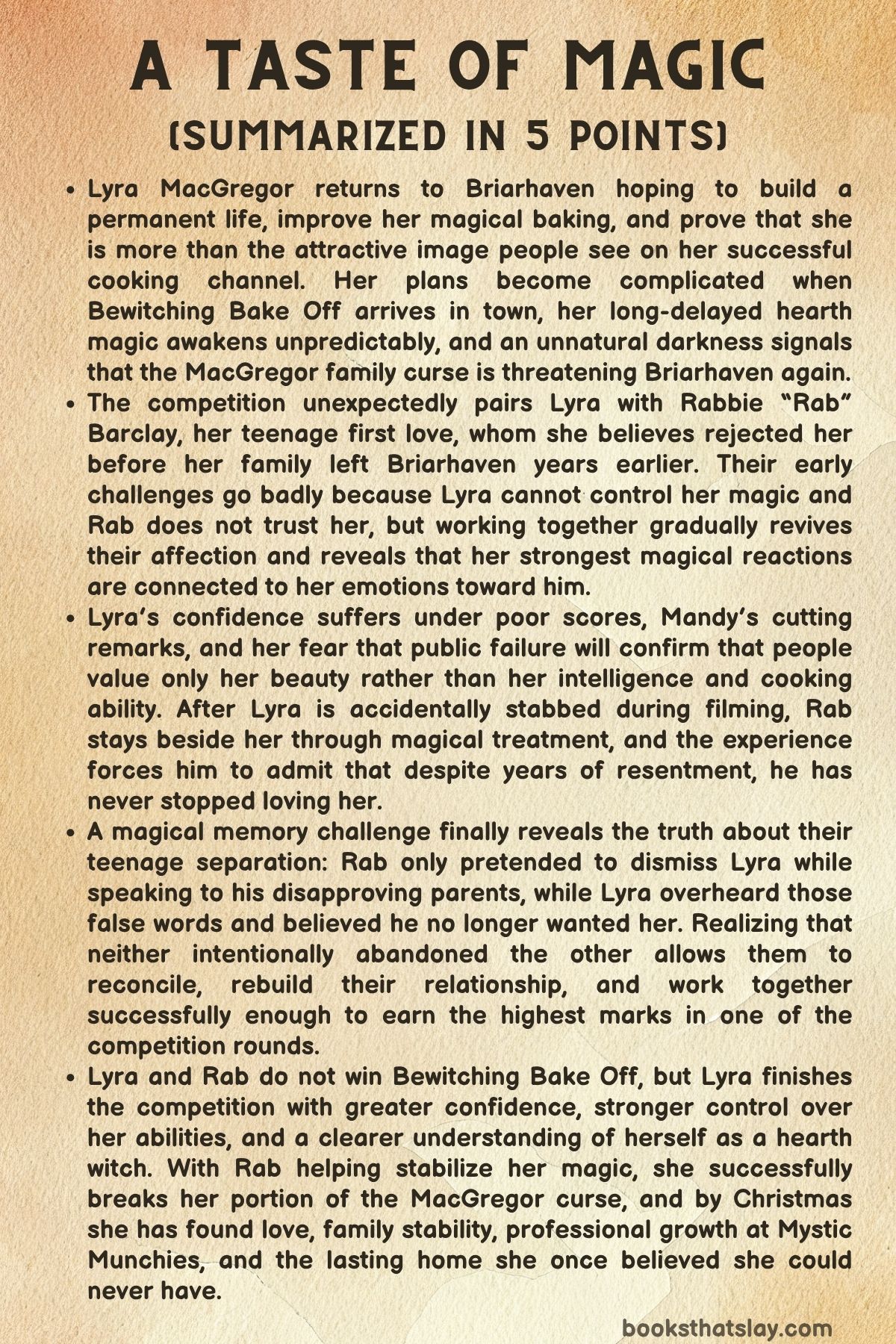
Lyra MacGregor has recently returned to Briarhaven, the magical town her family once fled, and she is attempting to create a life that feels more permanent than anything she has known before. Her successful cooking channel gives her an income, but she wants to be respected for her culinary ability rather than treated as a beautiful online personality whose appearance matters more than her intelligence or skill.
Her plans change when she learns that the television program Bewitching Bake Off will film its Christmas special in Briarhaven, using local competitors and Mystic Munchies as its central location. Lyra persuades the formidable forest elf Marcie to hire her at the bakery so she can improve her magical baking, but the opportunity arrives at a dangerous moment because an unnatural darkness has begun spreading across Briarhaven as the protective wards surrounding the town weaken.
Lyra’s personal difficulties are equally serious. The MacGregor women have lived beneath a bloodline curse that forced them to keep moving, and although her sister Sloane has already broken one portion of it, Lyra’s own magic has barely developed.
That changes when Lyra discovers Ruth, a tiny lavender fluttermouse armed with a sword, who reveals herself as Lyra’s familiar. Through Ruth and Broca, Lyra learns that she is a hearth witch whose magic is connected to cooking, home, nourishment, care, and acts of domestic creation, but the curse is corrupting the way that power appears.
Instead of responding predictably, Lyra’s magic reacts to impulses and emotions, frequently changing objects into things she never intended. Her frustration grows because the television competition will require magical baking in front of judges and viewers, exactly when she has the least control over her abilities.
Briarhaven also brings Lyra back into contact with Rab Barclay, her teenage first love. Both remain wounded by their separation years earlier, but each remembers the event differently: Lyra believes Rab dismissed her as insignificant before she left town, while Rab believes Lyra abandoned him after promising to meet him at their favorite barn.
Their encounters are filled with attraction, resentment, jealousy, and memories neither has successfully buried. At the Mabon festival, they quarrel about the past before dancing together, and their brief closeness exposes how naturally they still respond to each other despite all the anger accumulated during their years apart.
The competition soon forces them into even closer contact when the producers unexpectedly pair them as partners. Rab is immediately suspicious, wondering whether Lyra, their friends, or the production team deliberately arranged the pairing because their romantic history provides entertaining television.
Their first challenges are disasters. Lyra knows conventional cooking extremely well, but her unstable magic ruins ingredients and enchantments, while Rab has little baking experience and does not initially trust her explanations.
The humiliation is especially painful for Lyra because failure confirms the judgment she has feared throughout her adult life: that others see her as attractive but incapable. Mandy, the former leader of the Charms coven, repeatedly attacks that insecurity with cutting remarks, while the judges’ poor scores leave Lyra feeling that she is embarrassing herself and dragging Rab down with her.
After another unsuccessful round, Lyra finally tells her sisters what happened before she left Briarhaven as a teenager. She overheard Rab telling his parents that their relationship had been foolish and that she was nothing special, so she believed he had rejected her and never went to the barn where they had planned to meet.
Her family points out that Rab’s continuing anger does not fit the behavior of someone who never cared, forcing Lyra to reconsider what she heard. She visits Rab intending to discuss their problems, and although the deeper misunderstanding remains unresolved, she finally admits that her magic is malfunctioning and asks him to stop assuming that every mistake is deliberate.
Rab realizes that Lyra’s strange powers resemble transmutation, his own magical specialty, and proposes a practical partnership: she will rely on her cooking expertise while he helps manage the magical side. Their hostility softens into familiar teasing, and when Rab suddenly kisses her, Lyra responds so strongly that nearby objects transform into hedgehogs.
The incident gives Rab an important clue. Lyra’s magic is reacting to powerful feelings, particularly her attraction to him, and he gradually begins helping her instead of judging her.
Outside the competition, the MacGregor curse continues threatening Briarhaven. A suspicious spell intended to weaken Lyra’s portion of the curse nearly causes greater harm, the endless darkness disrupts wildlife, and hungry owls begin attacking smaller magical creatures.
Lyra’s difficulties take a frightening turn when a chaotic accident involving Felicity sends a knife deep into her side. Mandy immediately attempts to help, Sloane rushes Lyra to the castle, and Rab arrives terrified after hearing what happened.
During Lyra’s magical treatment, Rab remains beside her because she asks him to stay. Seeing her injured destroys the emotional distance he has tried to preserve, and he finally acknowledges privately that his love for her never disappeared beneath the anger and resentment of the intervening years.
As Lyra recovers, Rab brings her food, jokes with her, helps her move, and treats her with a gentleness that conflicts completely with her belief that he hates her. Her sisters later reveal how frightened he was during the emergency, making it even harder for Lyra to dismiss the possibility that his feelings remain strong.
Meanwhile, the Charms work together to protect Briarhaven from the continuing darkness. Even Mandy returns to participate, and the coven begins addressing practical problems while also showing early signs that its internal divisions might eventually heal.
The decisive change in Lyra and Rab’s relationship comes through a competition challenge involving magical memories. They are forced to revisit the night their teenage romance collapsed, allowing Lyra to witness the conversation she once overheard from Rab’s perspective.
She discovers that Rab lied to his parents when he called her unimportant because he was trying to make them stop interfering. He had secretly planned to leave with Lyra and spent the next morning waiting at the barn, while Rab finally realizes that Lyra stayed away because she heard his false words and believed them.
The truth changes everything. Neither deliberately abandoned the other; two frightened teenagers acted on incomplete information and then spent years interpreting the resulting silence as rejection.
Rather than allowing the cameras to exploit the discovery completely, Rab redirects their attention toward the baking challenge. Together they create jam-filled cookies called Mended Hearts, and Lyra begins approaching her strange magic with humor and flexibility instead of treating every unexpected result as proof of failure.
After filming, Rab takes Lyra away from the producers so they can finally speak in private. They acknowledge that they never stopped loving each other, and their renewed intimacy becomes the beginning of a genuine reconciliation based on knowledge rather than assumptions.
Lyra also discovers that Rab’s presence helps stabilize her magic. Their powers seem naturally compatible, and his ability to ground her becomes important not only during the competition but in the larger battle against the curse.
Lyra eventually discovers that the mysterious book she received during Mabon is a personal grimoire. It gives her a ritual requiring her sisters to name what the family curse has taken from them, but the first attempt fails when Lyra’s corrupted power overturns boiling water and burns her arms.
Although devastated, Lyra refuses to remain defeated and races to the final baking challenge rather than leaving Rab waiting. Her decision carries special meaning because their teenage relationship was destroyed by a missed meeting, whereas now she chooses communication and commitment despite fear.
During the final challenge, Lyra and Rab must prepare twelve Christmas-themed baked goods. Working as genuine partners, they combine her cooking experience with his magical steadiness, and Lyra’s abilities finally begin cooperating with her rather than turning every task into a catastrophe.
They do not win the competition, because Henry earns first place with spectacular dragon-themed mince pies, but Lyra no longer measures success solely by victory. She has proved her skill, learned to work with her powers, rebuilt her confidence, and repaired the relationship that shaped much of her emotional life.
Lyra then asks Rab to help her attempt the curse-breaking ritual again. With her family supporting her and Rab acting as a magical conduit, she finally recognizes her hearth magic as a force connecting family, home, memory, care, and belonging.
She cuts away the corrupted portion of the bloodline curse, and a broken piece of quartz associated with the curse repairs itself further when joined with Sloane’s fragment. Lyra’s part is finally broken, although Nova’s remains unresolved.
By Christmas, Lyra is flourishing at Mystic Munchies, her online audience has expanded, her dangerous hedgehog transformations have stopped, and she and Rab are openly together. Watching the televised competition, she hears Rab publicly describe the light she brought into his life and declare his love for her.
The conclusion also points toward future changes in Briarhaven. Liam reacts jealously when Raven appears with newcomer Jack MacIntyre, while Jack’s plans to open a tattoo studio immediately interest Nova, whose own magical tattoos react when he touches her wrist.
Lyra’s story therefore closes with the stability she once believed impossible. She has found a home, repaired her first love, accepted her magical identity, strengthened her relationship with her family, and stopped treating permanence as something that will inevitably be taken away from her.
Characters
Lyra MacGregor
Lyra is the emotional and magical center of A Taste of Magic, and much of her development comes from the conflict between the confidence she presents publicly and the insecurity she privately carries. She is attractive, socially capable, talented in the kitchen, and successful online, yet years of being reduced to her appearance have left her deeply sensitive to any suggestion that beauty is the only thing she can offer.
Her desire to enter Bewitching Bake Off therefore goes beyond professional ambition. She wants public proof that she is intelligent, creative, disciplined, and technically skilled, which is why every magical failure feels less like an ordinary mistake and more like confirmation of the judgment she fears others have already made.
Lyra’s hearth magic reflects her personality because her greatest strength has always been expressed through feeding, supporting, organizing, and caring for the people around her. Her instinctive response to Rab’s terrible dinner is to take over his kitchen, and even before she understands her magical identity, she repeatedly creates belonging through food and domestic acts.
Her greatest internal obstacle is fear of failure. She tries to force her powers into perfect obedience, but they become more chaotic when she is ashamed, angry, frightened, or attracted to Rab, teaching her that control cannot be separated from emotional acceptance.
Lyra’s romantic development is equally important. She has spent years treating relationships as temporary because the MacGregor curse taught her never to expect permanence, and Rab remains unique because he once offered to share the uncertainty of her life rather than protecting himself from it.
When she finally learns that their separation resulted from a misunderstanding, she is able to reconsider the entire emotional structure she built afterward. Her eventual willingness to trust Rab, remain in Briarhaven, and claim her place within her family represents a larger decision to believe that love and home can last.
Rabbie “Rab” Barclay
Rab functions as both Lyra’s romantic counterpart and one of the most important forces in her magical development in A Taste of Magic. He initially appears controlled, private, practical, and deeply resistant to anything that might disturb the predictable life he has constructed since Lyra disappeared.
His resentment toward Lyra is genuine, but it grows from pain rather than indifference. Rab spent years believing that he had been willing to leave everything for her only to discover that she had departed without meeting him, so his anger becomes a defensive explanation for an abandonment he never emotionally understood.
His flaw is that he allows this old interpretation to become certainty. Even when new evidence suggests Lyra’s motives may have been different, he initially assumes manipulation or bad faith because suspicion feels safer than accepting that he may still love someone capable of hurting him again.
Rab’s transmutation magic also makes him uniquely suited to understand Lyra’s unusual manifestations. Once he stops treating her magical accidents as intentional chaos, he recognizes patterns in them, helps her work around her limitations, and gradually becomes the grounding presence that allows her magic to function more naturally.
His response to Lyra’s stabbing exposes what he has been trying to deny. Fear strips away years of defensiveness, and staying beside her during treatment forces him to recognize that anger has never replaced love.
Rab ultimately becomes more emotionally mature by accepting that the suffering of his youth does not automatically prove malicious intent. His reconciliation with Lyra depends on replacing assumption with communication, making his romantic growth inseparable from his willingness to reinterpret the past.
Ruth
Ruth brings humor, loyalty, instinct, and fierce protectiveness to A Taste of Magic. Despite being a tiny lavender fluttermouse, she behaves like an armed guardian who considers a sword an entirely reasonable answer to danger, insult, romantic confusion, or suspicious behavior.
Her role as Lyra’s familiar is more significant than comic relief. Ruth’s arrival marks the moment Lyra begins understanding that her magic has truly awakened, and Ruth is also among the first to identify that Lyra’s abilities are connected to the hearth, emotion, and belonging.
Ruth often understands Lyra more clearly than Lyra understands herself. She repeatedly insists that Lyra still loves Rab, recognizing that denial does not match the intensity of Lyra’s reactions whenever he appears.
Her protectiveness occasionally becomes excessive, especially when she becomes suspicious of Felicity after the stabbing, but that intensity comes from absolute loyalty. Ruth gives Lyra a companion who challenges excuses, refuses self-pity, and treats Lyra’s developing power as something worthy of confidence rather than embarrassment.
Sloane MacGregor
Sloane is both Lyra’s sister and an example of what confronting the family curse requires. Having already broken her own portion, she understands that the supernatural threat cannot be separated from the emotional history carried by the MacGregor women.
She frequently provides Lyra with reassurance without dismissing the seriousness of her problems. When Lyra’s magic fails, Sloane does not interpret those failures as evidence of weakness but searches for magical explanations and practical solutions.
Sloane is also protective without becoming controlling. She supports Lyra’s decisions, rushes her to safety after the stabbing, participates in the curse-breaking ritual, and helps hold the family together during the continuing darkness.
Her presence strengthens the novel’s portrayal of sisterhood as active cooperation rather than simple affection. She demonstrates that breaking inherited patterns becomes easier when family members refuse to face them alone.
Nova MacGregor
Nova represents the unfinished future of the MacGregor family in A Taste of Magic. While Sloane and Lyra confront their individual portions of the curse, Nova remains the sister whose own decisive magical trial still lies ahead.
She is an important source of emotional stability for Lyra because their shared childhood gives her immediate understanding of the insecurity created by constant relocation. Nova knows why permanence frightens Lyra and why returning to Briarhaven carries emotional risks beyond ordinary homesickness.
Her magical tattoos and ambition to own a tattoo studio also distinguish her from her sisters. These details become especially significant in the ending when Jack MacIntyre’s touch causes one of her tattoos to glow, suggesting that her own story will involve a different expression of magic and identity.
Nova’s position at the end is therefore transitional. She celebrates Lyra’s success while standing at the beginning of a mystery that may determine how the remaining portion of the family curse is finally resolved.
Broca
Broca is the family elder who provides knowledge, continuity, and perspective. She understands the history of the MacGregor curse better than the younger women and repeatedly helps them interpret magical events that initially appear random or frightening.
Her most important contribution to Lyra’s development is refusing to let her confuse corrupted magic with personal inadequacy. When the curse causes spells to fail, Broca insists that the problem lies in the hostile influence affecting Lyra’s power rather than in Lyra herself.
She also provides structure during the final ritual, creating the conditions in which Lyra can safely attempt to separate herself from the curse. Broca’s presence makes the family’s struggle feel generational, emphasizing that the younger women are correcting damage that existed long before they understood it.
Marcie
Marcie is intimidating, demanding, protective, and professionally important to Lyra. By hiring her at Mystic Munchies, she gives Lyra a chance to turn natural cooking ability into disciplined magical craftsmanship rather than treating the television competition as a shortcut to recognition.
Her high standards initially increase Lyra’s anxiety, but they also represent something Lyra wants: judgment based on actual work rather than appearance. Marcie expects competence and effort, which gives Lyra an environment in which being attractive is irrelevant compared with learning the craft.
She also becomes protective when Vaughn openly flirts with Lyra. That combination of severity and care makes Marcie a valuable mentor whose support is expressed less through comforting speeches than through employment, expectations, correction, and practical concern.
Mandy
Mandy is one of the most complicated secondary figures in A Taste of Magic because she moves between hostility, isolation, vulnerability, and reluctant cooperation. As the former Charms president, her estrangement from the coven weakens relationships at exactly the moment Briarhaven requires magical unity.
Her treatment of Lyra during the competition is frequently cruel. She recognizes Lyra’s insecurity about being dismissed as superficial and repeatedly targets that wound, making herself an external voice for the criticism Lyra already directs inward.
Yet Mandy is not presented as incapable of compassion. When Lyra is accidentally stabbed, Mandy immediately tries to control the emergency rather than exploiting it, revealing that conflict has not erased her instinct to protect someone in genuine danger.
Her eventual participation in the Charms meeting suggests that reconciliation within the community remains possible. Mandy does not suddenly become warm or apologetic, but her willingness to contribute indicates movement away from complete isolation.
Felicity
Felicity occupies an uncomfortable position because two dangerous incidents are associated with her even though the story ultimately treats her intentions as sincere. She brings the magical book containing the harmful ritual because she believes it may help Lyra, and she is horrified when the spell turns out to contain something corrupted.
The stabbing creates even greater suspicion because Felicity is carrying exposed knives when a chain of accidents sends one into Lyra’s side. Careful reconstruction of the event establishes that the injury results from overloaded arms, a slippery floor, and terrible timing rather than deliberate violence.
Her character demonstrates how accidents can become emotionally charged when a community is already frightened. Ruth remains suspicious, but the broader group chooses evidence over accusation, preventing fear from turning Felicity into a convenient enemy.
Henry
Henry combines magical medical competence with culinary talent. He becomes especially important after Lyra’s injury, when his treatment saves her from the consequences of severe blood loss and a deep wound.
His victory in Bewitching Bake Off also prevents Lyra’s personal growth from depending on winning the television competition. Henry deserves the result through his own remarkable baking, while Lyra discovers that finishing behind him does not diminish what she has accomplished.
This distinction gives Henry a useful role in the story’s understanding of success. His victory and Lyra’s emotional triumph can exist simultaneously without one invalidating the other.
Knox
Knox is one of the chief forces pushing Rab out of isolation. He repeatedly challenges Rab’s claim that Lyra no longer matters, recognizing long before Rab admits it that avoidance itself reveals how powerful his feelings remain.
His insistence that Rab participate in local events and the baking program helps create the conditions for the truth to emerge. Although Rab often finds his interference irritating, Knox’s pressure prevents him from hiding indefinitely inside routine.
Knox also thinks about Briarhaven as a community rather than merely as a setting. His concern about publicity, tourism, supernatural disruptions, and public reaction shows that he understands the broader consequences of the curse for ordinary residents.
Liam
Liam forms part of Rab’s close friendship circle and helps create the relaxed male companionship that surrounds Rab outside his relationship with Lyra. His presence allows the story to show Rab joking, socializing, and interacting with people who know him well enough to recognize when he is lying to himself.
His interest in Raven also creates a quieter romantic thread. By the ending, his jealousy over Jack’s appearance suggests that his feelings may eventually force him into the same kind of honesty Rab has had to learn.
Liam therefore serves both as supportive friend and as a possible future romantic lead. His emotional hesitation mirrors, on a smaller scale, the danger of leaving important feelings unspoken.
Raven
Raven is part of Lyra’s support network and also contributes practical magical knowledge, particularly during medical emergencies. She helps Henry treat Lyra’s wound and participates in the wider community response to supernatural danger.
She also encourages Lyra to question her assumptions about Rab rather than accepting the teenage misunderstanding as settled truth. Her outside perspective helps Lyra recognize that Rab’s present behavior does not fit the story she has believed about him for years.
Raven’s developing connection with Liam remains unresolved. Her arrival with Jack near the end creates jealousy and leaves another relationship in Briarhaven positioned for future conflict or change.
Vaughn
Vaughn represents the entertainment industry’s appetite for personality, romance, and dramatic narrative. As executive producer, he immediately understands that Lyra’s looks, charisma, insecurity, magical problems, and past with Rab can become compelling television.
His attraction to Lyra appears genuine, but his professional instincts make it difficult to separate personal interest from his desire to create a successful program. He repeatedly encourages discussion of Lyra and Rab’s history because their emotional conflict gives the production exactly the material it wants.
Vaughn therefore increases pressure on both characters. For Lyra, he embodies the possibility of public success; for Rab, he becomes both a romantic rival and a reminder that private pain can be converted into entertainment.
Themes
Home, Belonging, and the Fear of Permanence
Lyra’s deepest struggle is not simply learning magic but believing that she is allowed to remain somewhere long enough to build a life. The MacGregor curse has trained her to expect departure, loss, and impermanence, so even successful relationships and possessions are treated as things that may eventually have to be abandoned.
Briarhaven gradually challenges that expectation. The Mabon gifts, her work at Mystic Munchies, the support of her sisters, the Charms, Ruth, and the townspeople all give Lyra experiences that connect physical place with emotional security.
Her hearth magic makes this theme especially significant because its power comes from the very things instability taught her not to trust: domestic space, food, family, continuity, and care. In A Taste of Magic, becoming a hearth witch therefore requires Lyra to redefine home as a source of strength rather than a temporary arrangement.
Breaking her portion of the curse completes that development without pretending all uncertainty has disappeared. Nova still has her own challenge ahead, but Lyra can finally imagine Briarhaven as a place she chooses to belong rather than a place she is merely staying until something forces her away.
Miscommunication, Assumption, and Emotional Truth
Lyra and Rab lose years of their lives because each constructs a complete explanation from incomplete information. Lyra hears Rab call her unimportant without knowing he is lying to his parents, while Rab waits at the barn without knowing that Lyra believes she has already been rejected.
Neither interpretation is irrational based on what each person knows at the time. The tragedy comes from allowing those interpretations to remain untested for years, eventually transforming hurt into apparent certainty.
Their adult conflict repeatedly reproduces the same pattern. Rab assumes Lyra may have manipulated the television pairing, Lyra assumes Rab’s hostility proves he still despises her, and both interpret defensive behavior without asking what fear or pain lies beneath it.
The magical memory challenge finally destroys the false certainty by letting each experience the missing half of the past. Their reconciliation becomes convincing because it is based not on forgetting the damage but on understanding how it occurred, and their later discussion about Lyra arriving late for filming shows that they are consciously replacing silent assumption with direct communication.
Self-Worth, Failure, and the Need for External Approval
Lyra’s confidence has been shaped by a frustrating contradiction: she knows she has talent, yet years of attention to her appearance have made her fear that other people will never value anything else. The baking competition intensifies this conflict because it offers public recognition while simultaneously placing her deepest insecurity before an enormous audience.
Her early failures therefore feel catastrophic. A bad soufflé or broken sugar decoration becomes emotional evidence that critics may have been correct to see her as a pretty face rather than a serious cook.
Mandy’s insults are effective because they echo thoughts Lyra already carries internally. The real struggle is not proving Mandy wrong but stopping Mandy’s judgment from determining how Lyra interprets every mistake.
Lyra’s eventual progress occurs when she stops demanding perfection from herself. The Mended Hearts cookies succeed after she begins laughing at magical surprises, and the final challenge goes well because she works collaboratively rather than constantly watching herself for failure.
Not winning the competition completes this shift. Lyra can celebrate Henry’s victory while still recognizing her own success, showing that self-worth no longer depends on defeating everyone else or receiving a trophy that proves she deserves respect.
Love as Partnership Rather Than Rescue
The romance succeeds because Rab does not solve Lyra’s life for her. He cannot break the curse on her behalf, give her confidence by declaration alone, or prevent every magical mistake, but he can stand beside her while she does the difficult work herself.
That distinction becomes especially clear during the competition. Once Rab learns to trust Lyra’s culinary knowledge and Lyra learns to rely on his transmutation experience, they stop functioning as opponents forced into one kitchen and become partners whose strengths compensate for each other’s weaknesses.
Their magical compatibility reflects this emotional structure. Rab can ground Lyra, but the power remains hers, and his role during the successful curse-breaking ritual is to provide stability rather than take control of the spell.
A Taste of Magic therefore presents romantic reunion as meaningful only after both characters confront the misunderstanding that damaged them. Rab must release the certainty that Lyra intentionally abandoned him, while Lyra must stop allowing one overheard conversation to define both her worth and his feelings.
Their second chance works because they choose communication, mutual trust, humor, and shared responsibility where fear once produced silence. Love becomes sustainable not because the past disappears, but because they develop a different way of responding when old fears return.