Siren Says Summary, Characters and Themes
Siren Says by Jennifer Herrera is a dark fantasy novel that combines Welsh folklore, inherited witchcraft, family secrets, and romance. The story follows Raven Wynn, a young woman whose suppressed magical abilities have caused years of physical suffering.
When an unfamiliar relative offers her a chance to escape her condition, Raven enters a supernatural community where her family’s history carries dangerous consequences. As she learns to control her powers, she discovers that the people who shaped her childhood have concealed extraordinary truths. Through Raven’s journey, the novel examines personal autonomy, the burden of ancestral wrongdoing, the complicated nature of love, and the possibility of recovering one’s humanity after confronting darkness.
Summary
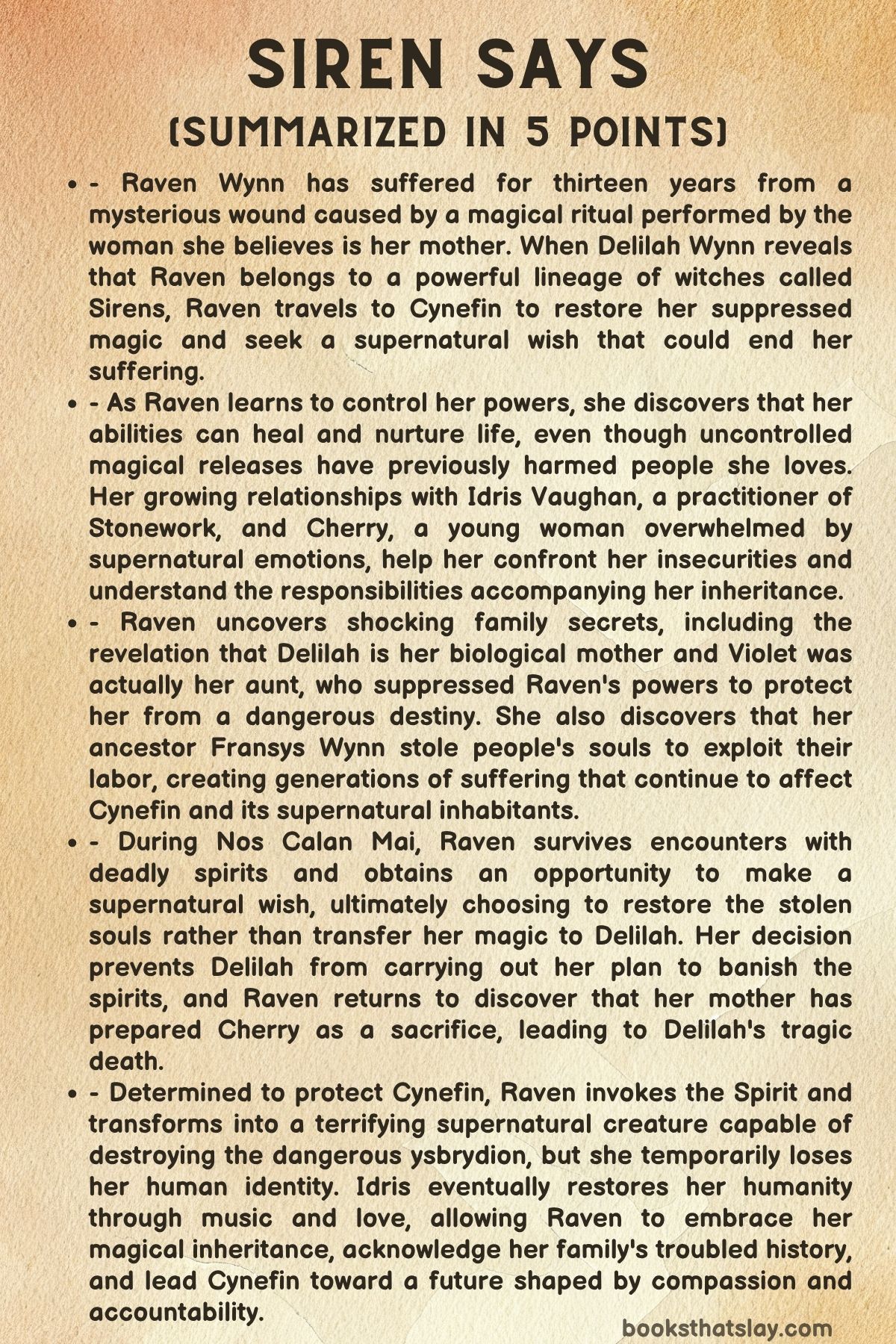
Raven Wynn has lived with a mysterious wound on her back for thirteen years. The injury appeared after her mother, Violet, performed a magical ritual shortly before dying, leaving Raven with a branching burn that continues spreading despite repeated medical treatments.
When crows gather outside her window, Raven remembers their appearance before Violet’s death and fears that something terrible is approaching. Desperate for relief, she visits a bonesetter in Coney Island, who identifies her injury as a blood binding.
The bonesetter explains that Violet deliberately suppressed Raven’s inherited magic, trapping supernatural energy inside her body. Only someone familiar with her maternal family’s traditions can help her reverse the condition.
Raven also discovers an unusual plant called a blood flower, which responds when she feeds it her blood. Its behavior provides further evidence that her connection to magic remains active.
At home, Raven lives under the authority of her abusive stepfather, Striker, a respected surgeon whose public reputation conceals his cruelty. Her closest companion is her stepbrother, Ash, whose anxiety and heart condition make Raven especially protective of him.
Everything changes when Delilah Wynn arrives, claiming to be Violet’s sister. She reveals that Raven belongs to a powerful lineage of witches called Sirens and invites her to Cynefin, Pennsylvania, where their ancestors practiced magic.
Delilah promises that Raven can permanently eliminate her unwanted abilities by obtaining a supernatural wish during Nos Calan Mai. However, she must first restore her magic and learn to control it.
Although Raven distrusts this unfamiliar woman, her desire to escape her suffering proves stronger than her uncertainty. She lights a magical Corpse Candle and experiences a vision of an ancestral woman named Mis transforming into a terrifying creature after witnessing her family’s slaughter.
The ritual partially reverses Raven’s blood binding, but her restored power is unstable. When Striker violently confronts Ash, Raven intervenes, only to release an uncontrolled burst of energy that throws Ash against a wall.
Horrified by the injury she has caused, Raven leaves New York and travels to Cynefin. She hopes that mastering her magic will prevent another accident.
Delilah welcomes her to Hawthorn House, the ancestral Wynn residence, where living vegetation repairs the building and responds enthusiastically to Raven. For the first time, Raven encounters a place where her unusual abilities seem natural.
Her sense of belonging is complicated by the arrival of Idris Vaughan, a jeweler she previously encountered through her employer, Paul. Idris practices Stonework, a magical discipline involving gemstones and the manipulation of energy.
He warns Raven that Delilah is dangerous and attempts to persuade her to return to New York. Raven refuses, unwilling to surrender her chance of recovery.
Delilah begins training Raven alongside Cherry, another young woman whose unexplained supernatural condition causes intense emotional suffering. Raven learns that Sirens practice Soul magic, drawing power from botanical essences and maintaining a special relationship with corvids.
During an early lesson, Raven accidentally creates a devastating blue fire. Although the uncontrolled release endangers everyone nearby, it also temporarily relieves the painful pressure within her body.
Raven begins understanding that her magic is not necessarily the source of her suffering. Its suppression has prevented her from expressing an essential part of herself.
Meanwhile, Cherry struggles with overwhelming emotions that she cannot explain. Recognizing similarities between their experiences, Raven approaches Idris for assistance.
Idris reluctantly agrees to investigate Cherry’s condition while helping Raven regulate her energy. Their arrangement gradually develops into a relationship marked by attraction, emotional vulnerability, and growing trust.
As Raven studies with Delilah, she learns about the ysbrydion, dangerous supernatural spirits that emerge when the boundary between worlds weakens. Among them are the Gwyllion, formerly human spirits capable of granting wishes.
To obtain her wish, Raven must capture a Gwyll during Nos Calan Mai. The undertaking requires her to survive encounters with deadly creatures, including a monstrous water horse, an enormous snake, and other supernatural predators.
While preparing for this confrontation, Raven grows closer to Cherry. She discovers that Cherry has injured herself while attempting to relieve her unbearable emotional sensations.
Raven uses her own magic to heal Cherry’s scars, experiencing extraordinary relief as her accumulated power flows outward. The act demonstrates that her abilities can restore rather than destroy.
Her developing relationship with Idris provides another opportunity for personal transformation. He creates a piece of jewelry incorporating a black opal and delicate golden elements that extend across Raven’s back.
Instead of hiding her remaining scars, the jewelry complements them, creating the appearance of wings. His gift challenges Raven’s belief that her altered body makes her unattractive.
Their attraction intensifies during an evening at a nightclub, but their growing intimacy is disrupted when Raven discovers that a magical substance has unintentionally influenced Idris’s feelings.
Idris feels betrayed because his autonomy has been compromised. Although Raven never intended to manipulate him, she recognizes that her ignorance does not erase the harm.
Her distress becomes even greater when Striker arrives in Cynefin and violently confronts her. A flock of crows intervenes, and the confrontation ends with Striker’s death.
Delilah helps conceal the aftermath, arguing that survival sometimes requires morally difficult actions. Raven struggles to accept this reasoning, fearing that her supernatural inheritance is making violence increasingly easy to justify.
Delilah subsequently reveals the true purpose behind her plans. She wants Raven to transfer her magic to her so that she can Invoke the Spirit, an extraordinary power capable of banishing the dangerous ysbrydion.
Years earlier, Delilah lost most of her abilities and became unable to protect Cynefin through this method. However, invoking Spirit magic risks transforming a Siren into a monstrous being who may never recover her humanity.
Raven becomes increasingly suspicious of the family history Delilah has presented. Through the ancestral grimoire, the Llyfr Cyfrin, she begins investigating the lives of previous Wynn women.
She also learns that Idris’s mother, Maggie Vaughan, lost her soul while attempting to obtain a supernatural wish. Maggie had tried to reunite Delilah with Raven when Raven was a child, but the spirits punished her unsuccessful attempt.
Meanwhile, Idris identifies Cherry as a Listener, someone who experiences the emotions of supernatural spirits. Cherry’s suffering comes from absorbing anguish that does not originate within herself.
These discoveries help Raven understand that her family’s past has consequences extending far beyond her personal suffering.
Her relationship with Idris gradually recovers. He comforts her during an emotional breakdown, and they eventually acknowledge their love.
Their physical intimacy becomes particularly meaningful because Raven’s previous experiences of desire aggravated her binding. With her magic restored, intimacy instead allows her energy to flow naturally into the surrounding vegetation.
Raven begins regarding her body as capable of pleasure and creation rather than merely pain.
As Nos Calan Mai approaches, Raven investigates Delilah’s concealed history. Inside a hidden box, she discovers years of letters addressed to her but never delivered.
The letters reveal that Delilah is her biological mother.
Violet was actually Raven’s aunt, who took her away when she was very young. Years earlier, Violet had used a wish to remove Delilah’s magic because she feared that Delilah would lose her humanity while attempting to banish the spirits.
After giving birth to Raven, Delilah raised her for two years before Violet disappeared with the child. Delilah spent the following years grieving and hoping for their reunion.
Raven realizes that Delilah’s emotional restraint conceals profound maternal love. Nevertheless, she remains troubled by the destructive sacrifices her mother considers acceptable.
During the Nos Calan Mai celebration, Raven prepares for her journey to the quarry. She extinguishes the final ceremonial flame, summoning the dangerous spirits.
Her preparations quickly collapse when the monstrous Gwiber attacks, scattering her carefully collected botanical defenses. Raven survives through improvisation and eventually reaches the quarry, where another creature paralyzes her.
Idris and Cherry arrive to help, and Raven finally obtains an opportunity to make her wish.
A supernatural vision reveals that Fransys Wynn, an influential ancestor, used magic to steal men’s souls and force them to work in the quarry. Their suffering has continued across generations, creating the anguish Cherry experiences.
Raven must choose between transferring her magic to Delilah and restoring the stolen souls.
She chooses restoration.
Her wish returns the souls of the victims, including Maggie Vaughan, but destroys Delilah’s opportunity to recover her powers.
Raven subsequently realizes that Cherry has disappeared. Returning to Hawthorn House, she discovers that Delilah has prepared Cherry as a sacrifice to appease the approaching spirits.
Cherry had agreed because she believed death would finally release her from her suffering.
Raven confronts Delilah, who recognizes that her plans have failed. Mother and daughter finally acknowledge their relationship, but their reconciliation is tragically brief.
Determined to protect Raven, Delilah takes a powerful medicine and confronts the spirits herself. She dies during their attack.
Overwhelmed by grief, Raven experiences a vision of Violet that reveals the truth behind her childhood.
Violet had foreseen that Raven, rather than Delilah, was destined to Invoke the Spirit. However, Raven would die if she attempted the transformation before reaching sufficient maturity.
Violet therefore concealed Raven and suppressed her magic to protect her until she could survive her destiny.
Understanding her aunt’s intentions, Raven decides to confront the spirits herself. Before acting, she asks Idris to use his music to restore her humanity if the transformation overwhelms her.
Raven invokes Spirit magic and draws upon the power of generations of Wynn women. Her body becomes a terrifying supernatural creature, capable of destroying the ysbrydion.
She defeats the spirits, but her victory costs her connection to ordinary human compassion. Unable to recover her identity, she retreats into the wilderness and lives according to predatory instincts.
Idris eventually finds her and begins playing music. His patience, tenderness, and familiar melodies gradually awaken Raven’s memories.
She returns to human form, demonstrating that her transformation does not have to be permanent.
Later, Raven presides over another Nos Calan Mai celebration. She openly acknowledges her family’s violent history while honoring the restoration of its victims.
Maggie has recovered her soul, and Raven maintains meaningful relationships with Ash, Cherry, and Idris. Hawthorn House now contains photographs honoring generations of Wynn women, including Violet and Delilah.
Raven finally accepts her place among them. She understands that her inheritance contains both destructive possibilities and extraordinary gifts, and that her humanity depends upon how she chooses to use them.
Characters
Raven Wynn
Raven Wynn is the central protagonist of Siren Says, and her transformation provides the novel with its emotional and supernatural foundation. Her experiences examine what happens when a person is taught to fear an essential part of their identity.
For thirteen years, Raven believes her inherited magic is responsible for the wound spreading across her back. Her repeated medical treatments, physical pain, and isolation create a relationship with her own body defined by shame and suspicion.
Her childhood under Striker further damages her confidence. She becomes accustomed to anticipating danger, suppressing anger, and accepting responsibility for circumstances beyond her control.
Raven’s protectiveness toward Ash demonstrates her capacity for love, but it also reveals how deeply she associates affection with responsibility. When her uncontrolled magic injures him, she interprets the accident as confirmation that she is inherently dangerous.
Her arrival in Cynefin challenges these beliefs. The plants at Hawthorn House welcome her, and her magical training reveals that her abilities have been trapped rather than fundamentally corrupted.
Nevertheless, Raven does not immediately embrace her inheritance. Her mistakes involving Ash and Idris establish that possessing extraordinary power does not automatically provide the judgment required to use it responsibly.
Her relationship with Idris is central to her developing self-acceptance. Through his admiration and tenderness, she begins recognizing that her scars and supernatural abilities do not make her undeserving of love.
However, her development extends beyond romance. Raven repeatedly confronts difficult ethical decisions, particularly when Delilah encourages her to accept sacrifice as an unavoidable consequence of protecting others.
Her decision to restore the stolen souls demonstrates her willingness to prioritize justice over personal convenience. She refuses to continue a pattern of exploitation simply because her family has benefited from it.
Raven’s final transformation represents the ultimate confrontation with her fear of becoming monstrous. By recovering her humanity after defeating the spirits, she demonstrates that her identity is not determined solely by inherited power.
Her eventual leadership of Cynefin reflects a profound change. She becomes a woman capable of acknowledging her family’s wrongdoing without rejecting the meaningful parts of her inheritance.
Delilah Wynn
Delilah Wynn is one of the most morally complicated figures in Siren Says. Initially introduced as Raven’s mysterious aunt, she eventually emerges as her biological mother and a woman whose protective ambitions have led her toward devastating choices.
Delilah possesses extensive knowledge of Siren magic and the supernatural history of Cynefin. Her intelligence, determination, and authority make her an influential figure within the community.
Her emotional restraint initially appears to be evidence of coldness. She frequently dismisses Raven’s concerns, withholds important information, and insists that magical training must take precedence over personal feelings.
The discovery of her hidden letters transforms this impression. Delilah has spent years mourning the daughter she lost, and her controlled behavior conceals emotional suffering she believes could interfere with her responsibilities.
Her relationship with Violet explains much of her determination. Violet’s decision to remove her magic deprived Delilah of both her supernatural identity and her intended role as Cynefin’s protector.
Delilah believes that recovering sufficient power will allow her to eliminate the ysbrydion and prevent further suffering. Yet her conviction gradually becomes inseparable from a willingness to sacrifice innocent people.
Her treatment of Cherry reveals this contradiction. Although she develops genuine affection for the younger woman, Delilah remains prepared to offer her to the spirits.
This decision exposes the dangerous limitations of Delilah’s reasoning. She has convinced herself that protecting a community justifies actions that violate the autonomy and humanity of individuals.
Her relationship with Raven contains the same conflict. Delilah genuinely loves her daughter but conceals information that Raven needs to make an informed decision about her own future.
Delilah’s death is tragic because she never fully reconciles her protective intentions with the harm caused by her methods. Her final act demonstrates maternal devotion, but it does not erase the consequences of her earlier decisions.
She represents the difficulty of distinguishing necessary sacrifice from the desire to control events through overwhelming personal certainty.
Idris Vaughan
Idris Vaughan serves as Raven’s romantic partner, magical guide, and an important counterbalance to Delilah’s influence. His role gradually expands from that of a suspicious outsider to someone whose loyalty helps Raven understand her own humanity.
When Idris first encounters Raven, he is sarcastic, secretive, and determined to prevent her from becoming involved with Delilah. His behavior initially resembles another attempt to restrict Raven’s choices.
However, his hostility toward Delilah has a personal foundation. His mother, Maggie, lost her soul while attempting to assist Delilah, leaving Idris with firsthand knowledge of the dangers associated with Siren magic.
His Stonework allows him to manipulate energies through gemstones. Although this makes him capable of influencing emotions, he understands that magical intervention can threaten another person’s autonomy.
This concern becomes especially important when Raven accidentally affects his attraction through a magical substance. His anger reflects the importance he places on distinguishing genuine affection from supernatural manipulation.
Despite their separation, Idris eventually recognizes Raven’s willingness to acknowledge her mistakes. Their reconciliation develops through communication and emotional honesty rather than magical control.
His black opal jewelry is particularly significant. By designing something that complements Raven’s scars, he offers her an alternative perspective on the body she has spent years concealing.
His musical abilities reveal another aspect of his personality. Music allows him to express emotions that his guarded manner often prevents him from communicating directly.
During Raven’s monstrous transformation, Idris fulfills his promise to find her. Rather than attempting to dominate her through Stonework, he relies on patience, music, and their shared emotional history.
His actions demonstrate that love can preserve another person’s freedom while providing the connection necessary for recovery.
Cherry
Cherry is among the most psychologically complex supporting characters in Siren Says. Her initial detachment conceals a desperate struggle with supernatural sensations that she cannot identify or escape.
When Raven first encounters her, Cherry appears distracted, uncooperative, and emotionally distant. Her behavior makes it difficult for others to recognize the severity of her suffering.
The discovery of her scars reveals that she has been attempting to manage overwhelming distress through self-injury. Her situation demonstrates the consequences of enduring pain without understanding its source.
Cherry’s eventual identification as a Listener changes the interpretation of her experiences. She has been absorbing the emotions of spirits, particularly the anguish associated with the quarry’s violent history.
Her apparent emotional instability is therefore connected to suffering that extends beyond her own life. Without knowing the origin of these sensations, Cherry has struggled to distinguish her personal feelings from those of supernatural beings.
Her relationship with Raven provides an important source of compassion. When Raven heals her scars, the experience temporarily relieves Cherry’s suffering and establishes a connection between the two women.
Nevertheless, Cherry’s vulnerability makes her susceptible to Delilah’s plans. She agrees to become a sacrifice because she believes death will finally provide relief from the emotional noise surrounding her.
Her willingness reflects the depth of her desperation rather than a freely chosen expression of spiritual duty.
Through Cherry, the novel explores the consequences of emotional isolation and the importance of recognizing suffering that may not be immediately visible.
Her survival and continued relationship with Raven suggest that understanding, companionship, and relief from the causes of suffering can create possibilities that once seemed unreachable.
Violet Wynn
Violet Wynn occupies a complicated position in Siren Says because much of her influence occurs through memories, hidden documents, and supernatural revelations. Although she dies before the main events, her decisions shape Raven’s entire life.
Initially, Violet appears responsible for inflicting the blood binding that has caused Raven years of suffering. The ritual seems to represent a deliberate rejection of Raven’s magical inheritance.
The revelation that Violet was actually Raven’s aunt changes the nature of this apparent betrayal. She had taken Raven away from Delilah after foreseeing the dangers associated with her niece’s destiny.
Violet possessed prophetic abilities that allowed her to recognize Raven’s future role in confronting the ysbrydion. She also understood that attempting the transformation too early would result in Raven’s death.
Her decision to suppress Raven’s magic therefore emerged from a desire to protect her. Nevertheless, the protective ritual imposed extraordinary physical and emotional suffering upon the child.
Violet’s actions reveal the moral difficulties associated with possessing knowledge of a possible future. Her certainty that Raven needed protection encouraged her to make decisions without allowing the people affected to participate.
Her conflict with Delilah demonstrates the opposing directions that protective love can take. While Delilah attempts to confront danger through power, Violet attempts to prevent catastrophe through concealment.
Neither sister fully escapes the consequences of trying to control Raven’s destiny.
Violet’s eventual revelation helps Raven understand that her childhood suffering was not evidence of rejection. It also allows her to recognize the difference between understanding a person’s intentions and accepting every consequence of their choices.
Ash
Ash represents the emotional security Raven struggles to preserve during her life in New York. His relationship with her provides an important contrast to the cruelty and unpredictability of their household.
Living with anxiety and a heart condition, Ash is especially vulnerable to Striker’s controlling behavior. Raven consequently assumes a protective role that shapes many of her decisions.
Their affectionate interactions demonstrate that Raven remains capable of tenderness despite the fear surrounding her. Ash also provides a perspective grounded in ordinary concerns rather than supernatural expectations.
When Raven considers restoring her magic, Ash questions whether she should trust Delilah. His caution encourages her to examine the possible consequences of accepting an unfamiliar relative’s promises.
The accident that leaves him unconscious becomes a defining moment in Raven’s development. Because she injures someone she loves, she can no longer regard magical control as merely a personal concern.
Ash’s importance extends beyond his physical vulnerability. He represents the possibility of maintaining meaningful family relationships outside the ancestral expectations imposed by the Wynn lineage.
Raven’s eventual reconnection with him confirms that her journey does not require abandoning the relationships that sustained her before she discovered Cynefin.
Striker
Striker is Raven and Ash’s abusive father figure, whose authority exposes the difference between public respectability and private cruelty. His position as a successful surgeon gives him social credibility that contrasts sharply with his behavior at home.
He exercises control through intimidation, humiliation, and physical violence. His treatment of Ash demonstrates his willingness to exploit vulnerability rather than protect it.
For Raven, Striker embodies the conditions under which she learned to suppress her emotions and distrust her own judgment. His authority has encouraged her to associate resistance with danger.
His attack on Ash triggers Raven’s first destructive release of restored magic. The incident establishes a disturbing relationship between her emotional trauma and supernatural instability.
When Striker follows Raven to Cynefin, he attempts to reestablish the dominance he previously exercised. His inability to recognize her growing independence contributes to their violent confrontation.
His death ends his immediate power over Raven, but it does not automatically free her from the psychological consequences of his abuse.
Raven’s horror afterward reveals that escaping an abusive authority does not eliminate difficult questions about violence, responsibility, and self-perception.
Striker functions as both a personal antagonist and an example of how coercive relationships can distort a person’s understanding of power.
Maggie Vaughan
Maggie Vaughan provides an essential connection between Raven’s present circumstances and the hidden history of the Wynn family. Her supernatural condition demonstrates the long-lasting consequences of magical decisions.
Years earlier, Maggie became involved in Delilah and Violet’s conflict over Raven. She attempted to capture a Gwyll because she hoped to reunite Delilah with her daughter.
Her effort failed because she did not possess the necessary Siren abilities. The spirits stole her soul, leaving her physically alive but deprived of an essential part of her existence.
Maggie’s condition explains much of Idris’s distrust toward Delilah. His protective behavior emerges from watching his mother suffer because of decisions connected to the Wynn family.
Her history also demonstrates the limitations of good intentions. Maggie attempted to help another person, yet her intervention carried consequences she could not foresee.
When Raven chooses to restore the stolen souls, Maggie becomes one of the beneficiaries of her decision.
Her recovery transforms an apparently irreversible tragedy into evidence that inherited wrongdoing can be corrected through actions directed toward restitution.
Fransys Wynn
Fransys Wynn is a foundational figure in the history of Cynefin and the ancestral legacy explored throughout the novel. Her accomplishments initially appear inseparable from the establishment of the community and the Wynn family’s influence.
However, Raven eventually discovers that Fransys used Siren magic to steal men’s souls and force them to labor in the quarry.
Her exploitation created prosperity through the destruction of other people’s freedom. The consequences continued long after the original victims died.
Fransys therefore represents a version of ancestral achievement that cannot be separated from violence.
Her history forces Raven to reconsider the stories through which her family has understood its own importance.
Rather than accepting Fransys as an uncomplicated founder, Raven recognizes the people whose suffering made her accomplishments possible.
The restoration of the stolen souls and Raven’s later public acknowledgment of this history demonstrate the importance of confronting wrongdoing without concealing its relationship to inherited privilege.
Mis
Mis is an ancestral Siren whose story establishes the supernatural possibilities and dangers associated with Raven’s eventual transformation.
Raven first encounters her through a vision involving the violent destruction of her family. Overwhelmed by grief and rage, Mis undergoes a terrifying physical transformation.
Her changing eyes, altered body, and association with crows reveal the monstrous potential contained within Siren magic.
Initially, the vision reinforces Raven’s fear that restoring her abilities will inevitably destroy her humanity.
However, Mis’s history later acquires a different significance. Her experience provides evidence that supernatural transformation need not represent a permanent loss of identity.
Mis connects Raven’s personal struggle with a much older pattern of grief, extraordinary power, and the possibility of recovery.
Her presence demonstrates that ancestral knowledge can provide warnings without necessarily determining the choices of later generations.
Alys, Carys, and Glynnis Wynn
Alys, Carys, and Glynnis belong to the generations of Wynn women whose experiences are preserved within the family’s magical history.
Although their individual lives receive less attention than those of Raven, Delilah, and Violet, their collective presence establishes the continuity of the Siren lineage.
Raven encounters their legacy through the Llyfr Cyfrin and the ancestral consciousness associated with Spirit magic.
Their importance becomes especially apparent when Raven invokes the Spirit and experiences the accumulated presence of earlier Wynn women.
They represent the knowledge, strength, and unresolved experiences passed from one generation to another.
The photographs honoring them at Hawthorn House eventually establish their place within a family history that Raven has learned to approach with both pride and critical awareness.
Paul
Paul, Raven’s wealthy employer, helps establish her connection to plants before she fully understands her inherited abilities.
His tendency to rearrange the conservatory’s vegetation without considering its needs contrasts with Raven’s unusual sensitivity to living things.
Through her work for him, Raven demonstrates an instinctive understanding of plants that later becomes central to her magical training.
Paul also provides the setting for her early encounters with Idris and the extraordinary black opal.
The gemstone eventually becomes part of the jewelry through which Idris helps Raven reinterpret her scars.
Although Paul’s role is comparatively limited, his conservatory establishes important connections between Raven’s ordinary life and the supernatural world she subsequently enters.
Claude
Claude is associated with Idris’s investigation into Cherry’s unidentified abilities. His participation demonstrates that supernatural knowledge extends beyond the traditions practiced by the Wynn family.
Through the assistance available from Claude and Idris, Cherry gains access to explanations that Delilah has been unable to provide.
His role emphasizes the importance of examining unfamiliar magical conditions through more than one system of knowledge.
Although he receives relatively little individual development, Claude contributes to the discovery that Cherry is a Listener.
This discovery provides the foundation for understanding her suffering and its connection to Cynefin’s supernatural history.
Annwn
Annwn, Idris’s dog, provides companionship and emotional comfort during Raven’s visits to Idris’s secluded home.
His presence contributes to the domestic atmosphere that allows Raven to experience Idris as more than a guarded magical practitioner.
When Raven is distressed, Annwn’s companionship offers a simple form of reassurance that does not require explanations or supernatural intervention.
Although he does not directly influence the central magical conflict, Annwn helps establish the emotional security Raven gradually associates with Idris’s home.
His role supports the novel’s broader contrast between relationships based on care and relationships governed by fear or control.
Themes
Inherited Power and the Burden of Family History
Raven’s magical inheritance initially appears to be a source of suffering rather than privilege. The blood binding imposed during her childhood has transformed an extraordinary ability into a condition associated with pain, shame, and isolation.
Her arrival in Cynefin changes her understanding of this inheritance. The living vegetation at Hawthorn House recognizes her abilities, while the ancestral grimoire introduces her to generations of women whose experiences resemble her own.
However, discovering her family’s achievements also exposes its history of exploitation.
Fransys Wynn’s use of stolen souls demonstrates that inherited power can carry consequences extending far beyond the lives of those who originally exercised it.
In Siren Says, ancestry is therefore neither an unquestionable blessing nor an unavoidable curse. Raven must distinguish the abilities she has inherited from the harmful decisions through which previous generations exercised them.
Her choice to restore the stolen souls represents a rejection of the assumption that loyalty requires protecting a family’s reputation.
She acknowledges the suffering created by her ancestors and directs her power toward repairing it.
This distinction becomes particularly important after she assumes a leadership role in Cynefin. Rather than repeating a celebratory account of Fransys’s accomplishments, Raven publicly recognizes the violence underlying the family’s history.
Her willingness to preserve uncomfortable truths demonstrates a mature understanding of inheritance.
The past influences her identity, but it does not determine her moral responsibilities or require her to repeat earlier mistakes.
Bodily Autonomy, Self-Acceptance, and Personal Freedom
Raven’s relationship with her body is shaped by decisions made before she was old enough to understand or challenge them. Violet’s blood binding suppresses her magical abilities, leaving her with a spreading wound and years of physical distress.
Although the ritual was intended to protect her, it deprived Raven of control over an essential aspect of herself.
Her childhood under Striker reinforces this loss of autonomy. She learns to suppress anger, anticipate punishment, and regard her own desires as potential sources of danger.
Restoring her magic begins a difficult process of reclaiming personal freedom.
Yet the novel does not present freedom as the unrestricted exercise of power. Raven’s accidental injury of Ash and her unintended manipulation of Idris demonstrate that respecting autonomy requires acknowledging the freedom of other people.
Her developing relationship with Idris helps her reconsider her physical appearance. His black opal jewelry transforms the visual meaning of her scars without requiring her to conceal them.
The experience allows Raven to recognize beauty in a body she previously regarded as damaged.
Her magical healing of Cherry offers a related perspective. Cherry’s suffering demonstrates how a poorly understood condition can estrange someone from their own physical and emotional experience.
Both women begin recovering through greater knowledge of their abilities.
Raven’s eventual acceptance of intimacy, pleasure, and magical expression establishes bodily autonomy as something more than escaping pain.
She learns to inhabit her body without constantly treating it as an enemy.
Her transformation reflects the possibility of embracing a complicated identity while retaining the right to determine how that identity is expressed.
Love, Protection, and the Ethics of Sacrifice
The distinction between loving someone and controlling them shapes the central family relationships of Siren Says. Delilah and Violet both believe they are protecting Raven, yet their conflicting decisions impose extraordinary consequences upon her life.
Violet suppresses Raven’s magic because she foresees that an early confrontation with the spirits will kill her.
Delilah seeks to reclaim her daughter and eliminate the supernatural threat to Cynefin, but her determination makes her increasingly willing to sacrifice others.
Neither woman’s love is presented as emotionally insignificant. Their actions emerge from genuine fear, grief, and devotion.
Nevertheless, the suffering caused by their decisions demonstrates that protective intentions do not automatically justify coercive methods.
Delilah’s treatment of Cherry exposes this problem particularly clearly.
Although she cares for Cherry, she prepares to sacrifice her because she believes doing so will preserve the wider community.
Cherry’s willingness to participate complicates the situation because her agreement emerges from profound suffering and a desperate desire for relief.
The novel consequently questions whether a decision can be considered genuinely voluntary when the alternatives appear unbearable.
Idris provides a contrasting approach to love.
His relationship with Raven is initially affected by secrecy and attempts at magical influence, but it develops through the recognition that affection must coexist with personal freedom.
When Raven undergoes her monstrous transformation, Idris does not attempt to overpower her.
Instead, he approaches through music, patience, and emotional familiarity.
His actions demonstrate a form of devotion that seeks to recover another person’s agency rather than replace it.
Through these relationships, the story distinguishes love expressed through care from love distorted by fear and the desire for control.
Humanity, Monstrosity, and the Possibility of Redemption
Raven’s greatest fear is that her magic will transform her into someone incapable of compassion. Her early vision of Mis establishes this anxiety through the image of a grieving woman whose supernatural power produces a terrifying physical transformation.
The possibility of becoming monstrous continues to influence Raven’s decisions.
Her accidental injury of Ash, the magical incident involving Idris, and Striker’s violent death all encourage her to associate extraordinary power with the loss of moral control.
However, the novel gradually complicates the relationship between appearance and humanity.
Striker possesses an ordinary human body and a respected professional identity, yet his behavior is defined by cruelty and domination.
Conversely, Raven’s magical abilities allow her to heal Cherry, restore stolen souls, and protect people threatened by supernatural creatures.
The contrast suggests that humanity is expressed through conduct rather than physical appearance.
Raven’s transformation into a monstrous creature brings this distinction into sharper focus.
After invoking the Spirit, she defeats the dangerous ysbrydion but becomes increasingly detached from compassion. Her predatory instincts overwhelm the memories and relationships that previously defined her.
The transformation is frightening because she experiences pleasure in violence and loses the ability to recognize herself.
Yet her recovery challenges the assumption that such a loss must be permanent.
Idris’s music restores her connection to memories, affection, and ordinary human experience.
His intervention does not erase the destructive potential of her powers. Instead, it demonstrates that recovering humanity requires reconnecting with the relationships and values that give power meaningful direction.
Raven’s eventual leadership provides the clearest expression of this understanding.
She neither denies her monstrous experiences nor permits them to define her entire identity.
By acknowledging ancestral wrongdoing, restoring victims, and maintaining meaningful relationships, she establishes that redemption depends upon responsibility, compassionate action, and the continuing possibility of change.