Hunt the Villain Summary, Characters and Themes
Hunt the Villain by Rina Kent is a dark, emotional romance set inside the dangerous world of rival Bratva families. The story follows Vaughn Morozov, the controlled heir of the New York Bratva, and Yulian Dimitriev, the wild and wounded son of Chicago’s leader.
What begins as hatred at a summer camp turns into a bond shaped by violence, betrayal, desire, and years of misunderstanding. At its core, the book is about two young men raised for power and survival, learning whether love can exist in a world built on fear, loyalty, and blood. It’s the 2nd book of the Villain series, the first one being Kiss the Villain.
Summary
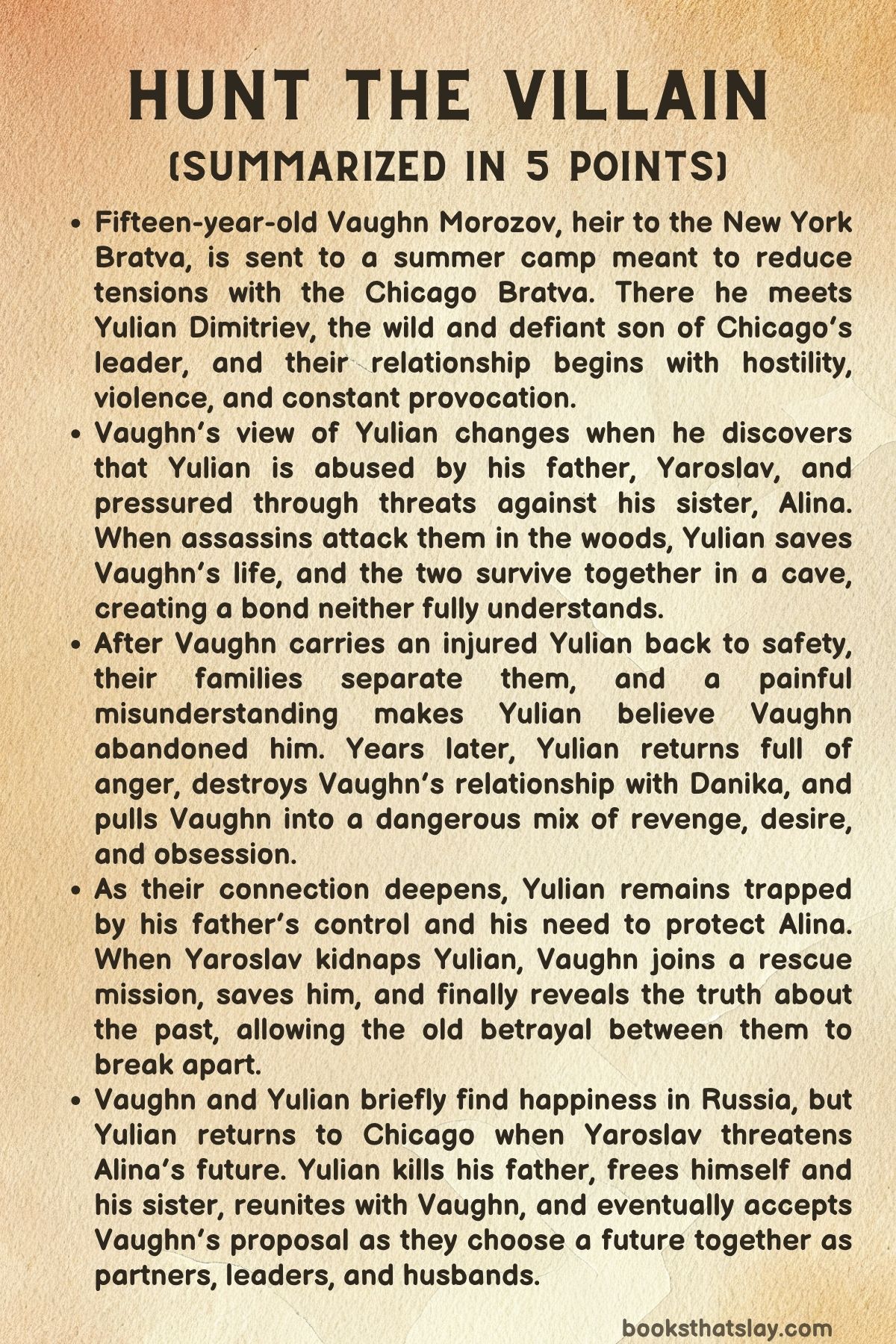
Vaughn Morozov is fifteen when he is sent to a summer camp in the Adirondacks, a place designed to reduce tension between the New York and Chicago Bratvas. As the heir of the New York Bratva, Vaughn arrives with discipline, suspicion, and little interest in making friends with anyone connected to a rival family.
He sees the camp less as a peace effort and more as a chance to study the enemy.
That changes when he meets Yulian Dimitriev, the unpredictable son of Chicago’s Bratva leader, Yaroslav. Yulian is loud, reckless, and impossible to ignore.
Their first meeting is hostile from the start. Yulian causes chaos, climbs onto Vaughn’s balcony, ruins his handkerchief, mocks the way he speaks Russian, and smears blood across his face.
Vaughn is furious and decides almost instantly that Yulian is someone he cannot stand.
Yulian, however, refuses to leave him alone. Over the following weeks, he keeps provoking Vaughn, pushing at his temper and trying to drag him into a fight.
Vaughn is used to control, but Yulian seems built to destroy it. Their tension finally breaks during training, where they clash violently and are punished together.
What Vaughn first sees as simple arrogance begins to look more complicated when he learns what Yulian faces at home.
Vaughn discovers that Yaroslav abuses Yulian, beating him for his lack of discipline and using Yulian’s sister, Alina, as a threat. This knowledge unsettles Vaughn.
Yulian’s wild behavior is no longer just rebellion or cruelty; it is also a response to fear, pain, and a life ruled by his father’s violence. Vaughn does not fully know how to comfort him, but his view of Yulian begins to shift.
The turning point comes when Vaughn and Yulian are sent into the woods to gather wood. They are attacked by assassins, and Yulian pushes Vaughn out of danger, taking a bullet meant for him.
The boys are forced to run through the forest, fighting for their lives and killing attackers as they try to survive. They hide in a cave Yulian had found during earlier punishments, and Vaughn takes charge of keeping him alive.
Vaughn removes the bullet, stitches Yulian’s wound, and stays with him through the night. In the cave, away from their families and the expectations placed on them, they speak more honestly than they ever have before.
They talk about their homes, their fears, and the futures waiting for them. The cold forces them close, and while Vaughn sleeps, Yulian kisses him.
The moment is quiet but life-changing, even if neither of them has the words to understand it fully.
The next day, Vaughn carries the unconscious Yulian down the mountain. Their families separate them afterward, and the fragile trust between them is damaged before it can grow.
Vaughn later visits Yulian in the hospital and kisses him, but Yulian’s mother warns him that staying close to Yulian could destroy him. Vaughn leaves, and when Yulian wakes, he believes Vaughn abandoned him.
That belief becomes a wound that hardens into hatred. Soon after, Yulian sees Vaughn kissing a girl named Danika.
At the same time, his life falls apart further when he learns that his mother has died and Alina has been in an accident. In Yulian’s mind, Vaughn becomes part of the pain, another person who left when he was needed most.
Four years pass. Vaughn is nineteen, studying at Columbia, and dating Danika.
He has tried to build a life that looks controlled and acceptable, but Yulian’s return destroys that illusion. Yulian appears at a restaurant in New York and confronts him.
He demands that Vaughn break up with Danika and transfer to The King’s U. Vaughn refuses to be ordered around, but Yulian knows how to hurt him.
To punish Vaughn, Yulian seduces Danika and sends Vaughn proof of her betrayal. Vaughn responds with cold precision, publicly exposing Danika’s cheating and ending their relationship.
Yet instead of freeing him, the incident pulls him deeper into Yulian’s orbit. Vaughn becomes increasingly fixated on him and eventually follows him to Brighton Island.
Their relationship becomes volatile, physical, and difficult to define. They fight, sleep together, push each other away, and return again.
Yulian wants revenge for what he believes Vaughn did years earlier, while Vaughn tries to convince himself that what they share is only desire. Neither of them is honest about the depth of their attachment.
Their bond is full of anger, attraction, old pain, and a need that neither can fully control.
Around them, danger continues to build. Yulian remains trapped by his father’s power, especially because of Alina.
His love for his sister shapes many of his choices. Yaroslav knows this and uses it against him.
Yulian may appear careless to others, but much of what he does is driven by the need to protect Alina from their father’s cruelty.
After another argument, Yulian is kidnapped by men working for Yaroslav. Cyrus tells Vaughn what has happened and blames him for abandoning Yulian in the past.
Vaughn refuses to let history repeat itself. This time, he does not step back.
He joins a covert rescue mission with his parents and goes after Yulian.
They succeed in saving him, and afterward Vaughn finally tells Yulian the truth about what happened four years earlier. He explains that he never abandoned him.
He carried him down the mountain, came to see him in the hospital, and left only after being warned away. The misunderstanding that has poisoned them for years finally breaks.
Yulian is forced to face the fact that the betrayal he built his hatred on was never real.
Vaughn takes Yulian to Russia so he can recover with his uncles, Anton and Maksim. For a short time, they are allowed to exist outside the reach of their fathers, their families, and the violence waiting for them.
They are happy there. They begin to imagine a future together, one that is not built only on pain or secrecy.
For the first time, their connection feels like something they might be able to keep.
But Yulian’s freedom does not last. Yaroslav threatens to marry Alina off unless Yulian agrees to a political marriage.
Yulian leaves Vaughn behind with a goodbye letter and returns to Chicago. He chooses his sister’s safety over his own happiness, believing he has no other option.
On the day of the wedding, Yulian decides that obedience will never save him or Alina. Instead of surrendering to his father’s control, he kills Yaroslav.
By doing so, he frees himself and his sister from the man who has ruled their lives through fear.
Vaughn follows him, and the two reunite. With Yaroslav gone and the truth between them finally clear, Vaughn and Yulian choose each other openly.
They stop hiding behind rivalry, revenge, or denial. One month later, Vaughn transfers to Brighton Island and moves in with Yulian, beginning the life they once thought was impossible.
Two years later, during Nikolai and Brandon’s wedding, Vaughn proposes to Yulian. Yulian accepts.
Their story ends with them looking toward a future not only as lovers, but as partners, leaders, husbands, and soulmates. After years of violence, separation, and misunderstanding, they claim a life together on their own terms.
Characters
Vaughn Morozov
Vaughn Morozov is one of the central characters of Hunt the Villain, and his journey is shaped by control, loyalty, emotional repression, and the gradual acceptance of a love he cannot easily define. At fifteen, Vaughn enters the summer camp with the mindset of an heir, not a boy looking for friendship.
He sees the Chicago Bratva as the enemy and approaches the camp as a place to observe weakness rather than build bonds. This shows how deeply his identity has been shaped by power, family duty, and the expectations placed on him as the future of the New York Bratva.
His first reaction to Yulian is hatred because Yulian represents everything Vaughn dislikes: chaos, recklessness, disrespect, and unpredictability. Yet Vaughn’s hatred is never simple.
It becomes tangled with fascination, protectiveness, desire, and eventually love.
Vaughn’s emotional complexity becomes clearer when he discovers that Yulian is abused by Yaroslav. This revelation forces him to see beyond Yulian’s provocations and understand that his wild behavior is partly a survival mechanism.
Vaughn is not naturally expressive, but his actions reveal his feelings more strongly than his words. When Yulian is shot, Vaughn takes charge, treats the wound, removes the bullet, stitches him up, and carries him down the mountain.
These actions show courage, discipline, and fierce devotion, even before he fully understands the depth of his attachment. His later silence and separation from Yulian create the central misunderstanding between them, but Vaughn’s pain comes from being trapped between family pressure, danger, and emotions he has not yet learned how to claim openly.
As an adult, Vaughn tries to live a controlled life through college, status, and his relationship with Danika, but Yulian’s return exposes how unresolved his past remains. His obsession with Yulian reveals that he cannot bury what happened between them.
Vaughn’s development lies in moving from denial to honesty. He initially tells himself their bond is physical, hostile, or temporary, but every major choice he makes proves otherwise.
His decision to rescue Yulian from Yaroslav’s men is a turning point because it shows that he refuses to repeat the mistake of losing him. By the end of the story, Vaughn becomes more emotionally open and more willing to choose love publicly.
His proposal to Yulian shows that he has transformed from a guarded heir into someone capable of embracing vulnerability, partnership, and permanence.
Yulian Dimitriev
Yulian Dimitriev is one of the most tragic, volatile, and emotionally wounded figures in Hunt the Villain. At first, he appears reckless, cruel, and deliberately provocative.
He enjoys getting under Vaughn’s skin, mocks him, invades his space, and pushes him toward violence. However, Yulian’s chaos hides a much deeper pain.
His behavior is not simply immaturity or arrogance; it is the armor of someone raised under brutality. Yaroslav’s abuse shapes Yulian’s personality, making him defiant, self-destructive, suspicious, and desperate for control over the few things in life that still belong to him.
His love for Alina also reveals a softer and more loyal side of him. Beneath his wildness, Yulian is a protector.
Yulian’s relationship with Vaughn is built on conflict, longing, betrayal, and misunderstanding. When he kisses Vaughn in the cave, the moment shows the vulnerability he usually hides.
For Yulian, Vaughn becomes someone who sees him beyond his reputation and pain. This is why Vaughn’s apparent abandonment wounds him so deeply.
Yulian does not simply feel rejected; he feels confirmed in his fear that everyone eventually leaves or uses him. The later sight of Vaughn kissing Danika intensifies his heartbreak and turns love into hatred.
His revenge against Vaughn through Danika is cruel, but it comes from a place of emotional devastation rather than simple malice. Yulian wants Vaughn to feel the humiliation and abandonment he believes he suffered.
As an adult, Yulian remains torn between vengeance and love. He tries to punish Vaughn, but he cannot fully detach from him.
Their physical relationship becomes a battlefield where anger and desire constantly overlap. Yulian’s greatest conflict is between his need for freedom and his responsibility to protect Alina.
Yaroslav uses that love against him, forcing Yulian into impossible choices. His decision to return to Chicago and accept a political marriage shows his willingness to sacrifice himself for his sister, but his eventual killing of Yaroslav marks his final rejection of fear and control.
By the end, Yulian is no longer only surviving his father’s violence; he is actively freeing himself from it. His acceptance of Vaughn’s proposal represents healing, trust, and the belief that he can finally be loved without being abandoned.
Yaroslav Dimitriev
Yaroslav Dimitriev is the main force of cruelty and control in the story. As the leader of the Chicago Bratva and Yulian’s father, he represents the darkest version of power: authority without tenderness, discipline without love, and family loyalty twisted into domination.
His abuse of Yulian reveals his need to break those beneath him rather than guide them. Yaroslav does not see his children as people with emotions and futures of their own.
He treats them as tools, political pieces, and extensions of his authority.
His threats against Alina make him even more dangerous because he understands exactly where Yulian is most vulnerable. Yaroslav’s power comes not only from physical violence but from psychological control.
He knows that Yulian will endure pain for Alina’s safety, and he uses that devotion as a weapon. This makes him a deeply oppressive figure in the book.
He is not merely an external villain; he is the source of Yulian’s trauma, fear, and self-destructive instincts. His death at Yulian’s hands is therefore not only an act of revenge but also an act of liberation.
By killing Yaroslav, Yulian ends the cycle of abuse and removes the person who has controlled both his life and Alina’s future.
Alina Dimitriev
Alina Dimitriev plays an important emotional role even though much of her presence is shaped by vulnerability and danger. She is Yulian’s sister and one of the main reasons he continues to endure his father’s control.
Alina represents innocence trapped inside a violent world. Her situation shows how Bratva politics affect not only heirs and leaders but also those who are used as bargaining tools in family power struggles.
Yaroslav’s threats against her reveal how little protection exists for someone in her position when the person who should protect her is also the source of danger.
For Yulian, Alina is not just family; she is his reason to keep fighting. His protectiveness toward her reveals the strongest and most selfless part of his character.
Even when he is angry, reckless, or cruel, his love for Alina remains sincere. She becomes the emotional pressure point that forces him to make painful choices, including leaving Vaughn and returning to Chicago.
Through Alina, the story shows that love can be both a source of strength and a vulnerability that enemies exploit. Her eventual freedom after Yaroslav’s death gives Yulian’s victory deeper meaning because he is not only saving himself but also saving the sister he has always tried to protect.
Danika
Danika serves as an important figure in Vaughn and Yulian’s adult conflict. At first, she appears to represent Vaughn’s attempt at a normal or controlled life.
His relationship with her suggests that he is trying to move forward from the emotional confusion and pain connected to Yulian. However, Danika also becomes part of Yulian’s revenge.
When Yulian seduces her and sends Vaughn proof of her betrayal, she becomes the instrument through which Yulian exposes the fragility of Vaughn’s carefully managed life.
Danika’s role is not as emotionally deep as Vaughn’s or Yulian’s, but she is significant because she forces Vaughn to confront the truth. Her betrayal ends the illusion that Vaughn can simply replace or suppress what he feels for Yulian.
The public exposure of her cheating also shows Vaughn’s pride and ruthlessness when he is hurt. Danika functions as a catalyst, pushing Vaughn out of denial and back into the unresolved emotional storm that Yulian represents.
In this sense, she is less important as a love interest and more important as the character who helps reveal that Vaughn’s real attachment has always been elsewhere.
Cyrus
Cyrus acts as a sharp and confrontational supporting character who pushes Vaughn to face the consequences of the past. When Yulian is kidnapped, Cyrus does not allow Vaughn to remain detached or passive.
By blaming Vaughn for abandoning Yulian once before, he voices the pain and resentment that Yulian has carried for years. His accusation matters because it forces Vaughn to confront the emotional damage caused by the misunderstanding between them.
Cyrus’s role is important because he helps move the story from conflict into revelation. He becomes part of the pressure that drives Vaughn to rescue Yulian and finally explain the truth.
Although he is not at the center of the romance, Cyrus helps expose the emotional stakes of Vaughn and Yulian’s relationship. He understands Yulian’s suffering and makes sure Vaughn cannot ignore it.
His presence adds urgency to the rescue and reinforces the idea that Yulian’s pain has been visible to others, even when Vaughn was unaware of the full extent of it.
Yulian’s Mother
Yulian’s mother is a tragic figure whose presence influences the emotional separation between Vaughn and Yulian. Her warning to Vaughn in the hospital comes from fear and experience.
She understands the danger surrounding Yulian and believes that closeness to him could destroy Vaughn. Her words contribute to Vaughn leaving, which then deepens Yulian’s belief that he has been abandoned.
This makes her a complicated character because her intention may be protective, but the result is deeply painful.
Her death becomes another emotional blow for Yulian. It arrives at a moment when he is already wounded by Vaughn’s apparent rejection and the sight of Vaughn with Danika.
Losing his mother adds grief to betrayal, making his hatred feel even more intense. She represents the fragile emotional connections in Yulian’s life, and her absence leaves him more exposed to Yaroslav’s cruelty.
Her role may be brief, but it is powerful because she helps shape the misunderstanding that defines Vaughn and Yulian’s separation.
Vaughn’s Parents
Vaughn’s parents represent the world of duty, power, and family loyalty that has shaped Vaughn since childhood. As members of the New York Bratva, they belong to a system where personal feelings are often secondary to strategy and survival.
Their influence helps explain Vaughn’s guarded personality. He has been raised to think like an heir, to calculate danger, and to protect his family’s position.
This upbringing makes it difficult for him to openly process his feelings for Yulian when he is young.
However, Vaughn’s parents are not portrayed only as obstacles. Their involvement in the rescue mission shows that they are capable of action and loyalty when Vaughn chooses to save Yulian.
Their presence during the rescue also reinforces the seriousness of Vaughn’s decision. He is not acting on a passing impulse; he is bringing his world into direct conflict with Yaroslav’s.
Through them, Vaughn’s character gains context. He is a product of a powerful family, but he eventually becomes someone who can make choices based on love as well as duty.
Anton and Maksim
Anton and Maksim provide a temporary refuge for Vaughn and Yulian in Russia. Their role is significant because they create a space away from the immediate violence and pressure of New York and Chicago.
With them, Yulian is able to recover, and Vaughn and Yulian briefly experience what life together could look like without constant fear, revenge, or family interference. Their presence helps soften the story’s intensity by giving the relationship room to breathe.
They also represent family as protection rather than control. This contrasts strongly with Yaroslav’s version of family, which is built on abuse and manipulation.
Around Anton and Maksim, Yulian gets a glimpse of safety, care, and belonging. This makes his later departure even more painful because he is not leaving out of lack of love; he is leaving because Yaroslav still has power over Alina.
Anton and Maksim’s role therefore highlights what Vaughn and Yulian could have if they were free, making the final fight for that freedom more meaningful.
Nikolai and Brandon
Nikolai and Brandon appear most importantly near the end, during their wedding, which becomes the setting for Vaughn’s proposal to Yulian. Their role is symbolic because their wedding represents open love, commitment, and the possibility of a future beyond secrecy and fear.
In a story filled with violence, revenge, and family control, their wedding creates a moment of emotional contrast. It gives Vaughn and Yulian a setting where love is not hidden or weaponized but celebrated.
Their presence also helps frame Vaughn and Yulian’s ending. By proposing at their wedding, Vaughn connects his own future with a larger image of partnership and acceptance.
Nikolai and Brandon’s relationship serves as a mirror of what Vaughn and Yulian are moving toward: a bond that is chosen, public, and lasting. Even though they are not central to the main conflict, their role in the ending gives the story a sense of hope and continuity.
Themes
Hatred as a Mask for Hurt
In Hunt the Villain, hatred often becomes the easiest language for characters who cannot admit pain, longing, or fear. Vaughn and Yulian begin by treating each other as enemies, but their hostility is never simple dislike.
Yulian provokes Vaughn because chaos gives him control in a life ruled by violence, while Vaughn answers with coldness because emotional distance feels safer than confusion. After their separation, the misunderstanding between them hardens into resentment.
Yulian believes Vaughn abandoned him when he was at his weakest, and that belief turns grief into revenge. His actions years later are cruel, but they come from a wound that never healed.
Vaughn, too, hides behind pride and denial, refusing to name his obsession or admit that Yulian matters beyond physical desire. Their hatred becomes a shield, protecting both of them from vulnerability.
The theme shows how unspoken pain can distort love into anger when truth is withheld for too long.
Survival Under Family Control
Family in the story is not only a source of identity but also a system of control, fear, and obligation. Yulian’s relationship with Yaroslav reveals how power within a family can become abusive when obedience matters more than love.
Yaroslav uses violence, threats, and political pressure to shape Yulian into someone useful to him, while Alina becomes another weapon in that control. Yulian’s reckless behavior is not just immaturity; it is a survival response to a home where punishment and humiliation are constant.
Vaughn also carries the burden of being an heir, expected to represent strength, discipline, and loyalty to his family’s world. Both boys are born into violent legacies before they are old enough to choose who they want to be.
The theme becomes especially powerful because freedom is not given to them; it has to be taken. Yulian’s final rejection of his father’s authority marks the moment he stops living as a trapped son and begins claiming his own future.
Love as Rescue and Recognition
Love develops not through easy tenderness but through moments of recognition, care, and risk. Vaughn first begins to understand Yulian when he sees the abuse behind the reckless behavior.
That knowledge changes Yulian from an enemy into someone wounded, complicated, and deeply alone. The cave scene becomes central to this theme because survival depends on trust.
Vaughn treats Yulian’s wound, keeps him warm, and refuses to let him die, while Yulian allows himself to be cared for in a way he rarely experiences. Years later, Vaughn’s decision to join the rescue mission proves that love is not only desire or obsession; it is action under danger.
He refuses to repeat the past as Yulian understands it and chooses to stand beside him openly. Their relationship grows because they finally see each other clearly: not as rivals, heirs, or weapons in a Bratva conflict, but as people who have been hurt and still choose one another.
Freedom Through Truth and Choice
Truth is the force that breaks the cycle of resentment and allows both characters to move forward. For years, Yulian’s hatred depends on a false version of the past: that Vaughn left him behind when he needed him most.
Vaughn’s silence, even when meant to protect or avoid conflict, allows that lie to shape both their lives. Once the truth is spoken, the emotional structure of their relationship changes.
Yulian’s anger loses its foundation, and Vaughn can no longer hide behind distance or denial. Freedom also comes through choice.
Yulian chooses to stop being controlled by his father, even when the cost is violent and permanent. Vaughn chooses Yulian despite family politics, public judgment, and the danger attached to their world.
Their ending matters because it is not only romantic; it is a declaration of self-determination. They move from being shaped by inheritance, fear, and misunderstanding to actively choosing partnership, honesty, and a future on their own terms.