Booked at Midnight Summary, Characters and Themes
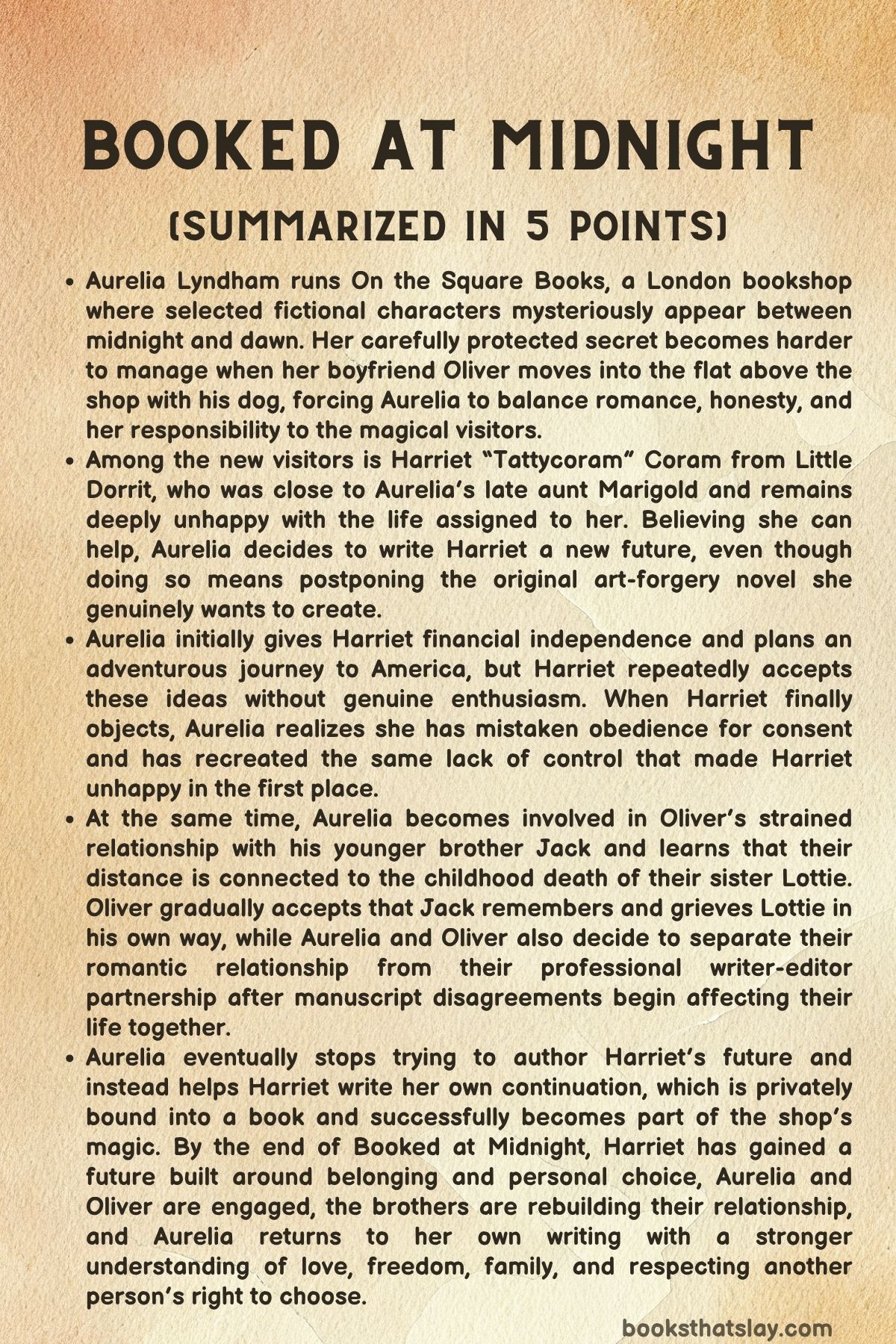
Booked at Midnight by Emily W. Andersen is a warm contemporary fantasy about bookseller and novelist Aurelia Lyndham, whose inherited London bookshop carries an extraordinary secret: selected fictional characters can step out of their books between midnight and dawn.
Aurelia’s attempt to protect this inheritance becomes harder when her boyfriend Oliver moves into the flat above the shop, while the arrival of Harriet “Tattycoram” Coram from Little Dorrit gives Aurelia a new responsibility. Through writing, grief, romance, family tensions, and magical encounters, the novel examines the difference between helping someone and deciding what is best for them. It’s the 2nd book in the Midnights On the Square series.
Summary
Aurelia Lyndham owns On the Square Books, the bookshop and upstairs flat left to her by her beloved aunt Marigold. Aurelia’s apparently ordinary life as a bookseller and published novelist contains one extraordinary secret: at midnight, characters from certain books placed on the Recommended Reads table can appear physically inside the shop and remain there until dawn.
The arrangement becomes complicated when Aurelia’s boyfriend Oliver suddenly loses his rented flat after his landlord discovers Oliver’s dog, Biscuit. Aurelia wants Oliver to move in with her, but she worries that sharing a home will make her midnight meetings impossible to conceal because fictional visitors vanish whenever an outsider enters the shop.
Aurelia finally asks Oliver to move in, explaining only that she sometimes likes to write downstairs in the middle of the night. Oliver happily accepts both the invitation and her unusual working habits, unaware that Aurelia’s explanation hides a far stranger reality.
Their domestic life develops comfortably as Oliver’s belongings join Aurelia’s and Biscuit slowly adjusts to sharing space with Fezz. At the same time, Aurelia chooses several Dickens novels for the Recommended Reads table, hoping to meet a new group of visitors.
Before Aurelia can properly meet them, she accompanies Oliver to see his younger brother Jack’s university theater production. Aurelia immediately likes Jack’s enthusiasm and warmth, but she also notices Oliver’s unusual impatience with him and begins suspecting that their distant relationship is connected to something deeper than ordinary sibling differences.
When Aurelia eventually reaches the shop after midnight, she meets David Copperfield and Peggotty, John Jarndyce and Esther Summerson, Pip and Joe Gargery, and Harriet Coram, known as Tattycoram. Harriet is especially important because she knew Marigold well and is devastated to learn that Aurelia’s aunt has died.
Harriet reveals that Marigold deliberately arranged for certain books to remain available near the end of her life because she wanted Aurelia to meet the fictional visitors after her death. Marigold had also hoped that Aurelia and Harriet would become friends, allowing each woman to share a different side of her memory.
Aurelia’s efforts to hide the visitors from Oliver quickly become difficult. Biscuit hears the characters and begins barking, waking Oliver, and the instant Oliver opens the connecting door, every fictional visitor dissolves and returns to the books.
The incident confirms that Oliver cannot simply be introduced to the magical community. Aurelia therefore continues inventing explanations for her nocturnal activities, increasingly relying on half-truths as her relationship with Oliver becomes more serious.
Meanwhile, Aurelia realizes that Harriet has appeared alone from Little Dorrit. The situation reminds her of Count Vronsky, another fictional character who once appeared without a companion because he was dissatisfied with the future his original story had given him.
Rereading Harriet’s ending confirms Aurelia’s concerns. Harriet returns to the Meagles household, apologizes, and resumes a dependent life in which she still has little control over her future, making Aurelia wonder whether she should write Harriet a new continuation just as she once did for Vronsky.
The decision is difficult because Aurelia already has an original novel she wants to write about an art-forgery scheme. Helping Harriet would require research and months of work, and Aurelia worries that becoming responsible for unhappy fictional characters could consume her entire career.
Harriet eventually admits that she is dissatisfied with the life she returned to after Little Dorrit. Learning that Marigold had wished she could help Harriet convinces Aurelia that writing a new future might be a meaningful way of honoring her aunt.
At the same time, Aurelia becomes increasingly involved in Oliver’s complicated family history. Jack suggests that Aurelia host lectures about classic literature in the shop, an idea Aurelia loves, although Oliver initially struggles to give his brother uncomplicated credit for it.
The reason for Oliver’s resentment becomes clearer when Jack mentions their sister Charlotte, called Lottie, during dinner. Lottie died from a heart condition when Oliver was eleven and Jack was still very young, and Oliver dismisses Jack’s claims that he remembers her.
Later, Oliver tells Aurelia how deeply Lottie’s illness and death shaped his childhood. He remembers reading to her as her condition worsened, watching his parents’ marriage collapse under the pressure, and feeling that Jack had been too young to understand what the family experienced.
Aurelia eventually learns from Jack that he does remember Lottie in fragmented but meaningful ways. Although warned by Antonia not to make the brothers’ reconciliation her personal project, Aurelia tells Oliver what Jack shared, encouraging him to reconsider the assumption that his brother has no legitimate connection to their sister’s loss.
While Oliver slowly begins seeing Jack differently, Aurelia proceeds with Harriet’s new story. Research at the Foundling Museum teaches her how severely Harriet’s choices would have been restricted by gender, social status, financial dependence, and her upbringing as a foundling.
Aurelia and the fictional characters settle on an inheritance that could give Harriet financial independence. Aurelia begins writing a continuation in which Harriet receives money from a wealthy widow and gains the freedom to leave the Meagleses.
At first Aurelia believes the collaboration is succeeding. Harriet agrees to most suggestions, and Aurelia becomes increasingly excited about sending her to America with Miss Rugg, imagining travel, society, scenery, and dramatic adventures.
The problem is that Harriet rarely shows genuine excitement. Because she has spent her life obeying other people and suppressing her own wishes, she often accepts Aurelia’s suggestions without truly wanting them.
Aurelia mistakes this compliance for consent. She becomes more focused on creating an entertaining novel and finishing it efficiently than on noticing whether the future she has created actually feels right to Harriet.
Oliver’s professional response makes the problem harder to ignore. As Aurelia’s editor, he argues that her new Harriet feels too passive compared with the angry, passionate woman in Dickens’s novel and questions whether an adventurous American journey suits her personality.
Aurelia reacts defensively because she knows Harriet personally in a way Oliver cannot understand. Their disagreement becomes serious enough that both eventually recognize that maintaining a writer-editor relationship while living together romantically is hurting them.
They mutually decide that Oliver will stop editing Aurelia’s books. The separation is painful because editing brought them together, but they choose to protect their romantic partnership rather than preserve a professional arrangement that no longer works.
Aurelia hires Louisa as her new editor, expecting a fresh perspective. Instead, Louisa independently reaches almost the same conclusion as Oliver: the Harriet on the page lacks the force and emotional intensity of Dickens’s character, and the American adventure seems more naturally suited to Miss Rugg.
Aurelia can no longer explain the criticism as Oliver’s personal bias. Yet rather than immediately changing direction, she becomes even more determined to produce something exciting.
Harriet finally refuses. When Aurelia proposes sending her into increasingly dramatic American experiences, Harriet angrily explains that she never wanted travel, danger, or adventure and only cooperated because she thought helping Aurelia might ease her grief over Marigold.
Harriet points out that traveling wherever the Meagleses wanted her to go had already taught her how unpleasant it was to have other people choose her life. Aurelia’s supposedly liberating continuation has therefore recreated the very situation from which Harriet wanted to escape.
Aurelia is devastated but recognizes that Harriet is right. She had confused obedience with enthusiasm and allowed her desire to complete the project quickly to turn Harriet into a problem to solve rather than a person whose wishes needed to be respected.
Rereading Dickens helps Aurelia recognize that Harriet responds more strongly to belonging and companionship than to wealth or travel. Another insight follows when Aurelia notices that several current visitors, including Pip, Esther, and David Copperfield, narrate their own stories.
Instead of writing Harriet’s future, Aurelia realizes that Harriet can write it herself. Because magical characters cannot leave permanent written material in Aurelia’s world, Harriet can write each night using materials from her own world while Aurelia copies the words before dawn.
Aurelia apologizes without qualification and promises that Harriet will control both the direction and language of her continuation. Harriet accepts, and for the first time her excitement about the project is unmistakably her own.
Rather than mapping out an entire lifetime, Harriet decides she needs only a believable beginning. She imagines discovering an aunt who never knew of her existence, creating the possibility of a loving family home and eventually reconnecting with Margaret, her childhood friend.
Aurelia abandons her own version of the Harriet novel and returns to the art-forgery idea. Louisa encourages her to make its protagonist a woman, giving Aurelia a fresh creative direction while leaving Harriet responsible for her own story.
During this period, Oliver and Jack continue rebuilding their relationship, largely by beginning to speak more openly about Lottie. Aurelia also grows closer to Oliver’s family, particularly his mother Johanna, whose affection helps Aurelia understand that accepting new family relationships does not diminish the people she has lost.
Aurelia and Oliver’s relationship reaches another milestone when Oliver notices Aurelia wearing her late mother’s moonstone ring. A casual conversation about marriage turns into a mutual decision that they already want a life together, and the ring becomes Aurelia’s engagement ring.
The engagement makes Aurelia’s continuing secrecy about the midnight visitors harder to justify. She seeks advice from Esther, who advises her not to confess simply because engagement makes her feel pressured, but Aurelia knows that Oliver must eventually learn the truth if their marriage is to rest on complete honesty.
Harriet eventually finishes a short continuation covering only the next part of her life. Aurelia refuses to publish it under her own name and instead has a single physical copy professionally bound under the title A New Beginning, by Harriet Coram.
When Aurelia places Harriet’s book on the Recommended Reads table, Harriet appears at midnight accompanied by Aunt Polly. Harriet remembers everything, seems happier and more confident, and explains that she has genuinely experienced the life she chose for herself.
The experiment proves that Aurelia does not have to become the author of every fictional character who needs help. She can instead give them the practical means to imagine and preserve their own possibilities.
Outside the magical world, Aurelia’s life also expands. The bookshop lecture series becomes successful, Oliver and Jack grow closer, Kali receives a major professional opportunity, Aurelia’s and Oliver’s families begin forming relationships with each other, and Aurelia prepares for an author appearance in Paris.
In Paris, Aurelia reflects on Count Vronsky, Harriet, and her own creative future. Harriet’s transformation reminds her that meaningful change does not come from imposing the perfect answer on someone else but from allowing that person room to make choices.
Aurelia finally returns with confidence to her original novel and begins recording ideas beside the Seine. Her final thoughts also turn toward Julia, the niece who may someday inherit On the Square Books, and Aurelia understands that even this tradition must ultimately be Julia’s choice rather than a destiny assigned to her by previous generations.
Aurelia still intends to tell Oliver about the magical shop before they marry, but she no longer believes every uncertainty must be solved immediately. Surrounded by Oliver, Antonia, their families, the memories of those she has lost, and the fictional lives she protects, she enters the future with a clearer understanding of love, authorship, responsibility, and freedom.
Characters
Aurelia Lyndham
Aurelia is the central consciousness of Booked at Midnight, and much of her development comes from learning that generosity can become controlling when she assumes she understands another person better than that person understands herself. She begins as someone deeply committed to preserving Marigold’s magical legacy, protecting the fictional visitors, maintaining the shop, and building a future with Oliver.
Her greatest strength is her instinct to care. She notices other people’s unhappiness quickly, wants Jack and Oliver to reconcile, wants Mark to recover from grief, wants Harriet to escape an unsatisfying life, and wants the shop to remain meaningful for future generations.
That instinct is also one of her weaknesses. Aurelia repeatedly moves from noticing a problem to imagining that she is responsible for fixing it, which causes her to interfere in Oliver and Jack’s relationship and eventually to impose an entire future on Harriet.
Her conflict with Harriet becomes the most important correction to this tendency. Aurelia finally understands that her American adventure was shaped partly by her own excitement and impatience, not by Harriet’s desires, and her willingness to admit this failure shows substantial emotional maturity.
Aurelia also develops professionally. She learns that Oliver can remain the person she loves without remaining the person who edits her work, and she returns to her original art-forgery novel with greater confidence in her own creative identity.
Her treatment of Julia at the end confirms how much she has changed. Instead of assuming family tradition gives her the right to choose Julia’s future, Aurelia understands that love sometimes means leaving the decision open.
Oliver
Oliver is Aurelia’s romantic partner, former editor, and eventual fiancé, but his significance comes partly from the fact that he possesses an emotional history Aurelia initially knows very little about. He appears practical, intelligent, affectionate, and often gently amused by Aurelia’s habits, making his ability to live comfortably within her crowded and unconventional world one of the foundations of their relationship.
He is also professionally serious. When he criticizes the Harriet manuscript, he does not soften his judgment merely because he loves Aurelia, and his insistence that the protagonist feels passive proves to be correct.
Oliver’s deepest personal wound is Lottie’s death. Because he was old enough to understand his sister’s illness, he experienced fear, helplessness, grief, and the collapse of his parents’ marriage, creating resentment toward Jack, whom he believes escaped much of that suffering.
His development comes from reconsidering that assumption. Once Aurelia tells him that Jack possesses genuine memories of Lottie, Oliver gradually stops treating his brother as an irresponsible child and begins meeting him as an adult who experienced the same family tragedy differently.
Oliver also demonstrates emotional maturity when he and Aurelia end their editorial relationship. Rather than treating the decision as rejection, he recommends other editors and continues supporting her career, showing that he values their partnership more than his professional authority over her work.
His mutual engagement with Aurelia reflects the same approach. Marriage is not presented as an act one person performs upon the other but as a decision they arrive at together, fitting the novel’s wider concern with consent and shared choice.
Harriet Coram
Harriet, also known as Tattycoram, becomes the moral and emotional center of Booked at Midnight because her struggle forces Aurelia to reconsider what freedom actually means. Raised as a foundling and later brought into the Meagles household without being treated as a true daughter, Harriet has spent much of her life dependent upon people who claim to care about her while retaining authority over her choices.
Her anger and emotional intensity are therefore not simple personality flaws. They emerge from exclusion, insecurity, loneliness, and years of being reminded that gratitude is expected from someone whose social position gives her little ability to refuse.
Harriet’s habit of obedience becomes especially important in her interactions with Aurelia. She often says yes because accommodation has become a survival strategy, not because she genuinely wants the American adventure Aurelia creates.
Her eventual explosion is one of her strongest acts of self-definition. By demanding that Aurelia stop writing and remove her book, Harriet finally expresses the anger that Aurelia had unintentionally trained herself not to notice.
Harriet’s decision to write her own continuation transforms her from the subject of another person’s rescue plan into the author of her own possibilities. Significantly, she does not choose spectacular adventure once she is truly free to decide.
She chooses belonging, friendship, family, Margaret, Aunt Polly, and an unfinished future. Her refusal to define every remaining year of her life is itself an expression of freedom because uncertainty finally belongs to her rather than being something imposed upon her.
Marigold
Marigold remains absent physically but present throughout Aurelia’s emotional and magical life. She is the aunt from whom Aurelia inherits the bookshop, the secret of its midnight visitors, and a powerful sense of responsibility toward the fictional people who appear there.
Her relationship with Harriet shows that Marigold treated the visitors as people rather than curiosities. Knowing that she was dying, she arranged books on the Recommended Reads table so Aurelia could meet characters who had known previous generations of the family.
Marigold’s influence is loving but complicated. Aurelia initially interprets her aunt’s concern for Harriet as an obligation to complete the work Marigold could not, which turns grief into a sense of duty.
Eventually Aurelia honors Marigold more faithfully by refusing to turn remembrance into control. Helping Harriet speak for herself becomes a better continuation of Marigold’s compassion than simply finishing an assignment Aurelia imagines her aunt left behind.
Antonia
Antonia is Aurelia’s sister and one of the most grounded voices in the story. She is supportive, affectionate, direct, and persistent, particularly when encouraging Aurelia to take her growing literary career more seriously.
She also functions as an important check on Aurelia’s tendency to intervene in other people’s lives. When Aurelia becomes preoccupied with Oliver and Jack, Antonia reminds her that two adult brothers with decades of shared history cannot simply be repaired by an outsider with good intentions.
Her relationship with Aurelia demonstrates the kind of sibling closeness that Oliver and Jack lack. That contrast helps Aurelia understand why Jack is affected when he hears the sisters speaking so naturally to each other.
Antonia’s practicality repeatedly balances Aurelia’s imagination. She encourages action when Aurelia underestimates herself but restraint when Aurelia begins assuming responsibility for problems that belong to others.
Jack
Jack initially appears through Oliver’s dismissive description as flighty and unsuccessful, but Aurelia’s experience of him quickly challenges that judgment. He is enthusiastic, friendly, observant, creative, and deeply interested in his work as a set designer.
His idea for holding academic lectures at the bookshop becomes one of the most successful practical developments in Aurelia’s business. The suggestion reveals that his creativity is useful even if his career does not follow the conventional path Oliver respects.
Jack’s relationship with Lottie gives him greater emotional depth. Although Oliver assumes Jack was too young to remember their sister, Jack retains specific fragments of childhood experience and feels hurt when his grief is treated as less authentic.
He wants a better relationship with Oliver but does not know how to overcome the older brother’s fixed assumptions. His restraint is important because he does not demand immediate reconciliation; he simply continues offering opportunities for connection.
By the end, Oliver’s attitude toward him has softened substantially. Their renewed relationship suggests that families can reinterpret old roles when people finally accept that shared events may produce very different memories.
Lottie
Charlotte “Lottie” is physically absent from the main action because she died as a child, yet she is one of the most influential figures in Oliver’s family. Her illness shapes Oliver’s childhood, contributes to the breakdown of his parents’ marriage, and becomes the hidden source of much of his resentment toward Jack.
Oliver remembers reading to her as she became sicker, giving books an especially intimate place within his memory of her. His grief is tied not only to her death but also to the helplessness of being an eleven-year-old who understood far more than the adults around him openly explained.
Jack’s memories create another version of Lottie: a sister who played with him, read to him, and remained present in fragments even though he was very young. She therefore represents the fact that no family member possesses exclusive ownership of grief.
The brothers begin healing when Lottie stops being the reason one brother can invalidate the other and becomes someone they are finally able to remember together.
Mark
Mark is closely associated with Marigold because he loved her for years despite knowing that she did not return his feelings romantically. After her death, his friendship with Aurelia initially becomes another way for both of them to remain close to the person they lost.
His growing relationship with Rebecca becomes difficult for Aurelia because Mark’s devotion to Marigold had seemed permanent. When he moves forward romantically, Aurelia briefly experiences it as if another part of Marigold is disappearing.
Mark ultimately demonstrates that continuing to live is not the same as forgetting. His new happiness teaches Aurelia that memory does not require permanent emotional suspension.
His continued Monday visits also reassure her that change does not automatically destroy existing relationships. Love and loyalty can remain even when someone’s life develops in a new direction.
David, Aurelia’s Best Friend
Modern-day David is Aurelia’s close friend and an important source of outside perspective. He understands her professionally without being personally entangled in the magical secret or her romantic relationship with Oliver.
When Aurelia discusses the Harriet project, David independently notices the same career problem Oliver sees: repeatedly continuing classic novels could define her public identity in a way she may not actually want.
His most significant advice concerns Oliver’s dual role. David recognizes that a relationship that worked when Oliver was primarily Aurelia’s editor may become difficult when he is also her partner and housemate.
Later, David’s own situation with James allows Aurelia to return that advice from a more mature position. Their friendship therefore becomes reciprocal rather than merely supportive, with each helping the other think about how professional collaboration and romantic intimacy can coexist.
David Copperfield
David Copperfield is one of the most important fictional visitors because his identity as a writer allows him to connect with Aurelia on creative terms. Aurelia is especially excited to meet him because his narration makes him feel closer to Charles Dickens than many other characters.
His discussions of writing stimulate Aurelia creatively rather than simply making him a magical curiosity. Their conversation about what resembles an early version of A Tale of Two Cities allows Aurelia to experience literary history as something active and personal.
David also supports Harriet without trying to dominate her. He contributes ideas and encouragement, but once Harriet takes control of her own writing, his role becomes that of an enthusiastic fellow storyteller.
His conversation with Aurelia after Harriet’s new book succeeds broadens the novel’s idea of authorship. He comes to accept that authors begin characters, but readers continue imagining possibilities beyond what is explicitly written.
Esther Summerson
Esther is calm, observant, compassionate, and particularly attentive to Harriet’s emotional state. She is one of the first fictional visitors to recognize when Harriet needs support rather than entertainment.
Her own complicated history makes her especially useful during discussions of family. When Harriet rejects the idea of inventing a perfect reconciliation with her biological mother, Esther understands why discovering biological relatives does not automatically produce belonging.
Esther also notices Aurelia’s increasing dominance during the writing sessions. Her quiet observations suggest that she understands Harriet’s hesitation earlier than Aurelia does.
Later, Aurelia trusts Esther enough to confess that Oliver was never actually her husband and to ask what she should do about the magical secret before marriage. Esther responds thoughtfully rather than morally condemning her, demonstrating a measured understanding of honesty, timing, and emotional readiness.
Peggotty
Peggotty brings warmth and practical emotional intelligence to the fictional group. Her close association with David Copperfield makes her one of the characters who most clearly represents loyal, chosen family.
She supports Harriet’s desire for a different future without assuming that the future must be spectacular. Her later observation that Harriet may need a smaller idea rather than an enormous reinvention proves especially important.
That insight helps Aurelia reconsider the scale of the problem. Harriet does not need someone to determine every remaining event in her life; she needs one believable opening through which she can begin making choices herself.
Peggotty therefore contributes not through dramatic action but through her ability to recognize what kind of care another person actually needs.
Pip
Pip appears as one of the visitors from Great Expectations and quickly becomes part of the midnight community. His tendency to notice practical details, such as Aurelia’s missing wedding ring, repeatedly forces her to improvise explanations for the fictional characters.
More importantly, Pip belongs to the group of characters whose stories are narrated from their own perspectives. Aurelia’s realization that Pip tells his own life becomes part of the inspiration for allowing Harriet to become the narrator and author of her future.
His contribution to the practical mechanics of Harriet’s writing also matters. Memories involving writing materials help the group determine how Harriet’s words might be preserved despite the limitations of the shop’s magic.
Pip consequently supports the final solution both conceptually and practically.
Joe Gargery
Joe brings friendliness, loyalty, and emotional steadiness to the midnight gatherings. His conversations with Aurelia about earlier generations of her family give her access to stories about women such as Lucy whom she could never otherwise have known.
He also represents uncomplicated affection within a novel concerned with complicated family structures. Joe’s presence reminds Aurelia that loyalty can exist without possession or control.
Like Pip, he participates in the communal effort to help Harriet find a way to preserve her own writing. His value lies less in directing events than in helping create the safe social environment in which Harriet can eventually speak for herself.
John Jarndyce
John Jarndyce possesses the dry practicality of someone whose own story has taught him to distrust complicated inheritances and legal entanglements. When Aurelia proposes solving Harriet’s financial dependence through money left in a will, he immediately warns against rival heirs and legal disputes.
His intervention is humorous but useful. It prevents Aurelia from creating unnecessary complications simply because they might resemble Dickensian drama.
John also participates in the broader community surrounding Harriet and treats Aurelia’s writing seriously. His practical objections contrast with Aurelia’s growing enthusiasm for increasingly elaborate plots.
He is therefore another quiet reminder that complexity does not automatically make a solution better.
Kali
Kali is Aurelia’s friend and an energetic professional woman whose career develops alongside Aurelia’s. Her children’s art tours become so popular that their success initially creates institutional problems at the National Gallery.
Aurelia connects Kali with Sarah McClellan, helping turn the difficulty into an opportunity. Sarah eventually recognizes the value of Kali’s work and offers her a major professional role.
Kali also supports Aurelia’s original art-forgery project by finding a possible connection to a former forger. Her enthusiasm for Aurelia’s writing reminds Aurelia that the original novel represents genuine creative desire rather than obligation.
By the end, Kali’s success parallels Aurelia’s return to her own work. Both women move toward careers shaped more confidently by their abilities and ambitions.
Sarah McClellan
Sarah is a regular customer of Aurelia’s bookshop who becomes important because she is the new director of the National Gallery. Aurelia realizes that Sarah may be able to help Kali when the popularity of Kali’s tours begins causing institutional friction.
Sarah ultimately recognizes the professional value behind the overcrowding problem. Instead of merely restricting Kali’s activities, she helps create a full-time opportunity from them.
Her role is brief but meaningful because she represents good leadership. She responds to evidence of public demand by finding a structure that supports talent rather than simply controlling it.
Count Vronsky
Count Vronsky is not part of the current midnight group, but his earlier relationship with Aurelia shapes the entire Harriet storyline. His solitary appearance once indicated dissatisfaction with his original ending, leading Aurelia to write a continuation that offered him another life.
Because that intervention succeeded, Aurelia assumes Harriet might need the same solution. Vronsky therefore becomes both the precedent that encourages Aurelia and the reason she initially fails to recognize that different characters may require very different forms of help.
His story returns to Aurelia’s mind in Paris. She remembers that the city became part of his recovery and recognizes that his new life worked because it suited him, whereas Harriet required an entirely different kind of future.
Lucy
Lucy is one of the earlier female owners of the bookshop and part of the family history that Aurelia accesses through the fictional visitors. Although she belongs to an earlier generation, memories of her reinforce Aurelia’s awareness that the shop’s magic existed long before she became responsible for it.
The characters’ familiarity with Lucy transforms family history into something unusually immediate. Aurelia can hear stories about relatives she never personally knew.
Lucy also apparently invented similar stories about a supposed husband when dealing with nineteenth-century visitors, amusingly showing that Aurelia is not the first owner forced to explain modern social arrangements to fictional people from another period.
Cristobel
Cristobel is another earlier owner connected to the shop’s magical lineage. Like Lucy and Marigold, she represents the chain of women who have protected the secret and maintained relationships with visiting fictional characters.
Her importance is primarily historical and symbolic. Aurelia does not inherit only a business; she enters a long female tradition shaped by books, guardianship, family memory, and secrecy.
The characters who remember Cristobel make that tradition personal. Through them, Aurelia experiences past owners as individuals rather than simply names in family history.
Julia
Julia is Antonia’s daughter and the niece who may eventually inherit On the Square Books. Earlier in the story, Aurelia thinks of herself as maintaining the magic until Julia is old enough to become the next owner.
By the end, however, Aurelia’s understanding has changed. Harriet’s experience teaches her that tradition cannot be treated as permission to determine another person’s future.
Aurelia still hopes Julia will love the shop and intends to introduce her gradually to that world. The difference is that she now recognizes Julia must ultimately decide whether the inherited role belongs in the life she wants.
Julia therefore represents the future test of everything Aurelia has learned about agency.
Rebecca
Rebecca is Mark’s childhood friend who becomes his romantic partner after they reconnect later in life. Although she receives relatively little direct attention, her presence marks an important stage in Mark’s recovery from his long attachment to Marigold.
Aurelia initially experiences Rebecca’s arrival as emotionally threatening because Mark’s devotion had become part of Aurelia’s continuing connection to her aunt. Rebecca therefore unintentionally forces Aurelia to confront the difference between remembrance and emotional immobility.
Her relationship with Mark ultimately becomes evidence that new love does not erase old love. She occupies a new place in his life without requiring Marigold’s importance to disappear.
Margaret
Margaret is Harriet’s childhood friend from the Foundling Hospital and one of the few people Harriet remembers with genuine personal attachment. Her significance becomes clearer whenever Aurelia asks Harriet what she actually wants.
Harriet responds far more strongly to the possibility of seeing Margaret than to Aurelia’s plans for fashionable travel and dramatic adventures. That contrast should have revealed much earlier that companionship matters more to Harriet than spectacle.
When Harriet finally writes her own future, Margaret naturally becomes part of it. Reconnecting with her allows Harriet to preserve a relationship she chose rather than depending entirely on people who chose roles for her.
Margaret therefore represents continuity, mutual recognition, and the possibility of rebuilding family through friendship.
Miss Wade
Miss Wade is one of the few people associated with Harriet’s earlier life outside the Meagles household. Her role in the present story is small, but her inclusion among Harriet’s limited connections demonstrates how narrow Harriet’s genuine social world has been.
When Aurelia searches for possible companions for Harriet, the limited number of available relationships exposes the deeper problem beneath the planned adventure. Harriet does not primarily need new destinations; she needs relationships in which she can exist without being managed.
Miss Wade consequently helps define Harriet’s isolation even when she does not actively participate in the new story.
Miss Rugg
Miss Rugg begins as a minor figure whom Aurelia selects to accompany Harriet to America. Aurelia assumes that Miss Rugg’s romantic disappointment and relative independence make her suitable for adventure.
The choice becomes revealing because Harriet accepts it mainly because Aurelia recommends it. Once Louisa reads the manuscript, she observes that Miss Rugg actually seems better suited to the adventurous plot than Harriet herself.
That editorial observation exposes how far Aurelia has allowed plot to override character. She has created a journey strong enough for someone, but not necessarily for the person she originally intended to help.
Miss Rugg therefore becomes an indirect measure of the manuscript’s central mistake.
Louisa
Louisa becomes Aurelia’s new editor after Oliver steps away from the professional role. She is humorous and personable but also confident enough to disagree, which convinces Aurelia that she may provide the independent editorial relationship she needs.
Her first major response becomes uncomfortable because it confirms Oliver’s criticisms. Louisa also finds Harriet too passive and questions whether the American adventure matches the established character.
Because Louisa has no personal history with the project, Aurelia can no longer blame criticism on Oliver’s emotional involvement. Louisa forces her to acknowledge that the manuscript itself contains a problem.
Later, Louisa helps Aurelia return to her original creative direction. Her suggestion that the art-forgery protagonist become a woman gives Aurelia a new way to convert what she has learned from Harriet into original fiction rather than another continuation.
Annie
Annie is one of the editors Aurelia considers after ending her professional partnership with Oliver. Aurelia finds her less suitable because Annie lacks enough experience with the kind of historical and literary material involved in the Harriet project.
Her suggestions also feel too gimmicky to Aurelia. The interview helps Aurelia clarify that she does not merely need encouragement from a new editor; she needs someone who understands the material and can challenge her intelligently.
Helen
Helen is another potential editor interviewed by Aurelia. Unlike Annie, Helen appears pleasant and agreeable, but this becomes the problem.
Aurelia senses that Helen accepts her ideas too readily. After the conflict with Oliver, complete agreement might seem comfortable, but Aurelia recognizes that a useful editor must question weak choices rather than simply protect the writer’s feelings.
Helen therefore helps Aurelia identify the difference between emotional comfort and productive editorial partnership.
Johanna
Johanna is Oliver and Jack’s mother and Lottie’s mother. Her life has been shaped by the death of her daughter, the collapse of her first marriage, and the long-term emotional consequences that tragedy had for both surviving sons.
Her conversation with Aurelia about loss is particularly meaningful. Johanna understands Aurelia’s grief for her mother and Marigold, while Aurelia acknowledges the devastation Johanna experienced through Lottie.
Johanna’s maternal warmth gives Aurelia something she has deeply missed without pretending to replace the mother she lost. Aurelia’s ability to accept that affection demonstrates a more expansive understanding of family.
Johanna also recognizes the improvement between Oliver and Jack and openly appreciates Aurelia’s influence, even though Aurelia correctly understands that the brothers themselves had to choose reconciliation.
Geoff
Geoff is Johanna’s husband and part of the extended family Aurelia enters through Oliver. His role is relatively minor, but his presence contributes to the sense that Oliver’s family has expanded beyond the structure created by his parents’ original marriage.
He helps create the relaxed family environment Aurelia encounters during shared meals. Rather than presenting remarriage as evidence of a permanently fractured family, the novel shows multiple adults forming a wider network around Oliver and Jack.
Geoff therefore contributes to the story’s broader definition of family as something capable of changing form without losing meaning.
Michael
Michael is Oliver and Jack’s father. Like Johanna, he survived the death of Lottie and the eventual collapse of his marriage, although the story gives fewer details about his individual grieving process.
His presence at family gatherings demonstrates that the adults have found a way to coexist after divorce and remarriage. This contrasts with the emotional distance that persisted between the brothers.
Michael contributes to the increasingly inclusive family structure that Aurelia joins. His willingness to participate in shared celebrations suggests that family relationships can survive major changes even when their original form disappears.
Ellie
Ellie is Michael’s wife and another member of Oliver’s expanded family. Her role is modest, but her inclusion during warm family gatherings reinforces the absence of competition between old and new relationships.
Aurelia encounters a family in which stepparents can participate without displacing biological parents. That structure mirrors one of the story’s recurring ideas: adding love does not require removing what came before.
Ellie therefore contributes quietly to Aurelia’s developing understanding of family as cumulative rather than exclusive.
Aurelia’s Father
Aurelia’s father provides stability within her family and welcomes Oliver warmly. His acceptance matters because Aurelia increasingly sees Oliver not only as a boyfriend but as someone becoming part of her long-term family life.
During the Yorkshire birthday visit, Oliver’s comfort with Aurelia’s father strengthens her belief that their lives fit together beyond romance alone. The visit also becomes the setting for a disagreement about Harriet’s book, showing how Aurelia’s hidden magical motivation has begun complicating otherwise ordinary family conversations.
Later, Oliver suggests bringing Aurelia’s father together with his own family. The ease with which both partners imagine this meeting reflects how naturally their relationship has progressed toward marriage.
James
James is modern-day David’s partner and becomes relevant when the two consider collaborating professionally on a cookbook based on David’s historical-recipe work. Their situation creates a useful reflection of Aurelia and Oliver’s experience.
Because Aurelia has recently separated romance from editing, David asks her for advice about whether professional involvement could damage a relationship. Aurelia recommends clear boundaries rather than assuming collaboration must either succeed completely or be avoided.
James therefore helps demonstrate that Aurelia has learned from her own difficulty. She can now describe boundaries as tools for protecting relationships rather than signs that those relationships have failed.
Biscuit
Biscuit is Oliver’s dog and one of the practical forces that causes Aurelia’s magical and ordinary lives to collide. Oliver’s housing crisis begins because his landlord discovers the dog, which indirectly leads to Oliver moving into Aurelia’s flat.
Biscuit also hears the midnight visitors and initially responds with enough excitement to wake Oliver. Aurelia must therefore train him to accept people who appear from books as part of normal life.
His growing ability to coexist with the magic parallels his improving relationship with Fezz. Biscuit repeatedly adds humor and domestic disorder, but he also helps make Oliver’s move permanent and therefore accelerates Aurelia’s confrontation with secrecy.
Fezz
Fezz is part of Aurelia’s established home before Oliver and Biscuit move in. Biscuit’s energetic attempts to become friends with Fezz initially add another layer of uncertainty to the shared household.
Their gradual adjustment becomes a small reflection of Aurelia and Oliver combining separate lives. By the time the flat feels fully shared, the animals are also able to coexist more peacefully.
Fezz therefore contributes to the domestic side of the story. The changing relationship between the animals gives visible form to the process through which unfamiliar lives gradually become one household.
Aunt Polly
Aunt Polly is created through Harriet’s self-written continuation as the relative who can offer the belonging Harriet wants without forcing a reunion with the mother who abandoned her. Her existence grows from Harriet’s desire for family rather than from Aurelia’s desire for dramatic plot.
When Polly emerges from the newly bound book beside Harriet, she becomes physical evidence that the experiment has succeeded. Harriet has not merely written words; she has created a new lived reality in which she has family and security.
Polly is therefore important despite her late appearance. She represents the first major relationship in Harriet’s life that comes from Harriet’s own authorship rather than from someone else deciding where she belongs.
Sean
Sean is the bindery employee who helps Aurelia create the single physical copy of Harriet’s story. He believes Aurelia is preparing a meaningful gift for a friend, which gives Aurelia another ordinary explanation for something magical.
His practical assistance allows Harriet’s story to become a real object. The pale gray cloth, purple marbled endpapers, gold lettering, and title transform the manuscript into a book capable of being placed on the Recommended Reads table.
Sean’s willingness to move the order forward also helps Aurelia test the experiment before leaving for Paris. His small professional kindness therefore becomes essential to one of the story’s biggest magical successes.
Themes
Agency, Consent, and the Right to Choose
Freedom in Booked at Midnight is presented as something deeper than giving a person attractive options. Harriet initially receives money, travel, independence, companionship, and imagined adventures, yet none of those things truly liberates her because Aurelia is still choosing them on her behalf.
Harriet’s history makes the distinction especially important. She has spent most of her life living under arrangements created by institutions and families with more power than she possesses, so agreeing with another person has become a habit connected to survival rather than a reliable expression of desire.
Aurelia’s mistake is therefore understandable but serious. She believes she is listening because Harriet rarely objects directly, yet she repeatedly interprets hesitation as fear that should be overcome instead of information that should be respected.
Harriet’s eventual refusal changes the meaning of the entire project. Her anger is not an obstacle to a happy ending; it is evidence that she has finally begun claiming authority over her future.
The decision to let Harriet write for herself provides the novel’s clearest answer to the problem. Aurelia stops offering predetermined possibilities and instead gives Harriet the practical means to preserve choices originating from Harriet herself.
This lesson also reaches Julia. Aurelia may hope her niece inherits the magical shop, but she ends by recognizing that family tradition cannot replace consent, making choice a principle that applies equally to fictional characters and real people.
Honesty, Secrecy, and Emotional Boundaries
Aurelia’s magical secret creates a persistent conflict between privacy and honesty. At first, concealing the midnight visitors seems harmless because Oliver does not need to know everything about the shop simply because they are dating.
Living together changes the moral weight of that secrecy. Aurelia begins inventing explanations for her clothes, her late-night absences, the voices Oliver hears, the lights downstairs, Harriet’s supposed connection to Marigold, and the reasons behind her writing decisions.
Most of the lies contain pieces of truth, which allows Aurelia to tell herself that she is not seriously deceiving Oliver. Yet the accumulation matters because Oliver is making increasingly permanent decisions about their shared life without understanding something that shapes Aurelia’s nights, work, grief, family history, and responsibilities.
The professional conflict between Aurelia and Oliver offers a related form of boundary-setting. Their decision to stop working as writer and editor initially feels like losing part of their relationship, but it ultimately protects the relationship that matters more.
The novel therefore distinguishes secrecy from healthy boundaries. A boundary openly acknowledged by both people can strengthen trust, while concealed information increasingly creates pressure.
The engagement makes this distinction impossible for Aurelia to ignore. Esther advises patience rather than impulsive confession, but Aurelia still recognizes that lifelong partnership will eventually require Oliver to know the truth.
Grief, Memory, and Continuing to Live
Grief repeatedly influences decisions long after the deaths themselves have occurred. Aurelia’s attachment to Marigold shapes her commitment to the magical visitors, while the loss of her mother becomes especially painful when marriage forces her to imagine important future moments without her.
Mark represents one possible response to grief. His love for Marigold survives her death, yet he eventually reconnects with Rebecca and allows himself a new romantic life.
Aurelia initially struggles with that change because Mark’s devotion had become one of the ways Marigold remained present. Oliver helps her understand that loving someone new does not erase the person who died, allowing remembrance and change to exist together.
Lottie’s death creates a more complicated example. Oliver and Jack both lose the same sister, but age and memory cause them to experience that loss differently.
Oliver mistakenly believes the depth of his own memories gives him greater ownership of the tragedy. Healing begins only when he accepts that Jack’s fragmented memories are still real and that grief does not become invalid merely because another person experienced events differently.
Johanna’s relationship with Aurelia extends this idea further. Aurelia can accept maternal warmth from Oliver’s mother without replacing her own mother, just as Mark can love Rebecca without forgetting Marigold.
The story ultimately treats memory as something that can accompany new life rather than prevent it. People do not honor the dead by refusing to change; they honor them by carrying their influence forward while remaining open to relationships and futures that continue developing.
Family, Belonging, and Chosen Connection
Family throughout the novel is defined less by a single biological structure than by relationships in which people are seen, accepted, and allowed to belong. Harriet’s unhappiness demonstrates the difference clearly because the Meagleses provide shelter and proximity without ever giving her the full emotional security of being treated as a daughter.
Her imagined solution therefore does not center on wealth alone. Once Harriet controls the story, she becomes interested in Aunt Polly, Margaret, companionship, and a household where belonging does not depend on service or gratitude.
Aurelia’s life develops along similar lines. She has lost important family members, but her relationship with Oliver gradually brings Jack, Johanna, Geoff, Michael, and Ellie into her life, while Oliver becomes increasingly comfortable with Aurelia’s father, Antonia, and her wider family.
The shop itself creates another form of chosen community. Fictional characters from unrelated novels gather each night, share advice, celebrate successes, disagree, and help Harriet work toward a future that none of them could create alone.
The lecture series extends that community into the daytime world. Jack’s idea transforms the bookshop from a place where people purchase books into a place where readers, scholars, friends, and relatives gather around literature.
By the end, Aurelia understands family as something capable of expanding around absence. Blood, friendship, romance, memory, shared work, and even magic can all create genuine connection when the people involved are allowed to choose one another.